
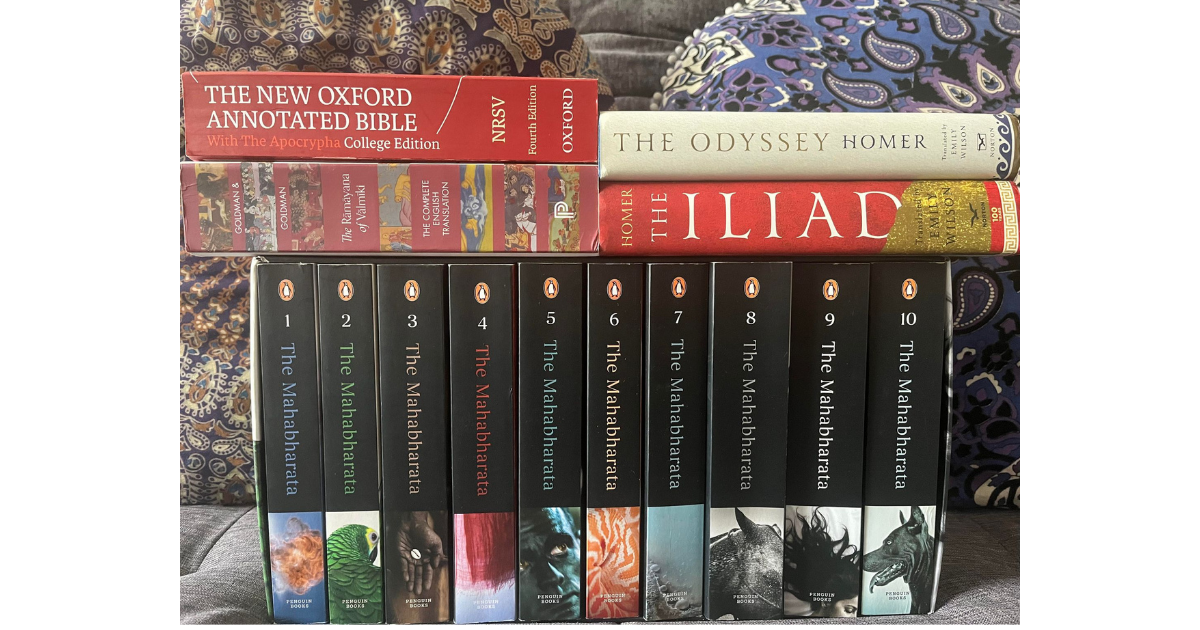
Longtime readers might remember that for much of 2024, I was writing about my experiences reading an unabridged translation of the Mahabharata, which is one of the two foundational Hindu epics. This book is so bananas, it is so wild. I am Indian, so I was very familiar with the story of the Mahabharata, but this unabridged translation contains much, much more than the story I was familiar with—it’s about ten times longer than The Iliad and The Odyssey combined.
I wrote about the Mahabharata for about a year, and during that entire time I never encountered another reader who’d read the entire thing. Surely somebody out there in the world has done it, but there’s not really a strong community of readers the way there is for The Iliad or The Odyssey—I would not be surprised if fewer than a thousand people have read to the end of this particular translation of the Mahabharata.
Then, a few months ago, I saw a comment, on an old post, from Akhilesh Pillalamarri, a foreign-policy journalist with bylines The New York Times, The Washington Post, Vox, The Los Angeles Times, The Hill, and many other outlets. (He also writes a Substack newsletter where he explores the religion, history, and literature of the Mediterranean, Middle East and Asia).
I was so excited to meet another Mahabharata reader that I invited him to have a conversation with me about his experiences. There are many questions that I have about this text that I wanted to run past another person who’d experienced it.
As always, with my interviews, I prepared a transcript (in this case using an AI transcription software) and then allowed the subject to edit it to make sure that he was fully understood. My voice is in bold italic, and Akhilesh’s voice is in the normal text.
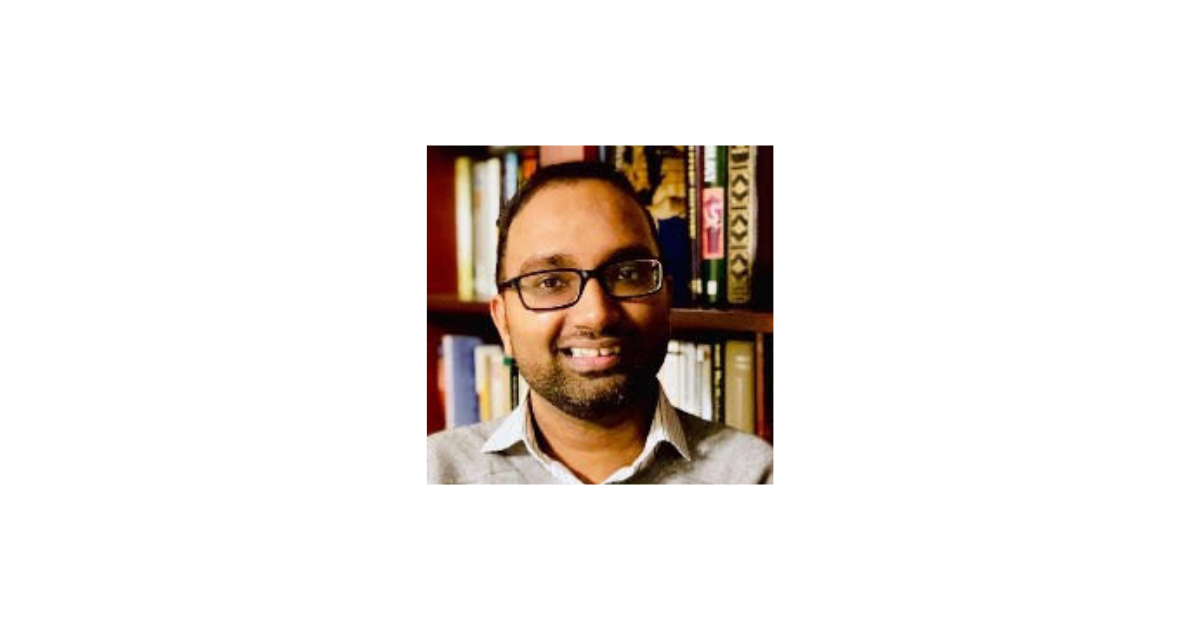

The Interview
So you mentioned you’re Indian American. Are you here [in the US]? You what’s your background? Where’d you grow up?
I was born in New York. I grew up on Long Island, but I spent half my life in DC, Washington, DC….I went to school at George Washington University [GWU] in Foggy Bottom, and then I lived in Woodley Park.
So what prompted you to read the Mahabharata?
While I was always interested in it, I am a foreign policy journalist. I write about the international affairs of India and also domestic politics there. So there’s that interest, and my interest is also in history, ancient history. So you know, the Mahabharata, especially if you’re of Indian Hindu origin, it’s not something you ever hear for the first time, or you ever read for the first time. You’re always exposed to the stories. So it’s really hard to pinpoint: Hey, this is the first time I ever saw or heard the story from the Mahabharata. But, you know, because of my interest in foreign policy and history, I wanted something more than just, Oh, I heard these stories. They’re interesting. You know, I wanted, like, textual evidence to cite when I wrote an article, if I wanted to write about the foreign policy of India and its ancient roots, it wasn’t enough to, you know, hear that ‘So-and-so said this, and that’s why why people in modern India have this foreign policy.’
You know, I wanted to actually get into the actual, full, original text without any middlemen and cite specific words. And that’s actually kind of a very un-Indian thing to some extent, because most people, they listen to the Mahabharata—It’s an oral experience. And you know, you know, it’s not like the Bible, where you’re citing Genesis, John 3:16, blah, blah, blah. But I am also genuinely interested from a philosophy point of view about what ancient Indians thought. Because, again, some of my background is you’re studying ancient history, and when you study ancient Greece, you need Plato and Aristotle. When you study China, you might have Sun Tzu or something. And again, when you get to India, you have fewer pathways. But there’s a lot of stuff you can get. To actually read political theory in the Mahabharata, you have to really sift through it and get into, like, the weeds of the text, but it’s there, especially in the discourses of Bhishma.
So what was your experience like? How did you go about it?
During the pandemic, I just decided to read the Mahabharata. It was the right time, and I found the Bibek Debroy ten-volume collection on Amazon. I really focused really hard on the text to get through it. So I, yeah, I for the most part, enjoyed it. Some parts I read everything, some parts I just skimmed through, which I understand was your experience was similar as well.
The first three books were the easiest to read. You can really get through them fast. One thing that really surprised me, I think, if you’re used to the Mahabharata as an oral story, or you watch the show [the B.R. Chopra 1988 Mahabharata series], the way they give the different parts of the show emphasis is different than in the text. But, you know, a large part of the text is actually the stuff after or during the [18-day Kurukshetra] war. But when you watch the TV show like…I don’t know if you ever watched the show…
Yes the TV serial, of course…
Yeah, yeah, the war is really just a third of the series in the TV show. So in the show they give a lot more weight to what happened before: the characters growing-up and the dice game and the exile [of the Pandavas] and the forest, and there’s a lot less weight to that in the book, which is why, I think I found it easier to get through the earlier books, which I found interesting. But, you know, [in the book] it wasn’t really in depth. Some of the stories in the first book are kind of sparse on detail, kind of fast, compared to the show.
I also would say, kind of, going back to your first question, we Indians, we don’t have our own histories [like Herodotus and Sima Qian], really. So if you want to get, like, a good anthropological historical sense of what ancient India was like, the Mahabharata is the best you’re going to get. And again, I found it really interesting, I guess, for that sort of thing, that sort of like anthropological historical details. I know it is not a specifically historical text, but you sort of get a sense of what you know they thought life was like in ancient India. So I like that.
And I think another thing—you might have pointed this out in your writing—is that if you’re approaching this as a non-Indian I don’t really know how far you’re going to get or how deep you’re going to get.
And maybe there’s a way of easing into it, but because people read the Bible who are not Jewish or even from a Judeo-Christian background, they convert all the time to Christianity, or they might take the approach of reading the Bible to understand Russian literature [like Dostoyevsky]. And so I do think if you become familiar with the text and the world over time, you can grow into it. And I think that’s true of the Mahabharata too. But I don’t think you should start with this ten-volume Mahabharata, you should read an abridgement first.
Yes, okay, so I’m really glad you have this interest in ancient India, because before I started reading the unabridged Mahabharata, my understanding was that this is somewhat akin to the Iliad–an epic poem that’s been written down. But, you know, when I read the Iliad, I felt like I really understood a lot more about, like, the concrete, historical, political makeup of the society that had written down the Iliad. Like I knew that, you know, in Athens, you had the tyrant Peisistratus, and he ordered the Iliad be written down, and then, later on, it was preserved in the library of Alexandria. And I knew all this context for what the Iliad was and the function it served in society. Whereas for the Mahabharata, the poem is much too long to ever have been orally recited. There is definitely a sense that it was composed, at least in part, for the page. And that means I feel a bit uncertain why this text exists, who ordered it written down, or what it was used for.
Let’s say the Mahabharata was written down, you know, in the first century AD, right? And I’m assuming it was written in many, many, like, very, very long manuscripts. How did people in the first century AD use the Mahabharata?
Actually, there is a question about when the Mahabharata was written down. You know, scholars can go on and on about when it was actually written down. There’s a theory I came across from a scholar [Alf Hiltebeitel] of Sanskrit, and he thinks that the Mahabharata was written down by a committee after the Mauryan Empire [during the Shunga Dynasty], very soon after the Mauryan Empire, as a reaction to the Buddhism of the Mauryan Empire. [To clarify, the oral Mahabharata and many texts that went into the Mahabharata predate the Mauryan Empire but it was all woven together with additional text around 150 BCE.]
And when you read the Mahabharata, you can tell it was probably written by Brahmins for Brahmins, just by the way it speaks about Brahmins. And, you know, seems to be very Brahmanical in terms of who the audience is. So my thinking is the average Indian was very familiar with the Mahabharata as an oral story. It was told to them by bards. And that oral story was used as the core of the written text, which used it as a scaffold to hang other philosophical and sociopolitical theories as the Mahabharata is filled with debates and arguments about the nature of the universe and god, how a polity ought to be run, what the pursuit of wealth and righteousness entailed, and the duties of kings. And these are all woven into the story, which uses its characters as mouthpieces for these many different views. You can get so much from the Mahabharata.
But I think Indians, for the most part, they didn’t really use the written Mahabharata as a text, what they heard was the oral Mahabharata, recited at the village level, which was a continuation of that older oral tradition.
Was the Mahabharata of Vyasa [its traditional author] ever really used the way, you know, the Bible has been cited in Russian literary tradition or in American public life? I have some doubts about that, like, I’m not sure: I haven’t myself been able to find enormous evidence of that literary use over time. I’m sure some people were familiar with the literary Mahabharata—the fact that it was continuously transcribed and preserved indicates that it did have some sort of continuous usage. And you look at Sanskrit poetry and plays, there are some that are obviously influenced by the textual version of the Mahabharata. Of course, the Mahabharata has an enormous impact on the folklore, arts, and theatre of India, but that is because of the pervasive presence of the folk Mahabharata in Indian life.
But if I were to, if I were to kind of say something defensively, I would say the educated Brahmin and Kshatriya in the Classical Period probably had some familiarity with the written Mahabharata [because passages from it were cited in other philosophical and literary works], though over time that happened less and less. The familiarity became less and less after the Muslim conquest, but the literary Mahabharata continued to be transcribed, and meanwhile the traditional stories continued to be heard orally and performed at the village level. And there are so many local variations of these stories that makes studying the Mahabharata as a whole, not just as a single text, but as a cultural phenomenon, so interesting. You can’t separate the Mahabharata from Indian life.
This is a great answer. Yeah, this is really interesting. I mean, I also had this the same thought about Buddhism, because if you look at kind of these Brahminical writings from before the Mahabharata, like the Vedas are so inaccessible–there’s not something anyone can really hold on to, and the Buddhists really have much more, much more accessible canon. Like, it’s actual stories that people can read. And so it did seem like the Mahabharata was kind of like a reaction: that with the written Mahabharata we’re going to create our own stories that elucidate some principles of dharma, so that people can see what we’re offering and how it’s different from what Buddhism is offering.
I agree that Hindus never really wrote much, and so the Buddhist began to do so first.
Yes, but I do think what’s really interesting is, like this idea that the written and the oral Mahabharata kind of have these separate lives. Like, if that’s true then even today we have these oral and visual versions of the Mahabharata, from the TV serials especially, that don’t really seem like interpretations of the written Mahabharata. Like, it feels as if the oral and written versions have never really converged–they feel fundamentally different in a lot of ways.
Yeah, I think the oral Mahabharata is definitely more of a story, right? You enjoy the story. Enjoy the rivalry between the cousins. You like the battle scenes. The written one is a lot more philosophical, which indicates a different target audience.
And that’s what I loved about the written one–I don’t know what your religious education was like, growing up
I had a Hindu background, but the way Hinduism was explained to me was very oral and nonsystematic.
Same thing for me, like my grandmother would explain to me all these, like, principles of dharma and karma, reincarnation. It was very oral, and so it’s quite fascinating to finally read an account of these principles that before I’d only ever heard about in an informal way. You know, it really feels like in the Mahabharata someone tried to put it all down, and say these are the principles of what we believe. This is right and wrong. This is how it all works. And I really felt like I understood something about Dharma after reading the Mahabharata that I had not understood before.
100% that was my experience, too. But I think you can only fully appreciate it, though, if you get both the oral and the written together. I mean, people like you and me have probably got the full spectrum of the Mahabharata, which is very rare, you know, to. To grow up with it, and then to read it. I didn’t know that many people who have had that experience.
Yeah, I agree. I don’t think anyone could ever approach this cold. Because since you already know the story by heart, it gives you a guide to what you’re reading, and like focuses your intention. And what’s so interesting about the Mahabharata is how it wouldn’t even describe itself as a Hindu text–it’s really just the state of all the knowledge that they knew back then. So even to call it a religious text doesn’t feel quite right.
How did you begin to read it?
Well I have this great books blog. And to inspire my reading I often look at a list of Great Books–and the white guys who put together this list of great books, they included the Mahabharata on the list. And I’d read the Mahabharata in various abridged versions, like I read the Subramanian version, which was in my grandparents house, but I always wanted to read a longer version. So at some point I was Googling, and I was like, oh, there’s a new translation of the Mahabharata, the Debroy version. And so I just started looking at it. And I was really kind of sucked in. I was really surprised by that first, those first few volumes. I was like, Oh, this is easy. I can just read this, no problem. Then it got quite difficult. Not only are there the battle parts, which are quite long and tedious, but then there’s the philosophical sections, which have this complicated Sanskrit terminology that’s so abstruse: it’s like you’re reading Hegel or Kant.
You really have to be committed, yeah.
So do you feel like you’re more religious now?
In a sense. I agree with your experience in that, it gave me the sort of philosophical scaffolding that really made Hinduism make sense. And I think, unfortunately, you know, a lot of Hindus don’t have that. I just wrote a post about this, in the context of JD Vance suggesting that his wife, Usha, should convert to Christianity. It made me wonder whether a Hindu can truly go toe to toe with a Christian theologically and say, affirmatively, this is why I think Hinduism has a truer cosmology, a truer sense of ethics, which makes you want to be Hindu rather than Christian.
And I think if you read the Mahabharata, you will, if you’re Hindu and you’re leaning towards Hinduism already, you will gain that appreciation. So yeah, I would say the Mahabharata has made me more religious in that sense. I mean, does it make me want to perform more rituals? not necessarily no. If anything, it moves you beyond the folk version of Hinduism. But it really imparts a grander philosophy, of which there are so many facets, than anything else I’ve ever seen. It makes me very happy to say I’m Hindu. And I really have a sense that, you know, this vision of life, this vision of the universe, is probably more true than the vision provided by the Christian religion, or Islam, or even Buddhism.
Yeah, I agree completely. Like, I read the Bible. And I was like, Oh, this is really powerful. It’s hard to argue with the vision in the Bible, because the Bible is seeking converts—it is really trying to sell you on this very, very different vision of divinity than other religions have. And Hinduism doesn’t really try to sell itself, so it hasn’t crafted messages that’re easy to grasp and appealing. The Mahabharata really seems like the closest thing to a sales pitch.
Yeah, and I agree we should treat the Mahabharata like we treat the Bible. You should go into it. Have a study group. Have a reading group, you know, discuss the questions together. With the Bible, people read the whole thing along with some commentaries and hear people talk about it, you know, the people talk about it all the time. People make videos about it. People talk about it on social media. The pastors who preach about it really give the sense that the Bible is not just the Bible, right? It’s this entire keystone for a much larger discussion back and forth people, a dialog. And I like that.
And, you know, if I was, if I had, if I had been born Christian, and I was reading the Bible, and I was reading that with the, you know, in context of the church fathers and the theologians and Aquinas, I would find that could be a very rich tradition that I would be proud to be a part of. No, it’s a very rich tradition. It’s part of this 3,000 year history of back and forth dialog. So I appreciate that, and I think we can appreciate the Mahabharata in the same way too, but we have to, we have to kind of ditch some of the dependence on gurus and the orality of our culture—and in some ways, you know, reading the Mahabharata requires a Western way of looking at text that isn’t encouraged in India today, but maybe it’ll happen.
I agree. Like, the way we’re talking about Mahabharata it does feel very like a Western way of thinking about the text, but I think it’s kind of fruitful. And that’s the whole reason Bibek Debroy translated the text into English, because more Indians can read English than can read Sanskrit.
Okay, I think those are the questions I had, but was there anything more you wanted to add?
I just want to conclude by saying that the Mahabharata has always been an important part of my life, I’ve known its stories since childhood, and I’ve always appreciated its realpolitik and nuanced take on human nature and issues—something that you don’t necessarily find all the time in Hinduism. But reading the text really transformed the way I look at and engage with Hinduism. Especially for those of us who grew up with Hinduism, but for non-Indians as well, we often encounter it in one of two ways: either as an over-ritualistic system that feels confusing or irrelevant in a modern, non-Indian context or as an abstract, otherworldly philosophy like Yoga or Advaita Vedanta that emphasizes transcendence, meditation, and liberation from the concerns of this world. But there’s a middle ground between those two - a Hinduism that is rooted in folklore and stories, but is also philosophical enough to ask and answer the questions of life without tending toward escape and idealism. A realist Hinduism that can talk about political questions, empirical questions, society, ethics, and really the whole gamut of life. And I think you can find that in the Mahabharata, which in turn opens the way for a further exploration of the Hindu tradition that’s midway between the two extremes I described. You can begin to get into that tradition by reading the Arthashastra, Nyaya Sutras, and the large Sanskrit literary canon containing works of drama, philosophy, dharma, and other subjects.

More from Akhilesh Pillalamarri
As I mentioned up top, Akhilesh is a prolific journalist. These days a lot of his work appears in The Diplomat, the premiere international affairs magazine for the Asia-Pacific region. He also posts about literature, religion and culture on his Substack. Here are a few recent posts that touch upon Hinduism:


More about the Mahabharata
I wrote a dozen posts about the Mahabharata over a year-long periods. Some are tales, some explainers about various facets of Hinduism. As I progressed through the book it became increasingly difficult to explain to people what I was reading, but I did my best!
Volumes 1 and 2
Volumes 3 and 4
Volume 5
Volumes 6 and 7
Volume 8
“The most important news you’ll hear about today” - This post, a sort of obituary for Bibek Debroy, attempts to contextualize the size of his achievement
Volume 9
Volume 10
Summation!
My father was a professor who studied Balinese puppetry and dance and so was intimately familiar with the Mahabharata. I grew up around some of those stories, particularly the Pandava brothers, but there's just so much to know....
This was a wonderful read and it makes me want to read Debroy's translation, when the right time comes for me to immerse myself in it. I like the distinction between the text version and the oral / folk versions. I'm more interested in the latter, maybe just because I find those to be more accessible and enjoyable, but clearly there's huge value in the unabridged version.
For outsiders to the stories, I wrote about my experiences reading abridged versions of the Mahabharata and the Ramayana, which would be good training wheels for the unabridged versions. Even a lot of these can be a challenge to people with no prior familiarity, but engaging with the epics is a must for anyone interested in Indian culture: https://www.sammendelsohn.com/post/beginner-s-guide-to-the-mahabharata-and-ramayana
I look forward to Naomi's Ramayana posts!