
LitStack
One of the strange things about subscribing to a newsletter is that you can spend months with an author’s voice, but never learn very basic information about them, like their age, location, or aims. That’s why every six months I write an introduction post for the benefit of new readers.
I am a forty-year-old woman who’s based in San Francisco. I write Woman of Letters, which is a blog that’s about literature. It publishes twice a week. On Tuesdays I try and publish a critical piece that’s about something I’ve read recently, while on Thursdays I publish lighter pieces—tales, reminiscences, or interviews.
The newsletter is marked mostly by what I don’t do. I don’t write about pop culture, films, music or TV—the focus is solely on the written word. I also don’t advocate political stances or venture into polemic. The name speaks of itself: I’m not a freelance intellectual, with a mandate to comment on the world at large—I’m a woman of letters, whose remit is literature and the written word.
In my critical writing, I can only write about whatever I’m reading at the moment. As a result, the nonfiction side of the newsletter tends to have sudden shifts in direction. For three months in 2023, I wrote mostly about the Icelandic sagas. Then in 2024, I wrote about the Mahabharata.1 In 2025, I wrote first about 19th-century American literature, and then about 20th-century American magazine culture. The latter culminated in an epic, fifteen thousand word post where I broke down the origin of the ‘New Yorker story’ and its apotheosis in the work of John Cheever.2
Now, in 2026, I seem to be writing about these contemporary intellectual journals. So far I’ve done pieces about four of these journals, and I’ll see how long my interest in the subject continues. I’ve also been reading a lot of Thomas Bernhard and W.G. Sebald and their various English-language imitators, and I’m pondering how I want to write about these authors.
The most distinctive part of this newsletter is my ‘tales’. This is a style of fiction, inspired by the Icelandic sagas, marked by plain language, an omniscient perspective, and a minimum of visual detail: these tales harken back to the earliest forms of prose language, which drew their inspiration from histories, biographies, fables, fairy tales, and jokes. One of my longest tales, “Money Matters”, was reviewed last year by The New Yorker and as a result of that attention I was able to sell a collection of tales dealing with money in contemporary San Francisco (I wrote here about the path to selling that book). That collection will likely come out in fall of 2027.

The broader Litstack community
I started my career as a fiction writer, with fairly traditional aspirations. I wanted to publish novels that you could purchase in bookstores. While pursuing that goal, I maintained an author blog, under various names, that was basically a journal, a chronicle of whatever I was reading.
Between 2016 and 2024, I published four novels with well-respected publishers. But then I had a crisis of confidence and decided that something about my approach wasn’t working. I wasn’t connecting with readers the way I hoped to. So I decided that from henceforward, I’d put my major creative energy into writing my blog.
This was immensely freeing, and it opened many new directions. Both fiction and nonfiction sides of my blog began to flourish. On the fiction side, I developed the tale form. And on the nonfiction side, I learned how to structure my pieces in a way that was engaging and built to a satisfying climax.
As I put more effort into this newsletter, I encountered a lot of other writers who were also doing exciting things with their blogs. In many cases, they were writers who had fewer publication credits than me—sometimes they had none at all. But we were all exploring this form—literary blogging—together, and I learned a lot from them. Collectively, I think of these writers as ‘LitStack’—the group of writers who seem to take online writing really seriously and who are working to develop their newsletter-game to the highest level.
Because I have a larger platform than most of these writers, I think it’s nice to periodically call out whoever’s caught my attention recently, and I like to think that Woman of Letters serves a valuable function as an entrypoint, for many readers, into this broader online community.
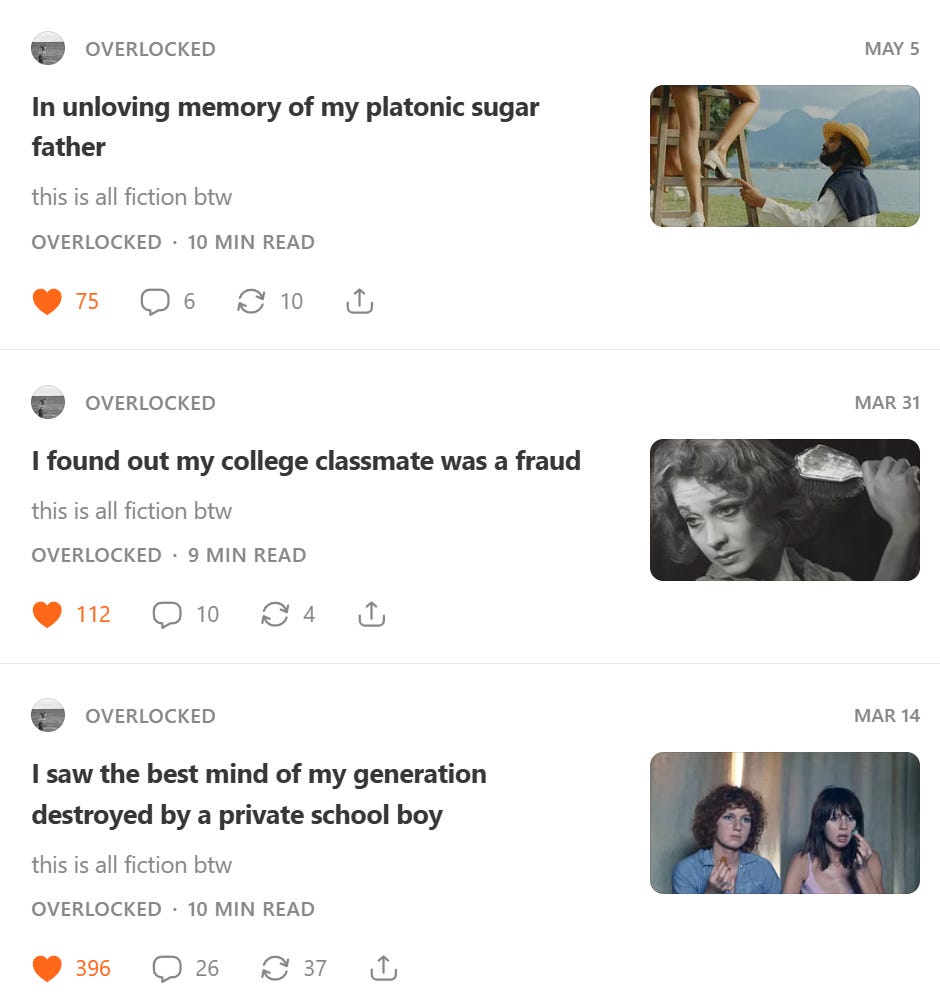
On the fiction side, the most interesting new voice on Litstack is overlocked, a pseudonymous narrator who claims to be a 26-year-old Stanford grad, and who writes portraits of the striver class. The stories are definitely fictional, but they look and feel like personal essays about people the narrator used to care for. The main selling point is overlocked’s voice, which superbly mixes kindness and condescension. She mercilessly dissects her subjects’ foibles, but she also has a certain respect for their ambition and determination.
Her most successful story is “I saw the best mind of my generation destroyed by a private school boy”.
Seeing James was my first brush with an emotion I was going to feel repeatedly throughout my life — a light indignation upon discovering an inefficiency, or a bureaucratic annoyance when one feels that a friend has been wasted on someone. I feel like a neoliberal writing this, or Jia Baoyu. But my law school friends and I agree that the best exam questions have a glimmer and wink in them; if that’s the case, James could not see that glimmer and wink in Alice. These days, I am suspicious of any notion of “intelligence” and find it a worthless thing to discuss, given how it has been used to naturalise inequalities in status or distribution. But you do have to see a person to understand what you have, and I do not think James saw what he had in Alice.
Lillian Selonick is another fiction writer who’s been doing exciting things on the platform. She has a personal blog, but her best work usually goes on Futurist Letters , a journal run by Cairo Smith. The recent piece of hers that I’ve enjoyed most was a personal essay, about an online friend who Lillian knew intensely and then lost: “To a Ghost of Web 1.0”
When you sent me the novel excerpt in 2017 you said you had finally gotten sober. Thirty days. I should’ve known better than to attempt to provide literary criticism to you in that state.
Lately, many of the nonfiction writers on Litstack have been exploring various techniques for selling other folks on their personal obsessions (a process I call ‘effort-posting’.)
Some of the best critics on Substack take their inspiration from me, which is really gratifying, and I also take a lot of inspiration from them. Three excellent critical pieces I’ve read in the last week, all by writers with fairly low follower-counts (Sam has only 86 subscribers!)
Michael Morgan wrote about Bill Watterson for Republic of Letters.
T. Benjamin White wrote about the Animorphs series for his personal substack, The Composted review.
Sam T. Oakes described a previously-uncharacterized genre, Programmer Science Fiction
Other superb critical writing on Substack:
Henry Begler on J.D. Salinger.
Alexander Sorondo on the letters of John Updike.
Ross Barkan on Pet Sounds.

Discourse-posting
This corner of the literary internet, LitStack, has its own little trends and obsessions. People like to write reactions (often negative) to popular books (this year it was Lost Lambs and Yesteryear, last year it was Ocean Vuong’s Emperor of Gladness). There’s also a lot of talk about AI, about kids not knowing how to read, about cultural stagnation, and about a perceived lack of white male writers.
When you write about these community touchstones, it’s called discourse-posting. I have mixed feelings on this type of posting. When you’re new to LitStack, it’s almost essential to do a little discourse-posting, just as a way of announcing yourself. It’s also a good way of learning how to disagree with other people. I find that many writers, particularly those who lived through the cancel culture period (2016-2024) are so terrified of being canceled that they’re afraid to really speak their mind—discourse posting teaches you to have courage and throw something on the internet even if you know you’ll potentially take heat.
On the other hand, discourse-posting can result in cheap growth. It’s the easiest way to get attention online, and at some point it surely occurs to most writers that if I just did discourse-posting, then my audience would grow and grow and grow.
However, no point in having an audience unless they’re an audience for things that you care about, so what you need is a form of discourse posting that still conveys your unique sensibility and that only draws readers who are fundamentally onboard with your worldview. Personally, I think the best discourse-poster on the literary internet is BDM. She has such a talent for writing posts that are reasonable and heart-felt, but ever-so-mildly irate. I really admire her.
I have my own ways of discourse-posting—often I use my tales to comment on various discourses, as I did with a recent post on whether there will ever be AI-assisted literary fiction. And, of course, I try not to ever write a discourse post that I don’t stand behind—the point isn’t just to say something provocative, it’s to say something that’s provocative and true.
The stereotype about discourse is that it’s angry and vapid, but I don’t think it has to be. I think it can actually be playful and fun. Lately I’ve enjoyed seeing a rash of discourse posts that respond to me.
Here is Masha Z on the future of fanfiction (doing a pitch-perfect imitation of my own tale style!)
Grace Byron defending the little magazine
Clare Frances giving her take on Yesteryear

Subscriber chats, meetups, comments, and paid posts
Woman of Letters is also a community. Every Friday there’s a subscriber chat, where people discuss what they’re reading and answer some question that’s currently on my mind. There’s also an active community of commenters: I read all the comments, and I try to respond whenever I have something to say.
I had two great events recently in SF and NYC, and I am thinking of having a regular SF Bay Area meetup (I might rotate the location between SF and Berkeley). More details on that soon.
And there are special posts for paid subscribers. Most of my readers are not writers and don’t necessarily connect to contact that’s about the writing life, so I tend to reserve those for paid posts.


More about me
I’ve had many lives as a writer, so many that I’ve given up on summarizing them all. I began as a sci-fi writer, selling my first stories to sci-fi journals in 2010. Then, between 2016 and 2024, I published three contemporary YA novels. I also released my debut literary novel in 2024. And somewhere along the way I started writing essays on literary topics. After 2024, I shifted focus and began writing mainly for this blog.
The tremendous growth in my subscriber count (from 600 in May 2024 to 13,300 in June 2026) has, oddly enough, rejuvenated my career, leading directly to the sale of my story collection and the highest advances I’ve ever gotten, but I still think of Woman of Letters as my main work. This blog is the engine, and my books are the train-cars. Without the blog, my books would go nowhere.
The process of working on this newsletter has been so magical and paradigm-altering for me. For my entire writing life, since I was a teenager, I aspired to be recognized as a great talent. But when I began putting serious effort into this newsletter, I realized that my own attention is actually the most valuable thing I possess. I didn’t necessarily need to have insights of my own or do something flashy that would attract attention to itself, I just needed to pay attention and then write about whatever I noticed.
Of course I also have this book that’s recently come out: What’s So Great About The Great Books? has been in the world for under a month! Just last week, Cathy Young at the Bulwark gave it a very positive review, saying:
Dynamic and thought-provoking. . . . I’d like to believe that this quirky, smart, passionate, occasionally frustrating but far more often charming volume does offer hope: that, even in the age of smartphone screens, Instagram, and TikTok, there is still room for the Great Books and for the ways in which they can help us think more deeply about what it means to be a human being and a citizen.
Many of my recent subscribers are probably here, in one way or another, because of the release of this book, which contains everything I wanted to say about reading classic literature. If you haven’t taken a look yet, you can order a copy on Amazon or on Bookshop or from your local bookstore.
Here is my rundown on the Mahabharata (with links to my other posts on the epic).
Thanks for the shoutout! I think the biggest inspiration I took from Woman of Letters, especially in 2023-24 (when I was working on my novel and kicking around the idea of starting a blog) was simply that there's still space for making a blog focused entirely on books. Not politics or movies or broader pop culture or even publishing, but just books themselves. Like... that can still be done. Reading your posts about Icelandic Epics gave me some sort of permission to start seriously considering the sort of posts I wanted to write.
I discovered your writing when Celine Ngyyen reposted How to Write a Short Story. The hybrid essay-story struck me as the most interesting thing anyone is doing with the medium of Substack, and I have shamelessly ripped it off. I'm especially interested in hearing more about the fiction side of LitStack!