
A cool new literary journal
I have a bias against cool New York-based magazines. I generally associate them with chic radical politics and meaningless academic jargon.
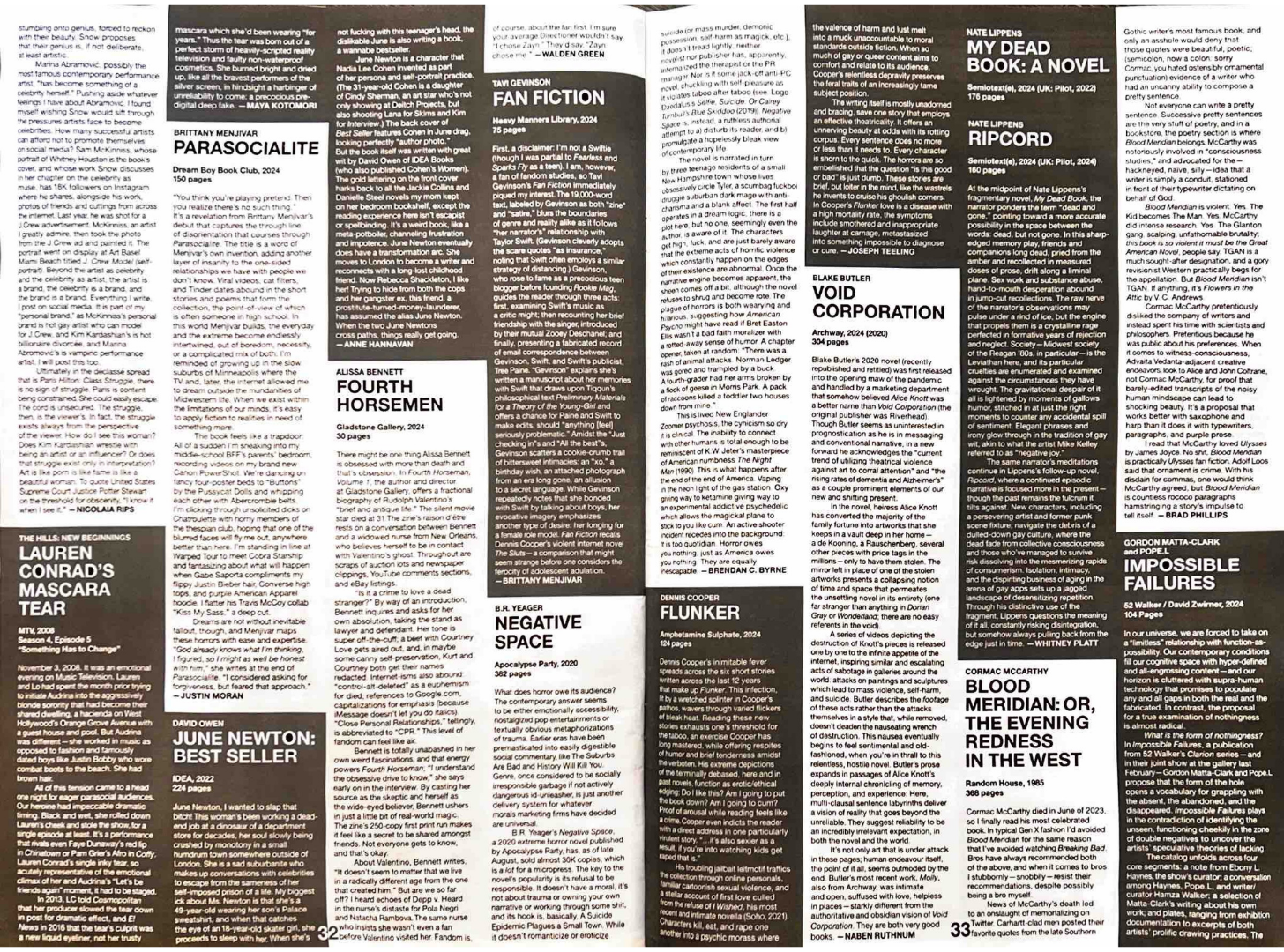
But The Whitney Review of New Writing is a journal founded to counteract those stereotypes. It’s a forty-page broadsheet-style journal whose main purpose is to review new books. Nothing in this journal is going to go viral, because...it’s print-only. That means the reviews are mercifully free from screenshot-ready dunks, and the journal doesn’t have any of those long, ponderous works of cultural criticism that are intended to be the final statement on pornography or the romantasy genre or something like that.
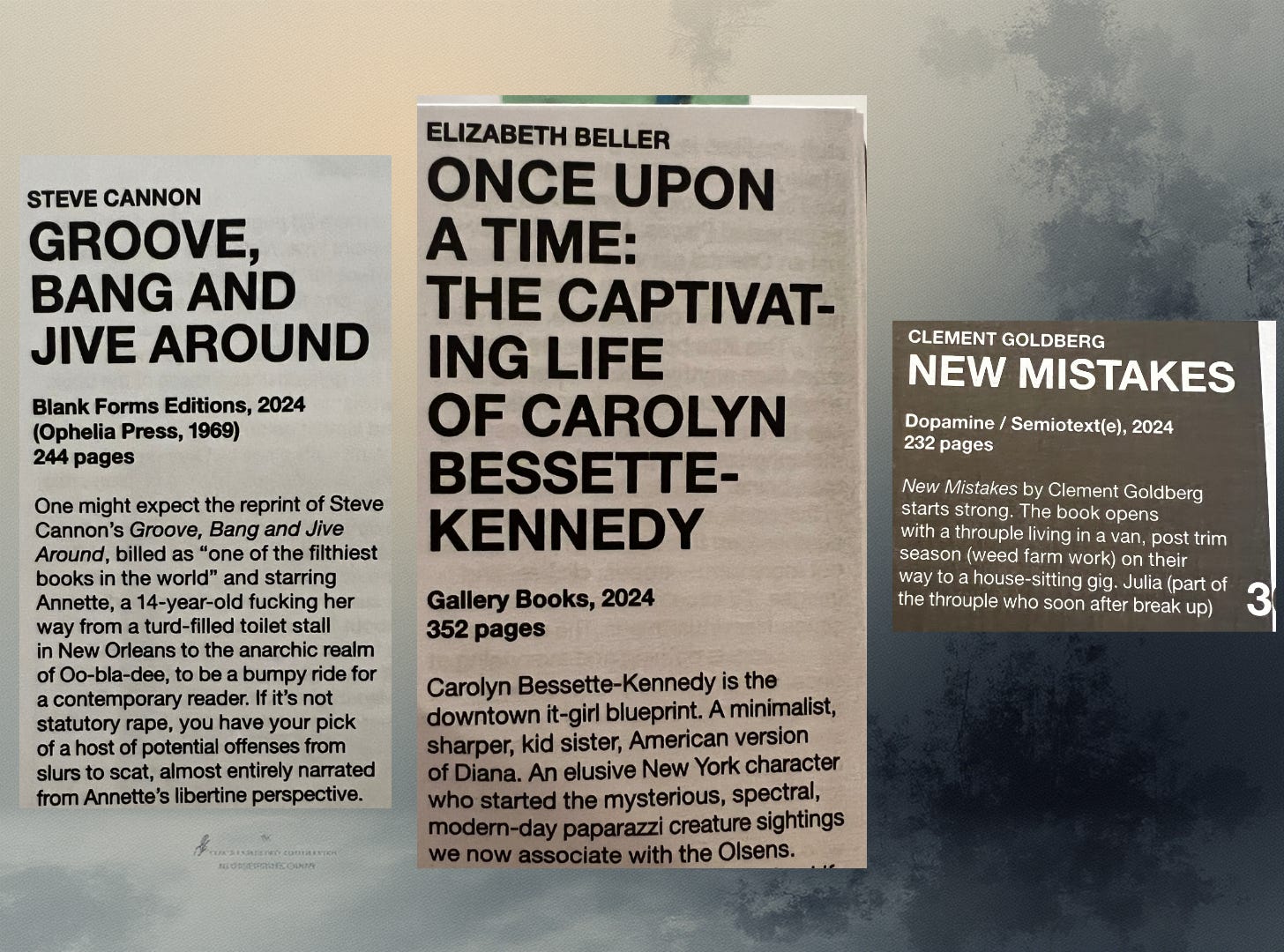
The journal appears to be written by a certain group of people (sceney New York-based writers) as a guide to a certain kind of literature.1 I don’t know if this literature has a name, but it’s basically the Semiotext(e) literary universe: The Whitney Review contains tends to cover the output of indie presses like Semiotext(e), Tin House, Clash Books, Verso, Catapult, Biblioasis, Soft Skull, and a few other imprints that I hadn’t ever heard of (Nightboat, Mandylion, Cash 4 Gold, Transit) but which I assume operate in a similar vein.
These books often seem to be autofictions, braided nonfiction, or gonzo weird fiction.2 The Whitney Review also covered a few oddball books that I had to google to make sure they were real, like this seven-hundred page collection of humorous Amazon reviews (Selected Amazon Reviews) written by Kevin Killian.
Many of the books are reissues of older books, and many of the reviews also reference older books, so after reading a few issues of this journal, it’s possible to get a sense of the predecessors to this particular literary scene. I spotted many references, for instance, to Lynne Tillmann. This is a writer that I knew existed: I even own one of her books (The Complete Madame Realism), but I had no idea she was so beloved or influential.
Nor was I aware of a late 20th-century literary movement called The New Narrative that aimed to report subjective experience more honestly and directly. I don’t know much about The New Narrative—Kevin Killian and Lynne Tillmann were apparently a major part of this movement—but it seems to be an influence on many of the autofictions and braided essays that I’ve read.

Reality Hunger
My first encounter with the Semiotext(e) literary universe was in 2012, when I heard about this cool new book called Heroines, by a writer named Kate Zambreno. This book was about the author’s subjective experience (of helplessness and frustration) as a faculty wife in an isolated university town, but it concretized that experience by also ventriloquizing the frustration of the wives of T.S. Eliot, Paul Bowles, and F. Scott Fitzgerald. I read Heroines and loved it! I was like...this book is incredible, the hype is fully merited. Heroines arose from the author’s blog, and it was published in book form by Semiotext(e).
At the time, I didn’t bother to think about the lineage for this kind of writing. I had heard about a good book, and I’d read and enjoyed the good book. That was enough.
Also in the mid-2010s I read Sheila Heti’s How Should A Person Be? and Ben Lerner’s Leaving Atocha Station? Both of these works were about characters who resembled the author. Both strived for an element of verisimilitude, and both contained sections of conversation that I understood to be transcripts of actual conversations between the author and their friends. Heti’s book originally came out from a small press in Canada (it couldn’t find a US publisher), and Lerner’s came out from Coffee House.
A few years before reading these books, I’d read a different book, a manifesto called Reality Hunger, by David Shields, which basically said the traditional novel is dead, we’re done with that stuff. What people crave is reality! We need books that are less story-like, less narrative-driven, and more driven by the need to contain as much real life as possible.
To me, these four books were the beginning of something. All of these books were well-reviewed and were talked-about in literary circles. And they seemed to combine spontaneously into a literary trend. The result was that the big presses—much larger than Semiotext(e) or Coffee House—started also putting out work that seemed to mix fiction and nonfiction.
When this mixing involved an author (Heti, Lerner) inserting great gulps of ostensibly-true material into their fiction, then it was called autofiction. And when it involved inserting great gulps of research-based material into their personal narrative, it was called braided nonfiction. Many writers combined both these techniques and produced fiction that was flavored both by their real life and by research-based material (e.g. Jenny Ofill’s Dept of Speculation), and there’s not really a term for this: it’s just a variety of autofiction.
Slowly, over the course of the last ten years, these forms of writing that mix fact and fiction became a part of the mainstream literary world. They were no longer published by small presses—now it was possible for this sort of writing to sell to a big publisher, even if you were a debut or otherwise-unknown writer.3 I would not say that this kind of writing ever struck me as avant-garde, per se, but it definitely felt new and fashionable.
Over the last year, there’s been a backlash against these forms. Last summer, the Cut’s Book Gossip newsletter described the revolt against the braided essay:
The form has been debated and playfully mocked online for years, and earlier this summer, Paris Review editor Sophie Haigney wrote on X that “One thing we must stop doing is ‘braiding’ things in essays.” Lily Meyer’s review of Catherine Lacey’s The Möbius Book in The New Republic blamed the book’s lack of cohesion on its unsuccessful braiding of Lacey’s childhood experiences with Christianity and the end of her toxic relationship…
Similarly, Book Gossip polled editors recently on trends that were tired, and one publicist said: “Internet/autofiction novels stemming out of the downtown literary scene.”
Oftentimes this backlash seems to come in the form of negative takes on the work of certain authors. Maggie Nelson has been drawing a lot of heat recently for her Taylor Swift book. And Brandon Taylor has been teasing a negative take on Rachel Cusk, saying her influence has resulted in authors who don’t fully imagine their characters and scenes.
I found this backlash somewhat confusing, because the vehemence seemed disproportionate to the cause. Over and over, I’m being told that the only books being published these days are autofictions. I also keep being told that Rachel Cusk, Kate Zambreno, Maggie Nelson, Sheila Heti and all these writers are dominant and era-defining figures.
However, I personally do not perceive the last ten years to have been dominated by these authors or these types of books. My perception is that literary fiction over the last ten years has been dominated by lyrical realism—work that is essentially continuing in the tradition of Philip Roth and John Updike. You take a realist story, and you relate it through a narrator who sometimes uses beautiful and poetic language. That, to me, describes the work of Ocean Vuong, Raven Leilani, Emma Cline, and many other highly-acclaimed writers of the past ten years.

The future of literature?
However, now that I’m reading The Whitney Review of New Writing, I kind of understand the backlash a little better.
Because this journal has taught me that there’s a large number of people who are deeply invested in these two forms of writing: autofiction and braided nonfiction. Not only are they likely familiar with the books I’ve just mentioned, but those books are probably somewhat passe! To these people, this blend of fiction and nonfiction has roots that predate Zambreno and Lerner, going back to Tillman and presumably many prior writers.
I found reading these journal to be so fascinating, because it really conjures up an entire self-contained world. And this world has certain preoccupations. For instance, The Whitney Review covers a number of books that are about celebrities and celebrity culture: there’s a biography of Carolyn Bessette-Kennedy; there’s an art book that’s about celebrity photographs; a memoir by Belinda Carlisle; a memoir by Gene Pressman (the man who inherited control of the dept. store Barney’s); and an interview with Tama Janowitz, whose story collection Slaves of New York gave her a quasi-celebrity status in the 80s.
At the same time, there’s a suspicion of wealth. One issue reviews a number of books about housing (un)affordability: Writing Against Rent, Abolish Rent, Foreclosure Gothic, Precarious Lease. The journal also tends to glamorize 20th-century queer culture, and there’s numerous mentions of the New York arts scene of yore, back when the city was grimy, dangerous and affordable.
The Whitney Review is cognizant of the fact that its influences have, to some extent, been embraced by mainstream literary presses, and it generally gives respectful reviews to big press books that touch upon its considerations. The latest issue has reviews of big press novels by Grace Byron, Patricia Lockwood, Stephanie Wambugu, Zoe Dubno, Michael Clune, and Madeline Cash. It also reviews certain translated works: the latest issue had reviews of books by Constance Debre and Vigdis Hjorth.
There was even some attempt to move outside this range of influences. In a review of Colm Toibin’s Long Island, the reviewer (Sammy Loren) wrote: “But with my corner of the literary world so dominated by autofiction, it was refreshing to see a novelist creating characters so richly distinct from the author’s own biography.”

Reviewing the Review
Before opening The Whitney Review, I was familiar with many of the names in the above section, but I hadn’t necessarily seen them all put into conversation with each other and presented as some coherent scene. Now that I’ve seen that juxtaposition, I’m much more interested in all of their work. As I get older, I have less interest in reading authors presented as sui generis (the way Zambreno, Heti, and Lerner were presented to me when I was in my twenties) and I’m more interested in lineages and in scenes.
What stood out the most to me about The Whitney Review was the earnestness and good faith. The interviews were never box-ticking exercises. Interviewers seemed very familiar with the work of interviewees, and they assume (to some extent) that the reader will be familiar with them as well. As a result, conversations tend to be congenial and very friendly. And the reviews aren’t presented for the purpose of ranking the books, but just to bring them to the attention of readers who might be interested. That’s why every book gets roughly the same amount of space, and big press books are presented alongside poetry collections, art books, and books in translation—because they’re all equally worthy of comment.
The format of the journal, with its narrow columns, makes block quoting very hard. This meant that reviews only tended to quote a phrase (rarely even a full sentence) from the books in question. As a result, it was very difficult to get a sense of the book’s writing. Each review has a credited writer, and different reviewers vary in their mastery of the capsule review form. Some capsule reviewers were very good at summarizing a book quickly, contextualizing it, and giving their reaction (Geoffrey Mak stood out as exceptional at this task). With other reviewers, I tended to come away with only a very fuzzy idea of even the genre of the book (is it a collection? a novella? A book of poetry? an essay?).
Since many of these books have a genre-blending quality, it feels like some level of description is necessary. When I read a book review, I want to know what I’ll see if I open the book: will it resemble a traditional novel with scenes broken up by white space? Or will I see long unbroken blocks of text and little dialogue? Will I read something that purports to be true? Or something that feels true, but purports to be false? Will I read multiple unconnected fragments? Or some continuous story?
Often the answer to these questions was quite unclear: the reviewer would recommend the book, but I would have no idea what reading the book entailed.
For instance, one review, of a book by Aurora Mattia called it: “an autobiography of vision” and “a sequence of detours”. To me this is confusing. Is the book told in fragments? Help me out here!
I also wished at times for more judgement. Almost all the reviews were positive. Any negative critiques tended to be voiced very softly, and were usually followed with praise or some ameliorating gesture. There no pans, and very few mixed reviews. Surely not everything can be good! I think negative reviews are less important given the capsule-review format, because the point of the journal is mostly just to describe whatever important books are being published in this scene. But still, a little more edge would’ve been nice.
In any case, I really enjoyed reading this journal! It was such a refreshing experience. It really did feel like I was stepping into a completely different world, one with influences and aims far different from my own. And I very much enjoyed my glimpse of this world.

Reality backlash
Having read this journal, I now understand why last year everyone turned on autofiction and on the braided essay.
Basically, there is this trendy New York literary scene that really, really, really, really loves mixing fact and fiction. And if you hang out in New York, you’ll meet a lot of people who are into this stuff. And these are the books they’ll talk about. So really a lot of this online squabbling is some kind of fight between these trendy people and a different group of people.
This is about fashion, not art. There is a changing of fashion. For the last ten years, in a certain subset of society, a certain kind of writing was fashionable. And now the fashions are slowly changing. All of this polemic about ‘the end of the braided essay’ is clearing the floor to make room for some new darling—some new Cusk or Zambreno or Heti—to take the stage.
I certainly await their arrival with interest.
As you’ve no doubt surmised from this post, I am not really a follower of fashions. I hear about things at basically the same time everyone else hears about them. And when those things are over, I hear about their demise at the same time as everyone else too. When I am supposed to enjoy something (Lerner or Heti or Zambreno), I tend to enjoy it. And when I’m supposed to dislike it, my opinion duly changes. For instance, I too have fallen out of love with the braided essay and with autofiction—there’s nothing exciting about it anymore.
But I do think that just because something’s out of fashion, that doesn’t mean it’s not good. The best writing in any style will always endure. Kate Zambreno was good! I will always remember the thrill of reading Heroines for the first time, and feeling like I was seeing something I’d never seen before. That the use of these external symbols (in her case, the wives of modernist writers) was a powerful and new (to me) method of ventriloquizing your struggles and emotions. If it wasn’t for the passion aroused by Heroines, it never would’ve come to my attention in the first place.
Many of our greatest works of literature were written because of fashion. For instance, during the middle of the 20th century there was a fashion for ‘ambitious’ works of modernism that were overtly inspired by Ulysses. That fashion is what produced the work of Thomas Pynchon, Don DeLillo, and David Foster Wallace. I see people often say, nowadays, “Why does nobody write ambitious works of modernism inspired by Ulysses anymore?” Well, they do, but…not as many, because the fashion is over. It passed. It’s no longer exciting. The works that were written were good, and we still read them, but writing these pastiches of Ulysses just doesn’t seem that productive anymore.
Similarly, this Semiotext(e) literary universe has produced great works that I am happy to have read. But…it does feel like the life has gone out of this movement. The excitement isn’t there, at least not to the degree it once was.
And, unfortunately, this particular world, the Semiotext(e) literary universe, traffics in a sense of transgression and novelty. Unlike the lyrical realists, these experimental writers can’t afford to just keep doing the same old thing.
But I have to remember that there’s nothing which is truly new. What I loved in Zambreno were apparently the same things many people had been doing for decades. Those techniques just got reconfigured in her work in a way that really hit hard for me, and for a lot of other people too. And there’s no reason that can’t happen again, for some other author.
And if it does, I’ll surely read about their book in The Whitney Review.
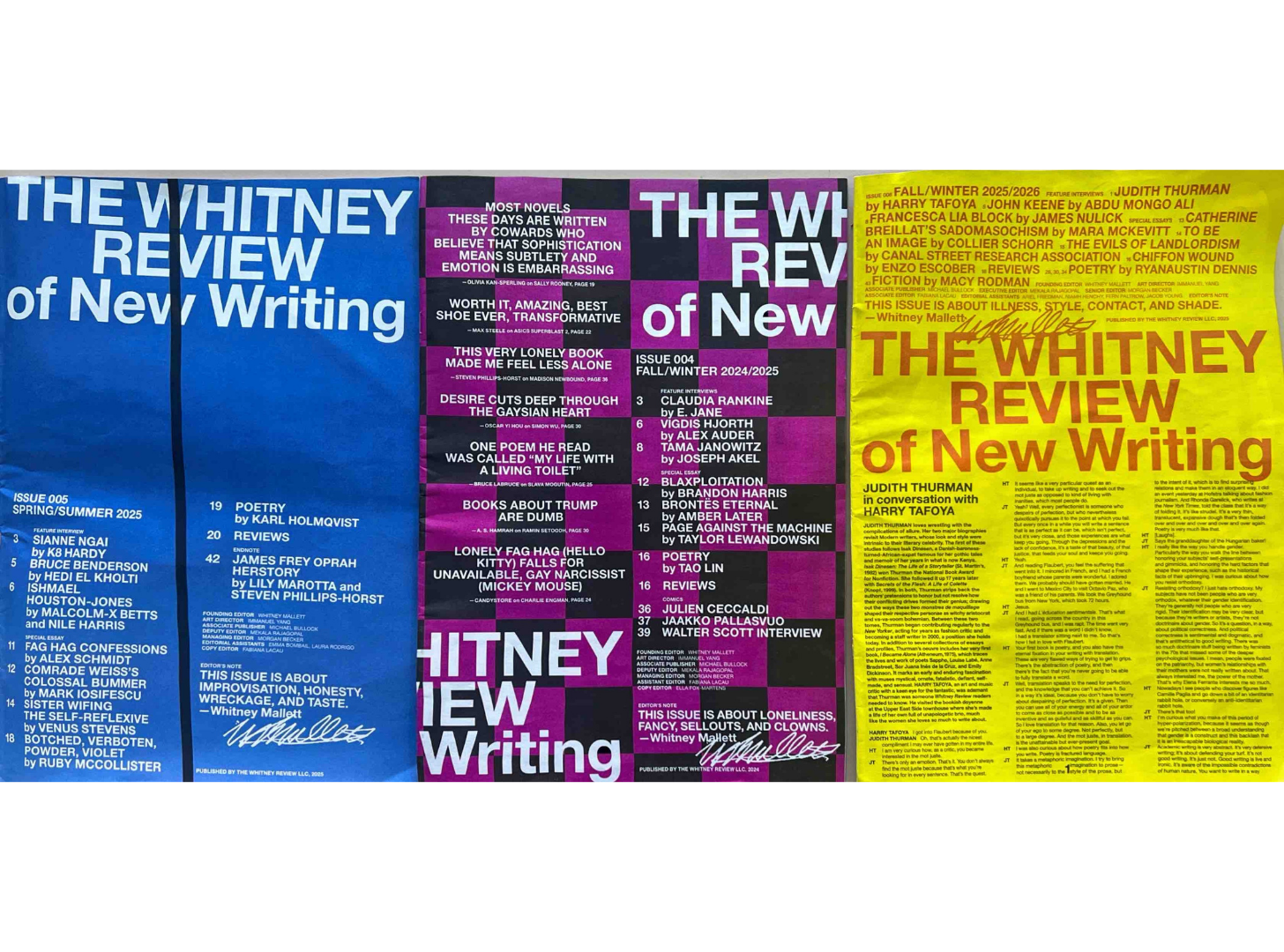
There is shockingly little overlap between Substack and The Whitney Review. But their editor-in-chief is Whitney Mallett. I also spotted Brendon Holder and rayne fisher-quann amongst their contributors.
These issues of The Whitney Review also covered a fair number of plays, poetry collections, traditional memoirs, and art books.
Michael M——— writes about the formal maneuvers of this type of fiction in a great recent post on Dhimmi Monde:
Increasingly, hip, often independently published novels can be classified along two poles—extremes having nothing to do with reading but looking, not the language itself but the ratio of squiggles to blankness.
This quote will make the post sound dismissive, but it’s really not. It’s just pointing out that the novels in this Semiotext(e) expanded universe tend to either be huge blocks of texts or written in fragments.
I'm not much of a contemporary fiction reader, but I'm a culturally oriented person who lives in New York and I don't think I've ever heard of a single name in this piece. Almost like trying to watch the Golden Globes, in that respect. Speaking as an elder millennial, who remembers when it was easy to tell what the "it" books were because they were the ones on the front table of the bookstore, the degree of fragmentation and people living totally parallel and non-intersecting cultural lives is staggering.
Fascinating as my novel is currently being re-issued by the marvel that is Empress Editions.
Ulysses by Joyce that I've read some four times, certainly based on reality: Portrait of the Artist. I loved Sheilds' _Reality Hunger_ and not sure your short summary of it is what I would have said. actually did say and sent to him: This book is breakthrough prose of the highest order. If you write (or if you read!) and haven't bought Reality Hunger, do! It's brilliant—the best work I've read on the writing process, on the nature of invention, on art and on the torturous permissions process that any writer who simply chooses to acknowledge and quote her influences—the writers who have been part and parcel of her thinking—that I have read in a lifetime of reading.
And here is his reply:
Thank you -for your post, which captures the book for me better than a hundred reviews. Yours, David
I also loved Dept. of Speculation and reviewed it: Dept. of Speculation by Jenny Offill
I read this novel in one sitting, during the night: It is oddly structured and that is part of its charm. Our narrator is a writer, trying to finish a novel, working with a would-be astronaut/writer to co-write or help write his views of the world, including the astrophysicist Carl Sagan—and ultimately Sagan's marriage becomes part of the mix--as marriage is the focus of this journey. Our narrator marries, lives in Brooklyn, has bedbugs, has a child and struggles through the process of it all with digressions that compel: quotes from Rilke, what the Buddhists say, what Fitzgerald once advised and many more dropped in like random thoughts that somehow add up, as the conundrum of her life unfolds and indeed unravels. What is startling about this original writing is that it reads like a memoir or as one friend put it, "auto-fiction." And that in itself is a reason to read it. I have actually written an essay on how fiction that reveals, meaning is ultimately self-revelatory shoots for the moon and gives us moving emotional truths. You can find that essay on my Substack site. Kudos to Offill: Terrific work.