
The end of my American literature era
To research my New Yorker story piece, I had to read a lot of literary biographies.
Most of these biographies are weighty tomes like Blake Bailey’s Cheever or Matt Bruccoli’s John O’Hara biography or Carol Sklenicka’s Alice Adams bio. These books are published by major presses, but surely do not have that many readers. And yet the authors often put years of work into these books. Carol Sklenicka spent nine years writing her biography of Alice Adams—a writer who was completely unknown to 77 percent of the respondents surveyed for my literary reputation poll.
I think sometimes a new biography of a little-known figure can spur a re-evaluation of their work. To resurrect a writer is a major achievement. Some say Bailey did this with Cheever—I think that might be overstated, but I believe that Bailey’s Cheever bio did great things for the author’s reputation.
At the same time, these weighty, definitive biographies are really not fun to read. I acknowledge the Cheever biography as a great work, but I mostly skimmed it for sections dealing with The New Yorker. It was too labored, too exhaustive, to be truly enjoyable as a reading experience.
But the book was an invaluable resource, and I drew a lot from it, so I suppose that the exhaustiveness was good. If that book had been half the length, a lot of the details of Cheever’s critical reception and his relationship with his New Yorker editors might’ve been left out, and that information was very critical for my piece.
However, it’s such an odd thing, to write a book that won’t necessarily be read for its own sake, but exists mostly to be an aide to other peoples’ researches. I respect the effort, but I could never do that.

The best biography of a NYer author
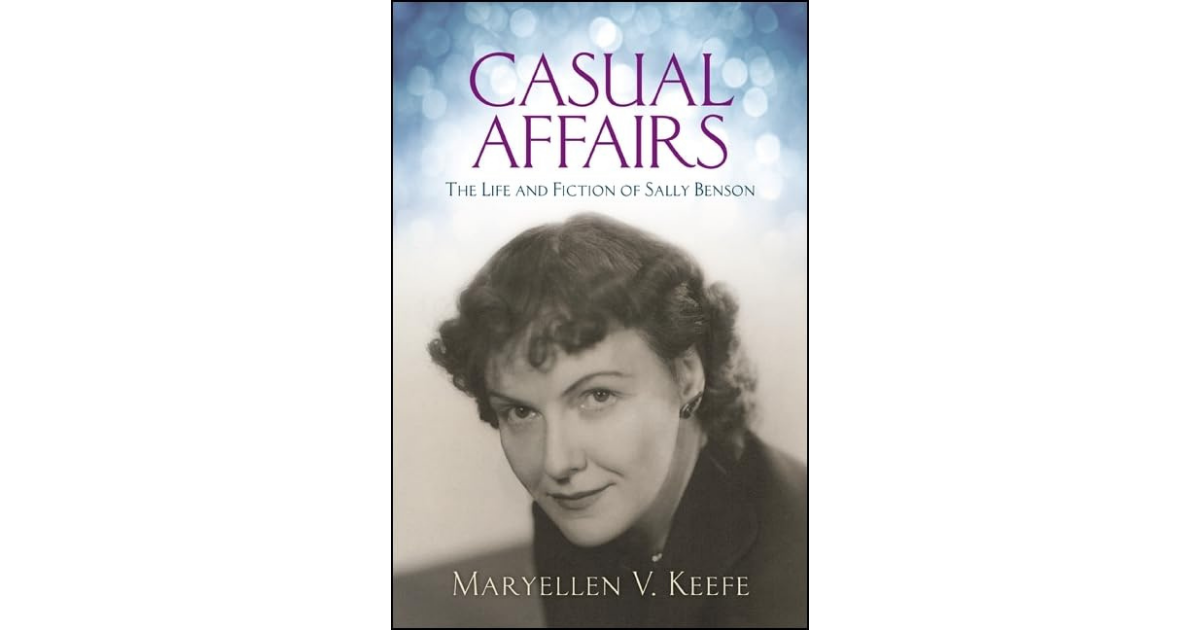
On the other side of the coin, I read a biography of Sally Benson (Casual Affairs by Maryellen V. Keefe) that was such an enjoyable reading experience. I cannot tell you how much I liked reading this book.
This book wasn’t at all exhaustive. It was about maybe a third the length of Bailey’s Cheever bio. And this Benson biography had major gaps, major limitations. It was written by a professor at SUNY Maritime, Maryellen Keefe—she had obviously done a lot of work for this book, but she wasn’t able to venture to far afield from her institution (SUNY Maritime is in the Bronx). So she put in a lot of time in the New Yorker archives at the NYPL, but she had paid short shrift to Sally Benson’s life in Hollywood, because (I presume) those records weren’t available to her in a way that was accessible.
She did the best that she could. The book itself was not well-edited and sometimes had continuity errors. I think that at some point, late in the book, it mentioned the death of a sibling (her brother John Perry) being very impactful for Benson, and I was like, “But you have literally never mentioned this sibling or their death before!”
Looking into the book, I saw only one review in a periodical. It’d gotten no other critical attention and had only ever been cited four times, according to Google Scholar.
I was so fascinated by this book, where did it come from? No other writer of Sally Benson’s stature has a full-length biography. And the book is funny because it’s done in a professional way—the author is a professor and did a lot of archival research—but serves no clear careerist aims. If you want to make an impact as either an academic or a literary biography, you don’t write a book like this: a straight-up biography of such an obscure writer.
What’s most astonishing about this Sally Benson book is that, despite its issues, it was so lively and readable. It was a great book! There was truly a spark of genius to this book.
For instance, there is a passage early in the book, where it describes Sally Benson getting engaged ten times (including to her eventual husband) over the course of one summer, and I was like, “What the fuck? What am I reading?”
…it is difficult to understand why Sally became engaged to nine other male friends in turn as they went off to serve in the Great War. Several of these fiancés—Peter Milne, Jack Johnston, John Lawson, George Ely, and Frank Brady—corresponded regularly with Sally from overseas. How, one is forced to wonder, did Sally convincingly respond to their letters? Only a practiced, inveterate liar or a gifted, imaginative storyteller could manage such a feat.
I had just read Carol Sklenicka’s biography of Alice Adams. And Sklenicka would’ve really belabored this kind of situation. In her biography she went on at length about Alice Adams’s various complex relationships with the men in her life.
But in the Sally Benson bio, you just get this insane anecdote about ten engagements and then the book moves on and never mentions it again! This was probably because the author didn’t actually know more, so there wasn’t more to say. But the general effect was that everything had its proper place. Every aspect of Benson’s life got about the treatment that it deserved. Ultimately, Keefe didn’t cover Benson’s Hollywood years because...she wasn’t interested in those! She was interested in Benson as an author and not as a screenwriter, and I think that’s smart, because it’s really as an author that she had an effect on American letters.

The mystery of Dr. Keefe
When I googled the biographer, I discovered that Maryellen V. Keefe was a Catholic nun! She was born in 1936, professed in 1959, and taught for many years in various Catholic schools, mostly in Delaware and Maryland. Then, around the age of sixty, she went to the University of Delaware to get a PhD in Literature. She received her PhD sometime in the early 2000s and was a professor at SUNY Maritime for 20 years. She retired in 2021 and died a year later, at the age of eighy-six.
(On a sidenote, you can tell she’s a true scholar because her teaching evaluations are pretty mediocre. My favorite was: “EXTREMELY rude to the girls in our class, it was truly uncalled for, for a NUN!”)
Sally Benson was the subject of her dissertation, in 2003. Apparently, while at Delaware, she was looking for a research topic and she was advised by Ben Yagoda—a professor at Delaware who has written a great book, About Town, about The New Yorker—that maybe she could study this obscure NYer author Sally Benson.
But this dissertation isn’t really available online in an accessible way. And it seems clear, to me, that before she retired she wanted to produce something about Sally Benson that would be as widely-accessible as possible, which is what resulted in the publication of this book in 2014, when she was seventy-eight years old.
I have to say, once I knew Keefe was a nun, the exasperated tone of this book made sense. There’s definitely a love/hate relationship between this biographer and their subject. Keefe respects Benson as a writer, but she is also extremely harsh and judgmental and sometimes goes out of her way to portray relatively innocent behavior as being malign.
For instance, Keefe reads a sexual component into virtually all of Benson’s relationships with men, even when there’s no evidence to support this. Like at one point she quotes some of Benson’s correspondence with Random House editor Bennett Cerf and tries to imply they’re having an affair:
The last two lines are suggestive of a more than professional relationship between Benson and Cerf. Knowing Benson, this is not surprising, though little evidence exists beyond this letter’s allusions and a formal invitation to a party at Columbia on April 8th with Cerf’s message: “How about driving me up there in the new chariot?”
Several of the Amazon reviews for this biography object to this sort of editorializing, which is fair enough, but I found it charming—anyone interested in Sally Benson is surely smart enough to disregard some of Keefe’s more tendentious suggestions.

Sally Benson’s obscurity is her own fault
I’ve been meaning to write about this book and about Sally Benson more generally, but I haven’t totally known how. Like, I felt such a connection to Sally Benson herself, who was a genuinely exceptional and innovative short story writer. I think with Sally Benson, I’ve been wondering whether it made sense to revisit her in a standalone piece, but it’s hard to truly explain her importance without explaining how she affected the development of the New Yorker story as a whole.
In the end, I decided that I’d done my best for Sally Benson already. I gave her much more attention in my New Yorker piece than I gave to Mavis Gallant, because my connection to Benson’s work was much stronger. With Benson I felt like there was unity of vision that was lacking in Gallant.
And because her vision was so strong, it influenced the editorial direction of an entire magazine! Benson’s influence on letters is written into the editorial vision of Katharine White and William Maxwell, the fiction editors at The New Yorker. She influenced them, taught them what kind of fiction could work well. And they influenced other writers. Cheever and Benson arose from the same milieu. She wrote a much more successful version of his early stories. He tried to succeed at writing those Sally Benson type stories. But he couldn’t. He had to innovate upon Benson’s blueprint and create his own signature product. Cheever is great, but his greatness couldn’t exist without her (in my opinion).
Sally Benson is entirely out of print, which seems unjustified. But it’s her own fault. She went to Hollywood and lost interest in a literary career. Her last story collection came out in 1943, and although she lived for another twenty-five years (and published thirty-seven more stories in The New Yorker), she never bothered to release a collection containing this later work. It’s really only because of the New Yorker’s digitization efforts that you can read her work at all.
Cheever was much more interested in leaving a literary legacy. Sally Benson wasn’t. So it’s hard to really argue that her work has been treated unfairly, especially when so much other work is clamoring for attention.

The real story is Maryellen Keefe
And so imagine my difficulty when what I really want to write about is Maryellen Keefe, who wrote a biography of Sally Benson. And this biography is good. Like, it would have benefited a lot from more editing and more research time. But if that was the requirement, then the book wouldn’t exist at all.
Honestly, the book only exists, as something for me to read, because it was published in the Kindle and print-on-demand era. If it’d been published earlier, it surely would’ve gone out of print by now. But, by the time it came out in 2014, the cost of keeping a book in print was much lower. And because it was readily accessible to me, I gave it a try, even though I wasn’t sure that I wanted to commit to reading a biography of such a minor writer.
And its author, Keefe, put in so much time and care into the book, and that effort pulled me in, because I could see that she had really made an attempt to structure the argument in a way that would be interesting to her potential audience. She knew her audience wasn’t ‘academics’, because academics don’t care about Benson. Her audience was just, ‘anyone who wanted to know more about this topic’. And although she, Keefe, presumably knew a lot about feminist theory and all kinds of English academia stuff, she really had to leave that aside, because it would just be a barrier to her goal, which is connecting to someone who wanted to know about Sally Benson!
And she couldn’t afford to be as labored and respectful as Bailey on Cheever or Sklenicka on Adams, because then nobody would actually read the book! She couldn’t afford to write a book that’d just be a reference book; it wasn’t the starting point for future efforts. She knew that her first book would be the first, last, and only word on Benson. And it would only have an impact if people actually read the book, so, above all, she couldn’t afford to be boring.
That’s the most incredible thing. That where more-established authors, publishing for big presses, allow themselves to be dull, this little author, writing for a tiny press, somehow knew she didn’t have that luxury. She succeeded wildly in her aim, which was to snare the attention of that one person who might come along, perhaps ten years after she was dead, with an interest in Sally Benson.
I respect Keefe so much. And I am sure this book cost her a lot of effort, because she was quite elderly when the book was published—she had reached an age when most people, even if they have more years to live, find their energies are dwindling, and it’s much harder to do things that are new.
Very, very, very few people have read this book, which I think is a shame, because the book is quite a bit better, on a page-by-page level, than many of the weightier literary biographies that I read.
I don’t think Keefe expected great things from this book. She was nearing the end of her life, and she just wanted to publish a book before she died. But she took the time to make the best-possible book that she could. She did a much better job than she had to. And that effort was so inspiring to me, I actually don’t have the words to describe it. But I hope some of my feeling comes through.
Keefe wrote with a lot of integrity, and that integrity came through with the choices she made on the page. The kind of writing that she did (or that I do) doesn’t necessarily get praised for its own sake. The reward comes from the impact of the work.
If it wasn’t for this book, I would know nothing about Sally Benson’s life. She would be blank, opaque, a mystery, like Mavis Gallant—a writer whose life remains inaccessible to me, because nobody has done a good biography of her.

The future of Woman of Letters
The format of this blog is that every six months I’ll get very excited by some literary phenomenon. And this interest takes off like a runaway horse. I read lots and lots of books, and then I get quite excited trying to explain it all to my readers.
Back in 2023, my big interest was the Icelandic family sagas. Every week, you were hearing about Njal and Egil and all those guys. But in 2024, my interest changed. Forget about the people of Laxdaela or Wapnaford, they were old news. Now I was all about the unabridged Mahabharata, and every post was aboutVishvamitra and Vashishtha and Parikshit and many other people like that.
Then, in January of 2025, I reread Huckleberry Finn, and pivoted again. Suddenly I was reading lots and lots of American literature—an interest which led through some circuitous path to John Cheever.
When I’m finished writing about a topic, it’s not that the topic itself is exhausted—it’s just that I’m ready to move on. Sometimes there’s also gaps just because I don’t want to reread something. Like, if I hadn’t read (and loved!) Sinclair Lewis fifteen years ago, I probably would’ve read him sometime in the last year and written about him. But I just didn’t feel the need.
In any case, here is my index of posts about American literature. I’m proudest of the post on the Western and on the New Yorker story, but I also think my posts on Robert E. Howard, Raymond Carver, O. Henry, and James Fenimore Cooper are very good.
19th Century American Literature
Mark Twain
James Fenimore Cooper
Herman Melville
Richard Henry Dana
Washington Irving
Maria Cummins
Harriet Beecher Stowe
Edgar Allan Poe
I tackled 19th-century literature in the first half of 2025, and when I got into 20th-century literature, I decided to approach things differently, organizing my writing around genres rather than individual authors. So, for instance, my piece about Raymond Carver is also about MFA fiction, my piece about O. Henry is also about early magazine fiction, and my Edna Ferber piece is about the middle-class realist novels that dominated bestseller lists throughout the 20th century. I also tended to focus more on short stories and on magazines, which is why I covered relatively few novelists.
This approach is hard to summarize in a link-post, but I think it provided much better context for each of these works, and I hope to utilize some of these descriptive techniques for other books.
20th Century American Literature
O. Henry
Edna Ferber
Robert E. Howard
The Saturday Evening Post
Dorothy Canfield Fisher
Ernest Hemingway (
Raymond Carver
Louis L’Amour
Larry McMurtry
John Cheever

Samuel Richardson Award
For the last year I’ve been running a contest for best self-published literary novel. During the first round, the ten judges selected the following nominees (links are to reviews of each book)
Eleanor Anstruther’s In Judgement of Others
Brian Jordan’s Wild Walt and the Rock Creek Gang1
But that was the first round,.
Now we’ve reached the second round, where the judges were asked to write a review of their favorite from this full slate of ten finalists, and those reviews have now begun to appear.
Moo Cat picked Drive A, which gave him a new appreciation for science fiction novels:
[The author] never tries to be too smart. Most of the characters are doped up with brain enhancers and fancy degrees from elite schools, but our protagonist is just like us: amazed, weary, and wary. The hyper-meritocracy of Graves’ world is never boring.
T. Benjamin White picked Cubafruit, saying
…for the time I had the book open in front of me, I was living in Cubafruit. It was one of the most immersive literary experiences I’ve had in a long time.
Lillian Wang Selonick picked The Wayback Machine, comparing it to a Philip K. Dick novel:
What is the essence of a PKD novel? Menacing darkness, deadpan humor, epistemological uncertainty, a malevolent and/or indifferent woman—the levels on the mixing board are set just so, and most attempts to replicate or remix the masters fail. My choice to win the contest has engineered a solution.
Adam Fleming Petty also picked The Wayback Machine, despite his suspicion that he was too much the target audience for this book:
Yet though I began The Wayback Machine a skeptic, I finished it a convert. Turns out, I love being a target market! Take it from this white man: being pandered to is the best! But that is not the only reason I selected this book as my personal vote for the Samuel Richardson Prize. Yes, this idiosyncratic and personal book made me respond to it in an equally idiosyncratic and personal way.
Four more second-round reviews should be forthcoming (including my own), and then we’ll tabulate scores and have a winner. The third round should be the easiest, judges simply have to write a review of the winning book. Whatever it is, I am positive that some of the judges will have hated it, so hopefully we’ll end up with a lively diversity of opinion that’ll spur even more debate about the merits of the winning book.
You’ll note that two of the finalists don’t have reviews. That’s because although their judges made a pick, they told me that personal difficulties delayed them from writing a review. I held off announcing these finalists in the hope that a review would appear, but I don’t think that’s going to happen.
These books were disseminated to the rest of the judges and were included in the second round of judging, but I am sorry that the authors didn’t get an initial review—I do think the lack of strong advocate left them at a disadvantage.
This is great -- I love posts that unearth and appreciate some mostly-unknown or forgotten book. Also, I like in-depth, last-word-on-the-subject biographies like this. I think that biographies should either take this approach or be much shorter (40k words or so). I don't need anything in between.
My favourite kind of literary biography is the kind where the author is visible in glimpses behind the text, but never eclipses their subject or even draws into the foreground in the first place.
There’s a recent biography of Malaparte I inhaled over the course of like two Shabbosim that I’m thinking of re-reading that has that quality also — it has the feeling of a conversation one’s having with a specific person about a third party. I read those kinds of literary biographies even when I have zero intention of reading the work of the subject. After I read the Malaparte biography, I went out and got … Folio Society editions of Primo Levi, instead. But the biography itself affected me on a level nonfiction rarely does.