
The Drift
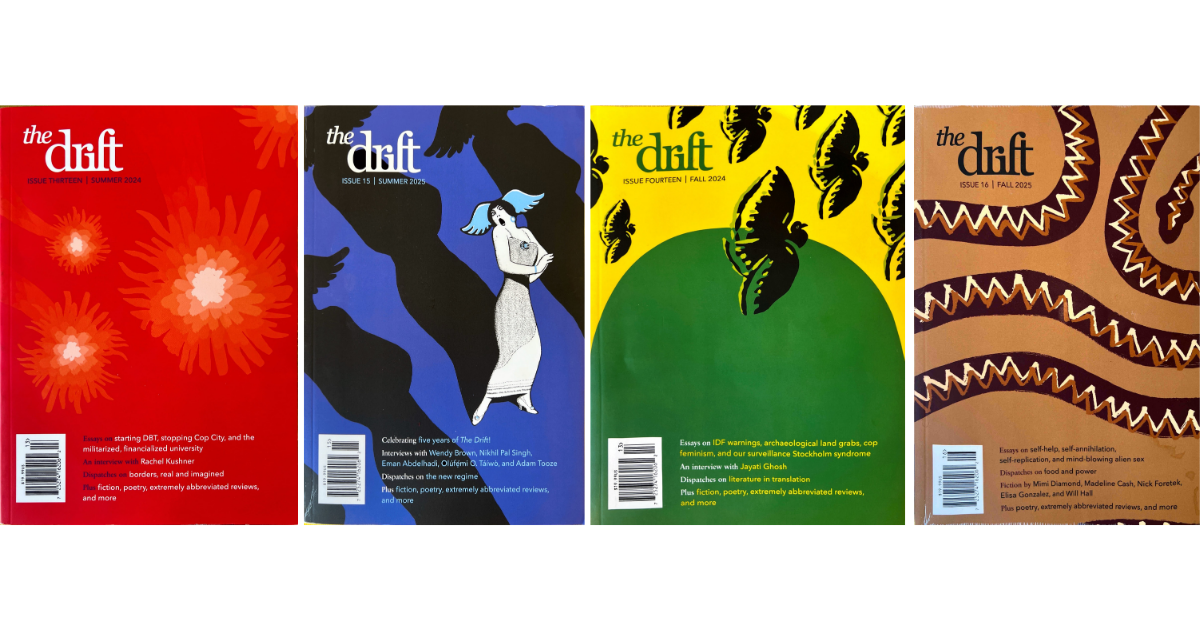
For the last few weeks, I’ve been reading a journal called The Drift, which is a young (less than five years old) socialist periodical that’s based in New York City.
Whenever I tell my friends that I’m reading The Drift, they rush to tell me that the magazine is no longer cool, or that they don’t read it, or that it’s far inferior to any number of other magazines that occupy a similar intellectual space.
It is shocking how unanimous this verdict is. Not once has someone said, “Oh yes, I read The Drift too.”
Even stranger is that everyone has such a fully-formed opinion about a magazine that they apparently do not even read. All they know about this magazine is that it sucks. Not one time has someone said, “Hmm, that’s interesting, I’ve heard about that journal but I’ve never read it—why don’t you tell me what’s inside it.”
No, people already know the contents of this magazine they haven’t read. They know those contents are bad!

The Drift’s signature product
In reality, The Drift is famous for a certain kind of takedown piece, very particular to this magazine, that often gets shared widely on Twitter. And most of my respondents are basing their opinion of The Drift upon these pieces.
These mass-culture takedown pieces don’t just take aim at a specific artist or work, instead they try to take down an entire cultural phenomenon! And they have a very unique way of taking down their targets. They usually claim that this terrible thing that they hate is somehow a manifestation of capitalism. That if it wasn’t for capitalism, this thing would not exist at all. So the thing’s badness is an inescapable outgrowth of the bad economic system under which we live.
The most famous recent example is their romantasy piece, where Daniel Yadin claims that, because of the horrors of capitalism, people have turned away from reality and now want to fantasize about having sex with dragons.
The air of tragedy and paralysis that overhangs so much of American life is, perhaps more than declining rates of marriage or property ownership, the real source of strength for the particular type of fairy-tale narrative that has come to dominate our literature. Because what are you supposed to do with your time between now and the end of the world? What should you do with your one adult life?
Romantasy suggests that you may as well suck off a dragon or two.
But there are other examples. There’s a piece by Lily Scherlis that claims a certain therapeutic technique, Dialectical Behavioral Therapy, is just a way of acculturating people to endure the terrible conditions they’re subjected to by capitalism.
DBT and workplace management are symbiotic. Though she doesn’t seem to know it…by reskilling burnt-out clients, DBT readies them for the strain of flexibilized, gigified labor.
The Drift enjoyed this take so much that they ran it again, in a slightly different form, in a piece where Erik Baker claimed a new rash of Stoic self-help books were merely teaching people to endure the terrible conditions of capitalism.
…I realized that I was spending more of my time thinking about my own despair than about the problems outside myself that were supposedly fueling it. And it seemed to me that a lot of people I knew were doing the same thing. So many conversations centered on how we were doing our best under difficult circumstances. Attendance at organizing meetings dwindled. My own attendance dwindled. Life is hard, we’d tell ourselves. Rest is resistance.
The best of these takedown pieces was this one about Simone Weil, where Jack Hanson talked about the way that this Christian thinker has been enrolled in so many modern peoples’ projects, and that when modern people write about Weil, they don’t really grapple with the strangeness of this woman, who literally starved herself to death for unclear reasons (perhaps out of solidarity with those suffering in World War II). This piece argues that it’s hard to really look at the totality of Weil’s life and conclude that she would support any of the modern people who are obsessed with her.
That’s fair enough, although it raises the question of…so what? I love Gandhi, I take a lot of inspiration from him, and from his idea that to resist evil you need to preserve your spiritual power by engaging in honest behavior. But, to Gandhi, preserving his spiritual power also meant vegetarianism, sexual continence, and a whole raft of other things that I don’t do (although I do think they’re good).
Still, this Weil article successfully excavated the strangeness of its subject, and I’m happy that it exists.

The Mass-Culture Takedown
I did not like the other articles of this nature. I felt like they weren’t particularly rigorous. Take the DBT article. At its core, it’s about the dialectic of left-wing self-improvement. You’re depressed and you tell yourself that your depression is merely a true experience of “the harshness of life under capitalism”. However, you really want to feel better, so you seek treatment, but then you feel bad about seeking treatment, so you need to extrude a lot of self-justifying rhetoric about how you know seeking treatment is ultimately a bad thing to do for some very complicated set of reasons.
This problem here isn’t with DBT, which is apparently quite effective at treating depression—the problem is with self-lacerating neurotics who think capitalism necessarily entails misery, so they’re required to be miserable until capitalism collapses.
To see the absurdity of this article, let’s begin by granting the premise that capitalism tends to produce certain difficult circumstances that result in depression. However once socialism arrives, I think it’s intuitively obvious that, at best, these miserable circumstances would be reduced, but not entirely eradicated. Even under socialism, people would still have tyrannical bosses, racist friends, shitty boyfriends, and all manner of other bad relationships that might make them very sad. I guess under socialism a magazine like The Drift would be full of articles about how people feel uncomfortable seeking therapy because “We have socialism now, so I ought to be happy!”
The worst of these articles, at least from the ones I read, was the romantasy takedown.
I found this takedown particularly aggravating, because in a previous issue The Drift had posted a long editor’s note about how Trump’s victory was basically because the Democrats were smug and superior and refused to connect with ordinary Americans (“[Liberals] do not believe they share a nation with Trump supporters in any meaningful sense, any more than Trump supporters believe they share a nation with liberals”).
But then, two issues later, they publish this romantasy piece which is so sneering, so contemptuous of the women who read this genre of fiction. And I guess that I was surprised that this well-funded magazine, founded by Harvard grads—a magazine with such strong socialist principles—wouldn’t feel a kind of noblesse oblige towards its social inferiors. In other words, I’d really expect a magazine of this sort to avoid taking cheap shots at the mass taste.
Like, if you’re building a coalition for socialism, then why, in your same magazine, are you going to talk trash on the most popular genre of fiction in America? It’s not just that the writer thinks this genre is bad. He also thinks its readers are deluded people who are resolutely committed to ignoring reality. And this vitriol seems so disproportionate to the offense, which is just…people reading books they enjoy.

The socialist elitist
I think what’s happening here is that you have socialist intellectuals who are supposedly striving for universal emancipation, but they don’t really connect with the artistic taste of the people they’re trying to emancipate. And this alienation from mass-culture makes these socialists feel really anxious and bad about themselves. So instead of just accepting that they don’t get it, they create these insane contorted essays where they argue that the peoples’ artistic tastes are somehow inherently diseased, and that under socialism, these people will finally be freed from their own poor taste.
This rhetorical performance just feels so unnecessary! Maybe art will be better under socialism, but if it’s not, who cares? The whole point of socialism is that everyone will have the freedom to make and support the art they want. Maybe, in that world, high art will no longer be privileged, but…the people who love it will still be free to enjoy it, and that seems great.
Okay, but now I am taking down this species of viral takedown. And I honestly detest these pieces, I agree with my friends—they’re dishonest and bad.
But the only reason The Drift has a reputation at all is because of these mass-culture takedowns! Their odiousness is exactly what renders them so successful in the attention economy. There’s something very dark and compelling about them, because they obviously arise from an authentic impulse—the contempt of the downwardly-mobile intellectual for those he considers to be his intellectual inferiors—but they (very successfully) disguise that contempt as some kind of public service, some defense of what is good and beautiful and true.
In some ways, it’s a magnificent product, and I respect the fact that it’s clearly serving the magazine’s larger aims. Obviously, the takedowns provide a lot of catharsis to the people who write, read, and share these articles.
However I do think these pieces are ultimately harmful to the reputation of the magazine, because the magazine is like a drug-pusher. It’s giving its readers something they crave, but which they know to be bad, and in return they resent the journal that proffers it to them.

The rest of the magazine is much less bad!
The magazine itself is beautiful. It’s about the length and width of a sheet of printer paper, perfect bound, with matte card-stock covers. The magazine interior is black-and-white, and they wisely eschew photographs—instead it’s full of line drawings and simple illustrations.
Many issues begin with an interview with some left-wing figure. For instance, issue sixteen had an interview with Stuart Shrader, a “leading scholar of the history of the American carceral state.”
Afterwards, many issues have a forum, where a dozen writers do short pieces on a certain topic. The forums were a good exercise, because they forced The Drift to affirm something and not be so relentlessly negative. There was a particularly good one about literature in translation. The temptation here is to say the idea of literature in translation is somehow fake or bad or ersatz or manufactured—a few of the writers took this tack (“Drawing borders in literature runs counter to what literature does at its best”). But you can’t just have a dozen essays saying the same thing, so a few of them were forced to defend it (“I needn’t speak Russian, or know anything about Soviet collectivization, to admire Platonov…”).
Each issue of The Drift also has a set of ‘mentions’ at the back—capsule reviews. And these were excellent! A lot of them are not takedowns—many of them are positive reviews—but they all contain a certain twist or sideways joke. I was really impressed by the quality of these mentions, and by their unique voice, which remained coherent even across dozens of separate writers. Whoever edits this section has done a great job of teaching writers to use this particular style (it reminded me a bit of New Yorker’s Talk of the Town, which also has a very idiosyncratic voice). Now that I’ve said this, I feel like their mentions editor will get hired away by The New Yorker. Watch out!
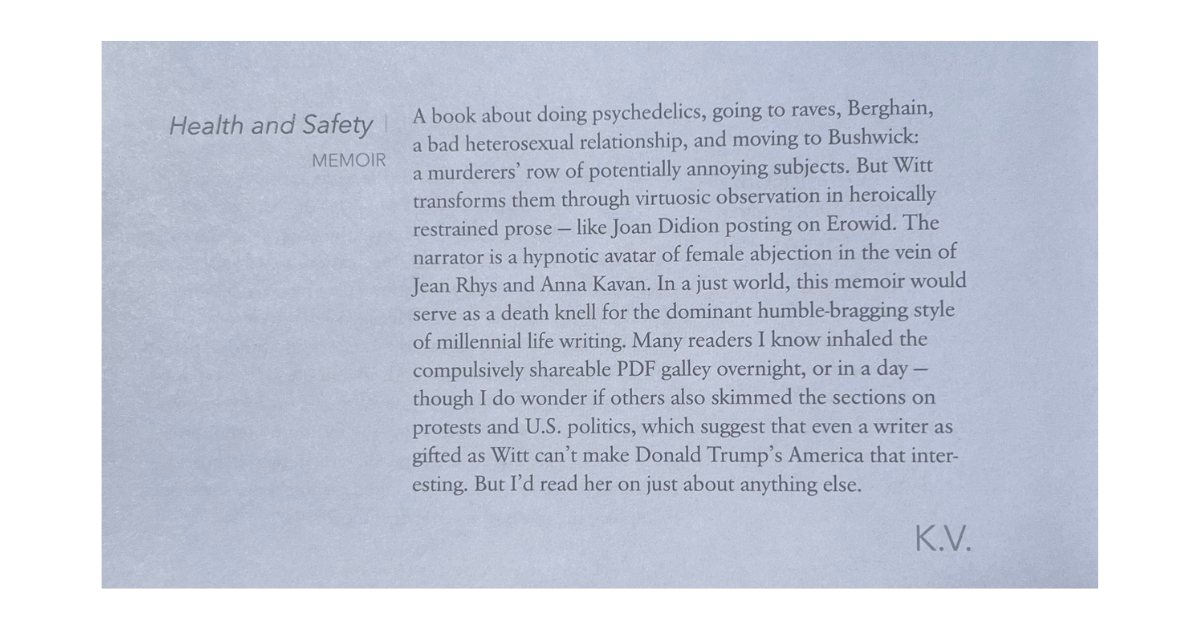
(On a sidenote, both the mentions and the forum are printed with a light-grey background that makes them a lot harder to read than the rest of the magazine.)

The Drift’s fiction section is superb
Many of the nonfiction pieces, even when they weren’t explicit takedowns, had a very sneering tone, which made the front half of the magazine quite difficult to read. That’s why it was always a relief when I reached the journal’s mid-point and could begin its best section: the fiction.
(By the way, this is how I could tell that none of my friends had read the magazine. Because they’d all say it was bad, and then I’d ask what about the fiction, and they would have no idea what I was talking about.)
I first became interested in The Drift when one of their editors noted on their Substack that three of their pieces had been selected for Best American Short Stories. It seemed remarkable for such a new journal to be getting so much attention.
When I read the journal, I saw why: it publishes a lot of fiction, maybe three to five pieces per issue. In one issue, fully half the page count was given over to short stories.
And the fiction is very unpretentious. It has a plain, unadorned style. The bulk of the fiction offerings are realist stories about the domestic life and professional worries of people under forty. I would say that I enjoyed almost all of the fiction, and I looked forward to reading it. I liked the stories about young women grappling with complicated parental relationships, as they did in Mimi Diamond’s “Good Health” or Mariah Kreutter’s “My Mother’s Husbands”. I enjoyed the stories about women in inappropriate relationships with older men, like Elisa Gonzalez’s “The Wife”, about a young woman who’s dating a mediocre film director. I really enjoyed the stories about female best friends torn up with envy towards each other, like Will Hall’s “Love Language” or Stephanie Wambugu’s “Working”.
A huge number of the stories were about young women living in the city, attempting to make it as artists, actors, or writers. This seemed fine! After all, most of the readers are in the same situation.
Sally Rooney was a strong influence on the fiction section. Most of the characters in these stories weren’t overtly political, but they often discussed ideas, had observations about the world, and grappled with self-doubt and their own artistic aspirations. It’s funny that these stories had a much more hesitant, thoughtful tone than the nonfiction pieces in this magazine (fiction and nonfiction were often written by the exact same people—some writers have written for both sections). The nonfiction and fiction felt like two sides of the same person. The strident, self-righteous nonfiction was an outward projection—it was how the writers wanted to be seen—and the shy, anxious fiction was a reflection of their fears about their true self.
Many contemporary literary stories feel like they see no value in entertaining the reader. Instead, they’re purposefully flat, obtuse or confusing and are full of elaborate metaphors and overtly-lyrical writing—all of it intended to showcase the author’s intelligence. These authors think being ‘literary’ means situating yourself as above the reader.
The Drift isn’t like this. Instead, the authors of The Drift recognize that there is nothing more literary than to respect your own audience by telling them a story that is honest and heartfelt and understated—something you trust them to understand. The stories had a simple, good taste that I really appreciated.
I read an interview with Mariah Kreutter where she said that after publishing in the Drift, she was contacted by five or six agents.1 I am not surprised. If you publish in this journal, it not only means you’re (perhaps) somewhat socially-connected in the New York literary scene, it also means you have something to offer that goes beyond credentialism and empty literary tics.
Any individual story in The Drift might not strike the casual reader as being special, but once you’ve read four or five of these stories in a row, you’ll see that the fiction section as a whole has a lot of integrity—the editors are great at finding stories that don’t feel like homework. At a minimum, the stories are usually entertaining and don’t feel like a waste of time, which is more than most magazines can say.
Because so many of these stories are about relatively similar situations, the few that deviate from that norm are the most likely to stand out. I really enjoyed Samuel Jensen’s “Mormon Lake Hotshots”, a near-future science-fiction story about a married couple who move to the desert and try to hold their life together as the environment becomes increasingly unlivable due to climate change. It starts in the present day, with this married couple bickering over where they ought to live:
Henry had expected all sorts of things from the process of moving from the city to the desert, but the one thing he hadn’t foreseen was his wife’s hesitation. He’d conquered his own in private, before mentioning the idea. Then he’d accidentally made Naomi perform hers in the open.
And this couple’s dynamic is so compelling that I just kept reading, only to pleasantly surprised as the story turned science-fictional at the halfway mark, as we moved into the future. I really loved the author’s confidence that they could hold my attention with the relationship drama, without having to tip their hand as to the real premise.
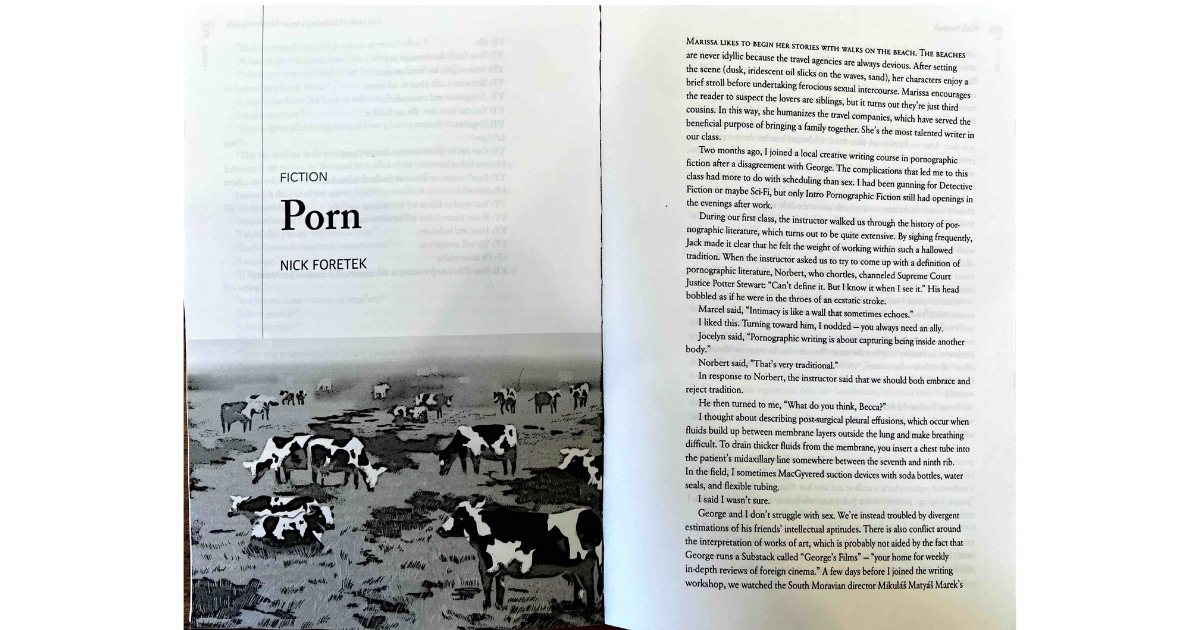
Another great story was Nick Forstek’s “Porn”, about an trauma surgeon who writes incompetent erotic stories that she submits to a sex-writing writing workshop (where they are torn apart, because there’s no sex in them). And you, as the reader, understand that she’s somehow trying to work out some frustrations with her husband.
My first story featured two characters named George and Becca. It culminates with George and Becca going to a nice dinner and sustaining conversation for over three hours…[then] an errant knife flies from the kitchen and lands between George’s ribs, puncturing his fascia. Becca drags him to the hospital, pausing to do compressions every fifteen feet. After identifying zero vital signs and some pretty significant jugular venous distention, she conducts an emergency room thoracotomy — a surgical incision into the chest wall — to temporize him. The story leaves his survival unclear.
It’s a really silly, moving story, that came out in the same issue as that horrible romantasy takedown! These same women—middle-class married women who write erotica—were treated with contempt by the mass-culture takedown, but were handled with good humor by this fiction writer, Nick Forstek.
Those two were my favorite stories, but I enjoyed almost all of them. There were only two stories that I didn’t enjoy, at least in these four issues. The first was an excerpt from Solvej Balle’s On The Calculation of Volume. The second was Matteo Ciambella’s “Fluff”. These were probably the two artiest stories published in issues 13 through 16, so I think these stories just define the limit of my own taste.
The journal’s depth of commitment to fiction seems quite unusual. I was so surprised by the number and quality of the stories that I reached out to The Drift’s editors to ask why their fiction section was so big. They said that their first issue had only one short story, but that the section expanded over time in response to the number and quality of submissions they received! Whatever they’re doing, it’s definitely working.
I gently probed them to figure out who I could credit most for this section, but they divided the responsibility between their first readers (Kanyin Ajayi and Andres Vaamonde), fiction editor (Livia Wood) and founding editors (Rebecca Panovka and Kiara Barrow)—they all collaborate in picking which stories to publish. If there’s a major magazine that wants to reinvigorate their fiction section, they could stand to learn a lot from The Drift.

The politics haven’t changed
The Drift is a socialist journal that came of age during the Biden administration, when its main aim was to lacerate the liberals. And when Trump was elected, their first reaction was, of course, that this was all the fault of the liberals. You all remember November 2024—it basically confirmed everyone’s priors. Whoever you thought was already bad, well…surprise surprise, it turns out those people are the reason Kamala lost. That’s why center-left commentators rushed to blame leftists for being out of touch.
But I will say, in the year since Trump’s victory, center-left commentators have generally remained flat-footed. Even now, in 2026, they continue to critique a toothless left, because that is all that these centrists know how to do.
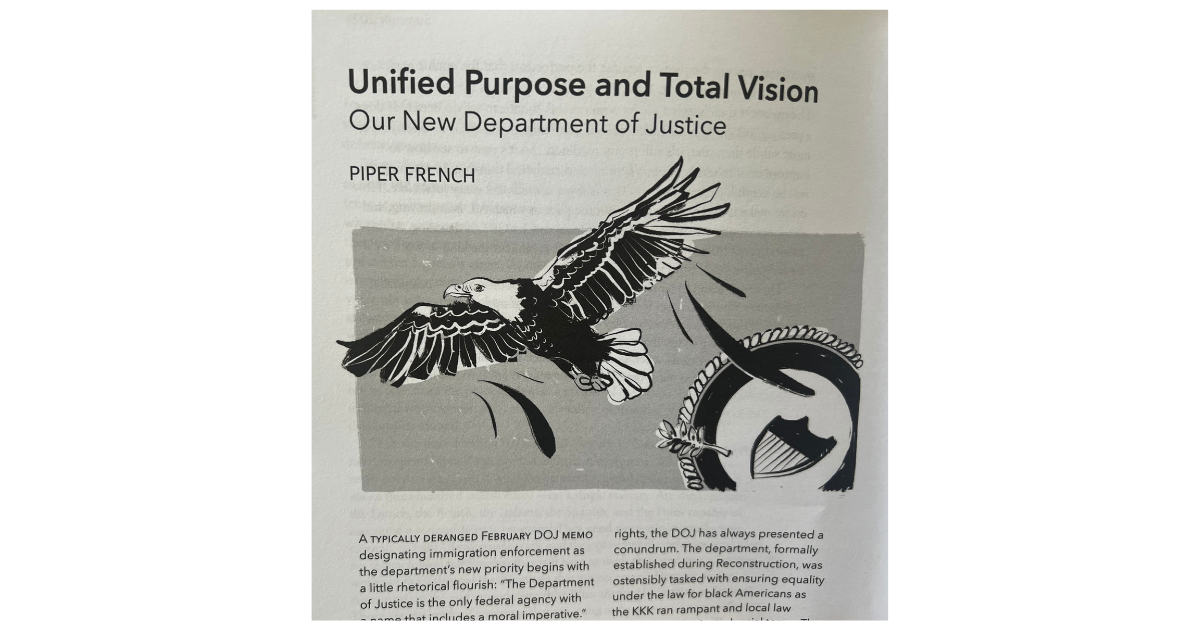
The Drift does not have this problem. That’s because, to The Drift, the ultimate evil is capitalism. So, to them, Trump is not really a break with what’s come before. He’s merely an acceleration of all the evils that we experience under Democratic administrations. Yes, Trump has an armed and militarized police force that’s unaccountable to the courts, but…we also had that under Democrats. Yes, Trump is deporting people in an arbitrary and cruel way, but…that’s also something that Democrats did. Yes, Trump is personally corrupt and in bed with industry, but…well…you get it.
I don’t share this worldview, but there’s a cleanness and moral clarity to it that is refreshing. I have now read a lot of these intellectual journals, and most of them seem to really shy away from confronting the reality of the Trump administration. The Drift is different. Their first issue after he was elected, they had interviews with five leftist figures, to try and work out, in real time, whether Trump’s reelection meant they ought to change their message. And, in that same issue, the Forum was entitled “Dispatches on the New Regime”—a dozen writers did their best to explain, from a leftist point of view, how and why the Trump administration was bad.
I appreciated the effort. And I also appreciated that the journal hasn’t abandoned its commitment to open borders, police abolition, trans rights and all the other stuff it believed. If you think something is right, then you ought to continue to believe in that stuff even when it’s unpopular.

The weakest section of the journal
I’ve talked a lot about the mass-culture takedowns, but most of the nonfiction pieces aren’t takedowns. Each issue had a few longer essays about political or intellectual topics, and these non-takedown pieces were usually quite weak.
Partially the problem was the tone, which often felt very smug. For instance, in the opening of this piece by Gabriel Antonio Solis on Chicano organizing in South Texas, the author claimed that the reason Dems had lost Chicano votes in South Texas was that the party had betrayed or undermined an earlier generation of radical organizers. But…the story told by the body of the piece is quite different. In the author’s own telling, the radical organizers didn’t necessarily have a strong desire to participate effectively in electoral politics, which was one reason for their downfall:
The RUP’s unexpected success raised its profile, but also exposed some of its internal divisions. While many saw the RUP as a means for improving Mexican American representation within the existing political system, others had a more separatist vision that included the possibility of seceding from the U.S. altogether.
The Democratic party took advantage of some of the radicals’ intellectual incoherence and ate away at the RUP’s power base. The author describes his own father’s role in the move towards the Democratic party:
[My father] became active in the Mexican American Democrats (MAD), an organization formed by the Democratic Party in 1975. Unlike the RUP, MAD did not call for “Brown Power,” Chicano national self-determination, or a global anti-imperialist program.
This story, which the author himself was telling, seemed like an opportunity for the author to reflect on the failures of radical organizing in the past. These radical organizers experienced initial success, but they failed because their goals were confused and impractical. Maybe there is a lesson there! The editors of the journal really should’ve pushed the author to think about that lesson.
As it is, a lot of the nonfiction pieces felt perfunctory in this way. They told a story, but they didn’t bother to tell the story in a way that would be truly convincing or energizing, even for a true believer.
On the nonfiction side, the journal is leaving a lot on the table. Unlike with the fiction, the mentions, and the mass-culture takedowns, they’re not pushing this section to be as good as possible.
That’s a shame, because it’s really this section that determines the long-term reputation of the journal. The Drift is often compared to N+1, which is a left-wing periodical founded in 2004. In its heyday, many people felt that N+1 was cliquey, was smug, was superior—they had all kinds of negative feelings about the journal. But they also had to admit that it had launched a number of real talents: Elif Batuman, Wesley Yang, Andrea Long Chu, and Anna Wiener all had breakout essays in the journal. Usually, these breakout pieces were a little askew—they didn’t feel like the typical thing you’d expect to read in an intellectual magazine.
Right now, it feels like The Drift isn’t giving its authors the scope to do something that would truly stand apart. I don’t exactly know how to fix that—I assume part of it involves trusting its authors a little more and allowing them to say something that would break, slightly, with the established leftist party-line.
And that, in turn, means really believing in the brilliance of your authors and believing in the possibility that they can perhaps push the world in a better direction.

The Verdict
It’s hard for me to criticize something that is confident in its own vision. The mass-culture takedowns, although I hate them, are a very well-conceived and effective product. They’re honestly perfect for the attention economy, because they get shared widely, but they don’t actually piss off any powerful people.
Other journals rely, for this same effect, on author takedowns, where they find a sacrificial critic who is willing to say that Ben Lerner (for instance) really sucks. But the problem is that if you, as a writer, get a reputation for writing author takedowns, it’s really harmful for your long-term career—you make a lot of enemies and eventually get taken down yourself. The Drift doesn’t do this. These mass-culture essays are so unique to The Drift that I don’t know their authors necessarily benefit from writing them (the pieces honestly seem more like they’re written by the magazine itself than by any individual), but I don’t think authors suffer from writing them either. This essential harmlessness makes the mass-culture takedown difficult to truly despise.
A lot of craft goes into the takedowns—something I realized when The Point tried to do its own version of a mass-culture takedown. As I was reading Selen Ozturk’s recent piece on BookTok, I couldn’t help thinking that The Drift would’ve done this piece much better. Because they would’ve pushed her to at least create the illusion of engaging deeply with the subject (the Romantasy takedown author claimed he had read 3,600 pages of romantasy), and The Drift also would’ve had the perfect closing for the piece (they would’ve blamed capitalism).
I do think being a socialist elitist (a la The Drift) is better than being a liberal elitist (a la The Point). That’s because liberal elitism just comes off as contempt for the masses. The liberal elitist says that ordinary people love bad things, because ordinary people are dumb and have bad taste. But a socialist elitist has a different message. They get to say, “Ordinary people don’t really love bad things…it’s just capitalism that foists bad things onto them.” This is a much cleaner and more compelling message than regular elitism. I don’t think the message is true, but I at least want to believe in it.
If I have any critique, it’s that right now there’s something about The Drift that seems very cautious. It’s well-produced and often very entertaining, but it operates within a world of highly-online socialists who tend to tear everything to shreds, and each article in The Drift seems like it’s written, first and foremost, to avoid the possibility of critique. Their critical pieces are relentlessly critical, so you can never accuse their authors of liking or affirming anything, and their political pieces have the bland feeling of conventional wisdom (at least within the social circles where they operate).
As a result the magazine comes off like a jobs program—an opportunity for a group of young people to prove that they can create a magazine-shaped product.
The Drift feels like it’s very anxious about being laughed at, so they’re careful to never write anything that seems too sincere. But this anxiety is exactly why people are so dismissive of the magazine. If The Drift went out there and said, “Here is a ten thousand word essay by the next great socialist thinker—this person is gonna teach us how to win” then people would laugh, but they would also pay attention.
Despite its radical politics, The Drift gives off an aura of careerism, because the editors don’t seem to see a point in publishing essays that are actually good. It’s like the magazine doesn’t believe that a thoughtful, well-reasoned, impassioned piece would actually have an impact and get attention. So instead they limit their expertise to producing these takedown pieces that are designed to circulate widely online without ever actually having a cultural impact.
But I don’t really think the editors are cynical or careerist. If they were, the founding editors could just hand off (or close down) the magazine and bank their reputational gains. I think they want to make an impact, but it’s just hard to know how to begin, and it’s a bit scary to really try. They have gained a lot from this magazine, and if they start trying to launch new talents and make big statements, then they might falter, become a laughingstock, and lose much of what they’ve gained.
However, if you really believe that something is important, then surely you’re willing to lose your career over it. I would love for The Drift to commit to a piece and stake its reputation on saying something interesting.
And yes, if they committed to a piece, it would probably get trashed by the same crowd of envious para-intellectuals who form the primary audience for The Drift’s mass-culture takedowns. But that would be good! Right now the magazine is overtly respected, but privately mocked. The opposite is much preferable—you know you’re having an impact when someone bothers trying to take you down.
From Mariah Kreutter’s interview:
After my first story in The Drift came out, I immediately got emails from five or six literary agents who said they loved the story and were interested in my work. I didn’t end up signing with any of them—I actually met my agent through an NYU event [She is with Susan Golomb—Jonathan Franzen’s agent—in case you ever wondered if the NYU MFA program knew how to set you up! –NK]—but it still felt like a turning point in my career. Before that, I’d published fiction in a few smaller journals, but nothing had ever “happened” the way things started happening after I published in The Drift.
I think it’s one of the best places to publish fiction right now because a) they mostly publish emerging writers and b) people in the industry actually read it. There aren’t many magazines where both those things are true. The Drift also pays pretty well: $1,000 is by far the most I’ve ever gotten for a short story. In most places, you’re lucky to see $100 or $200. I will note that The Drift’s contract is... aggressive... about subsidiary rights, dramatic rights, etc.
At the time this didn’t seem worth kicking up a fuss about—how valuable could the dramatic rights to my 1200-word short story possibly be?—but I may live to regret it. For now, I think I’ve gotten a lot of name recognition and professional legitimization out of publishing in The Drift, although it hasn’t directly led to more money (yet).
I think what Mariah is describing is that when The Drift publishes your short story, they also ask for the TV/film rights to the pieces. This is highly unusual (usually you only sell First North American Serial Rights to a publisher) and does seem a bit exploitative. There’s been a year-long controversy in the sci-fi world regarding similar contract language at three leading sci-fi magazines—the trade association for sci-fi writers, SFWA, spent months fighting this language and seemingly has prevailed, though it’s unclear whether the changes will stick.
The Drift has a number of important literary agencies (Cheney, Gernert, Frances Goldin, Janklow & Nesbit, Wylie), amongst its donors, and I highly doubt any of their agents would let a client sign this kind of contract.
I really despair at how these progressive & socialist movements capture so much youthful energy on the left, while remaining just completely alienating to the majority of Americans who didn't go to college and don't live in rich, tech-obsessed metropolises.
Rather than attacking capitalism, which is remarkably effective at producing the kind of affordable goods people have come to rely on, I wish these movements would focus on positive goals, like building up the institutions (social, communal, spiritual, academic, artistic) that naturally act as balancing forces against capitalism.
I read one story in The Drift a few years ago. It was about a Brooklyn litbro who "explains things to women," and turns out to be raping the narrator, in a kind of nasty, Cat-Person-esque twist ending. Never touched them again.
County Highway and Harper's are the gold standard for people who are turned off by the yuppie socialist crowd. The fiction is pretty good, too.
Thanks for this thoughtful, engaging take! I agree with many of your points and am eager to more deeply consider others.
I rarely have reason to share this outside of chronic illness circles, so I'm leaping at the chance to share this nonfiction essay from 2023: https://www.thedriftmag.com/the-bad-patient/
It was one of the most lucid, important things I read when I was in deep in the murk of my own chronic illness 'journey,' and I'm wildly grateful to them for publishing it.