
Liberties
Liberties is a young (less than five years old) intellectual journal that’s based in Washington, D.C. But although the journal is young, the vibe is very old. Its founder is 73-year-old Leon Wieseltier, who was literary editor for The New Republic for thirty years.
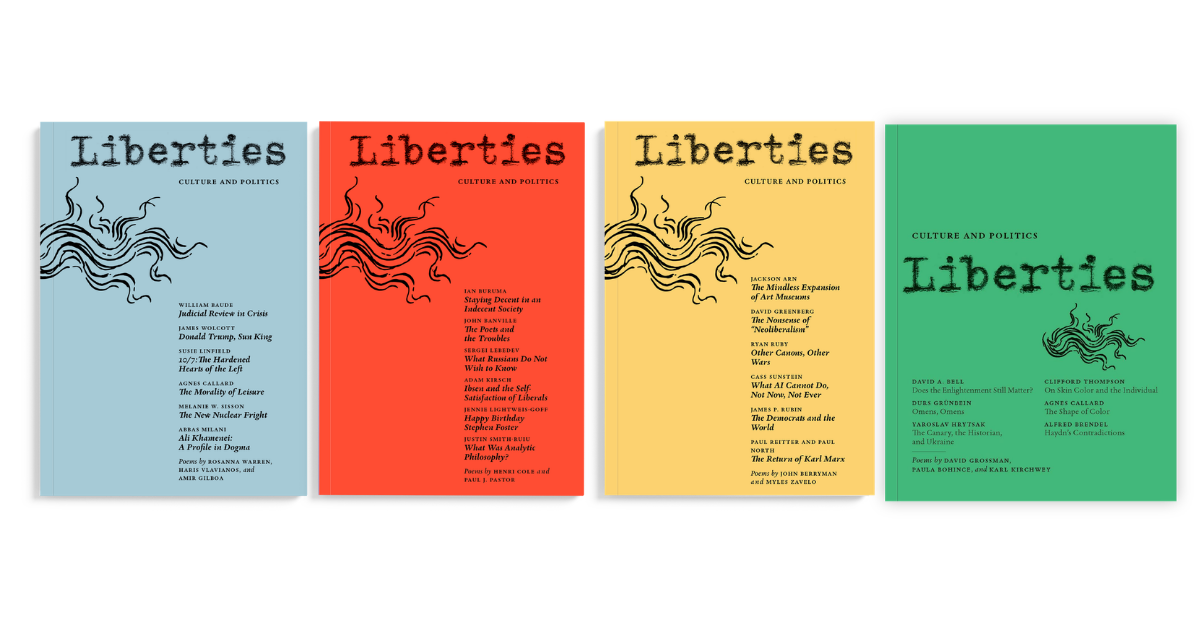
The journal is quite barebones: it has the size and heft of a typical trade paperback; it doesn’t even have a cover-image, each issue’s cover is just a different monochrome color, on matte cardstock, with a table of contents printed directly onto the cover. Inside, there are no images, and the magazine is laid out as if you’re meant to just read straight through, from front to back, which is exactly what I did.
Liberties is a resolutely analog affair. Pieces are available online, but there’s a very strong paywall (you don’t get any free articles per month) so articles are rarely shared by link-aggregation sites and almost never go viral online. As a result, the only way to know what’s in Liberties is to buy a copy. I have no idea how this is supposed to work. Who is this for? Who even hears about Liberties in the first place?
Personally, I loved the journal. I really enjoyed reading it. Turns out the answer to the question “Who is this journal for?” was “Naomi Kanakia”.
In part this was because my politics are essentially the same as the journal’s politics. You know, I often read journals just to stay abreast of what ‘the other side’ thinks, but reading Liberties has taught me that it’s so much more fun to keep up with my own side: it is a pleasure to be pandered to.

Liberties felt like going home
I grew up in Washington, D.C., and I also worked there for a while after college. People who haven’t lived in D.C. cannot understand the strength of the Beltway consensus. In my hometown, “politics” is synonymous with “electoral politics”, and all discussion is bounded by the limits of the mainstream platforms of the Democratic and Republican parties. When I was growing up, there was also a strong technocratic element to the culture in DC—for every issue, there was an expert, and the solution to all problems was to listen to the experts and institute some carefully-crafted policy that would solve the issue with a minimum of trouble.
In D.C., for most issues there is a right answer. Oftentimes, the right answer changes, but at any moment, there is usually a consensus about which policy is the smartest (even if people agree that it’s not politically workable). For instance, during my time in D.C. the consensus was that climate change could only be solved by carbon taxes.
Indeed, when I lived in D.C. there was a huge amount of enthusiasm for market-based solutions (what people nowadays call ‘neoliberalism’): you solved problems by using government policy to align peoples’ incentives, so that negative and positive externalities were priced into the cost of whatever you were talking about (healthcare, gas, education, etc), which then resulted in people investing the socially-optimum amount of money into that good.
I have no idea whether D.C. is still like this, but Liberties definitely feels like a product of the D.C. that I knew and understood. In contrast to The Hedgehog Review, which had an issue about how neoliberalism was bad, there is an entire article in Liberties, by David Greenberg, about how actually neoliberalism was good. It is an excellent piece: a thorough-going defense of neoliberalism as practiced by the Clinton, Obama, and Biden administration—much better and more carefully-written than any of the articles on the topic in The Hedgehog Review, because the Liberties article (“The Nonsense of ‘Neoliberalism’”) pays attention to the specifics of what the two parties actually advocated:
Witting or unwitting, the wrongheaded conflation of neoliberalism with free-market conservatism has continued to flourish. The practice yokes together two groups who are clear ideological enemies. A category that embraces such stark opposites as Ronald Reagan and Bill Clinton, or Hillary Clinton and Donald Trump, can only obfuscate. And, besides, good names already exist for market-friendly economics: free-market conservatism, economic libertarianism, classical liberalism, laissez-faire. But leftists prefer “neoliberal” because it enfolds liberal Democrats in their blunderbuss critique. If to a hammer everything looks like a nail, then to a Marxist every non-Marxist looks like a neoliberal.
I am sure it’s possible to argue with this article, but it was a very strong, well-written, and carefully-argued article, precisely because the author didn’t go wild with polemic—if you want to know to understand how neoliberalism is conceptualized by its practitioners, this is the piece to read.

Flailing in the Trump Era
In my piece last week on The Drift I wrote that liberal journals seem unable to handle the reality of the Trump administration. The people who write for liberal journals are like me, they see the Trump administration as a sharp break with pre-existing norms. And yet those norms, as represented by the Democratic Party, were decisively defeated at the ballot box. This means there is a toothless, flailing quality to the current events coverage in Liberties.
For instance, there was a piece by James P. Rubin about how America could reconstitute its foreign policy under a Democrat. It felt like Rubin was writing from another planet: there is no point in a Democrat creating foreign policy alliances if a Republic administration will just overturn or undo them. The piece was about how Trump had overturned a preexisting foreign policy consensus, but it couldn’t really grapple with the reality of that situation.
In contrast, a journal like The Drift is able to more decisively call out the Trump administration’s lawless and irrational behavior precisely because The Drift doesn’t see that behavior as being much of a break with the Biden Administration. The Drift is used to channeling a certain amount of outrage at the US government, in a way that Liberties really finds itself unable to do.
The best current events coverage in Liberties was a piece on judicial review, by William Baude, which examined the complicated history of this concept and the ways in which the Supreme Court has, in the past, backtracked and seemingly-cooperated with lawless Presidents in order to preserve the idea of judicial review. The piece suggested that the Roberts Court has been strategically deciding in Trump’s favor in order to preserve the concept of judicial review (the idea that the Court is the final arbiter of the law in America).
It is uncertain how the administration would take a significant loss in Court. No amount of “give and take” can necessarily avert a war between the Court and the White House. But it can help to ensure that the war takes place on the Court’s strongest ground, with many members of the administration already well invested in the Court’s power and legitimacy.
This seems like a very charitable reading of the Roberts court, but it’s the kind of reading that Liberties, with its institutional mindset, needs to make, because the alternative is that our system of government has changed in a fundamental way (or that it always functioned in a way very different from how liberals imagined it did).
I do wish this journal would think a bit harder about what it would mean if future Presidents have the same powers that Trump has now. What would that look like, functionally? To what extent could a Democrat use those powers? And what kinds of policies can a federal administration enact if they know those policies will be overturned immediately by the next hostile administration?

Not all serious
But the political coverage was only a small part of the journal.
There was also a strong vein of good-natured humor running through Liberties. There were a number of pieces that the authors had obviously written just for fun, because they wanted to spool out an argument. I really liked Jackson Arn’s ‘Grids, Glass, and More Glass’ about how museums are endlessly rebuilding and expanding themselves. What made this piece particularly good was the tone of amusement; obviously, museum expansion isn’t a horrible social problem, and he doesn’t treat it like one. But it is still amusing the way museums just grow and grow and grow, endlessly adding to themselves, in order to feed the ego of their donors:
The question with which I began was not all rhetorical: what does museum expansion have to do with art? Very little, but also everything. Unless you happen to be wealthy enough to buy masterpieces yourself, to experience art means to experience it with a pack of strangers in a shiny new room named after people you couldn’t stand much more than they could stand you.
James Wolcott’s “Gloire Days” was another tour-de-force. The author begins with a study of Versailles, before moving slowly into the present, ending up at Mar-A-Lago. I never would’ve read a piece that explicitly set out to compare Mar-A-Lago and Versailles, because I would’ve felt the comparison was lazy, but Wolcott doesn’t make it in a lazy way. First, he sells you on the idea of reading about Versailles, and only then does he move into current events.

The cultural coverage
The wonderful thing about Liberties is that it’s so eclectic. It’s a very old-style magazine experience: your only decision is whether or not to subscribe. The magazine doesn’t care if you actually read it, and it especially doesn’t care if you’re interested in the topic of the individual articles.
For instance, there is a shockingly large amount of poetry coverage in the journal. I read a long, pretty-fascinating piece, by John Banville, about the poets of Northern Ireland in the 20th century:
Were writers in the South shocked by the quantity and the quality of the work that suddenly started pouring out of the North? Certainly the poets were — shocked, and envious. One of them, whom I shall not name, from an earlier generation, born at the end of the 1920s, carried a bitter lifelong resentment, frequently and vociferously expressed, of Seamus Heaney’s lavish successes.
I would never ordinarily read something like this, but with Liberties it’s easier to just keep going, to march resolutely through the journal, page by page, instead of skipping ahead to the next article.
One of the very best articles, in any these issues, was another poetry article, by Jaroslaw Anders, about the generation of Eastern European poets who came of age after WWII. These poets ended up as a species of secular saint (who the following generation, the poets of the ‘80s, tried unsuccessfully to take down):
One of the reasons for the pique of the younger generation might have also been the extremely elevated, almost prophetic status that the great few enjoyed in the post-war decades. Especially, but not exclusively, in Poland, great poets were treated, often against their will, as moral arbiters, spiritual guides, guardians of their nation’s soul.
The article was a great analysis of these ‘great poets’ (I recognized the names Miłosz, Szymborska, and Zagajewski, but the article also discussed a dozen others) and what, if any, shared characteristics gave their poetry such power.
The cultural coverage in this journal was superb. It hardly covered anything recent, mostly it was all about 20th-century literature, though there were also articles on Neapolitan opera and about a 19th-century composer of minstrel songs. The literature coverage wasn’t exclusively Western. I really liked an article by Abhrajyoti Chakraborty on Urdu short story writer Saadat Hasan Manto. Robert Rubsam (one of the few younger writers for the magazine) wrote an excellent piece about Yasunari Kawabata and Ryan Ruby (a critic I usually don’t like at all) wrote a good piece about an 18th-century Chinese novel, The Scholars.
The caveats
I fear this review will be short. As I was reading Liberties, I kept thinking, “How would I make this better?” And I really have no idea. The whole journal is perfectly calibrated for me. It’s like they knew exactly what Naomi Kanakia would enjoy, and they published a journal containing that content.
The journal works best in print, and it works best if you just read it straight through. At one point I lost an issue, and I tried to finish reading it on my phone, but my attention kept wandering. There is something very patriarchal and old-school about this journal. It’s like the 1950s New Yorker: you’re meant to just take whatever the magazine lays down. If you don’t care about a topic, you can theoretically skip the article, but most of them are engaging enough that it’s simpler to just read through to the end, because the whole point you’re reading this journal is because it’s full of things you wouldn’t ordinarily care about.
Just as a warning, there is a lot of liberal Zionist hand-wringing. Every issue ends with a piece by assistant editor Celeste Marcus and another by founder/EIC, Leon Wieseltier. These articles almost always have an anguished tone and are about the West Bank or Gaza or have some other Israel focus. The liberal Zionist position is that you really want a Jewish state in the Middle East, and you don’t believe that a one-state solution is tenable, but you are horrified by the current government in Israel.
Susie Linfield summarized this position in a long article in the Winter 2026 issue, in which she writes about several recently-published anti-Zionist books. In discussing Peter Beinart’s book, Linfield writes:
Beinart’s book also points to the ways that left-wing thinking after October 7 has calcified. He views any version of political Zionism as a form of Jewish “supremacy,” and he has long advocated a single “democratic binational state” in what had been Mandatory Palestine. Presumably, the lions and the lambs — or rather, the lions of Israel’s messianic right and those of Hamas and Islamic Jihad — will lie down together and nuzzle each other toward democracy and mutual acceptance. Always a fantasy, this vision has become ever more imaginary since October 7. “I’m not going to be fellow citizens with any of Gaza’s Nukhba Forces terrorists or their hundreds of thousands of supporters,” the historian Fania Oz-Salzberger, a longtime member of the peace camp, recently told Haaretz. “There will be no one state, Israel-Palestine, in our lifetimes, and probably not our children’s lifetimes, because the next generation are victims of October 7 too — on both sides.”
Most of my Jewish friends have liberal Zionist opinions just like these, so I have no objection to the magazine on this score. I have found that many intellectual journals hold very strong opinions about the Middle East (The Drift also had many pieces about Israel-Palestine, all of them holding to the kind of anti-Zionist position that Linfield is decrying here), so it’s hard to find a journal that won’t piss off somebody with its Israel-Palestine stances.
To some readers, this kind of Zionism is probably a deal-breaker. But I am struggling to think about anything else I could criticize in the content of the journal.
I guess there were a few anti-woke pieces that were cringe-inducing just because they felt dated, like Clifford Thompson’s “On Skin Color, and the Individual”—however a lot of mainstream magazines run way more of this content and do it in a much more annoying way.
This is probably also the place to note that Leon Wieseltier got MeToo’ed in 2017, resulting in him being fired by The Atlantic and in the collapse of a previous magazine venture that was going to be funded by Laurene Powell Jobs. I find these accusations to be credible, and I have also heard through the whisper network that he was a notorious sexual harasser. Wieseltier is an older man now and Liberties is a much smaller organization than The New Republic, so hopefully he has less desire and opportunity to harass young female staffers, but you never know.1

Will it last?
I suppose my primary feeling about Liberties is just a sense of worry. How many subscribers does it really have? It is supported, financially, by a friend of Wieseltier’s, Alfred Moses, a 94-year-old lawyer, and surely that money will dry up when Moses dies. Hopefully they’re doing something to ensure the sustainability of the journal. I can’t help wishing they had a little more grit, a little more careerism, that they recruited some younger writers, and covered current culture more (in these four issues, I don’t think they wrote about any work of literature published in the 21st-century), just as a way of getting some younger readers into the door.
Right now, this is a magazine that is for a certain kind of older person (probably 60+) who is nostalgic for an idealized vision of what magazines used to be: the magazine decides what is important, and you just sit down and read it, even if you’re not interested in the topic.
And what’s great is that Liberties delivers that vision on a shoestring, which probably means it’s more sustainable than the old New Yorker was. But I would love if the magazine did a bit more to sell that vision to younger people. I think a lot of folks would really love Liberties if they only knew about it! Like, many people who read Woman of Letters would probably prefer Liberties to my own newsletter, but they don’t even know about Liberties.
I have no idea how many readers each article in Liberties gets—probably fewer than read the average Woman of Letters post—but the articles are written with the quiet confidence that the right person will come across them. I really hope that this confidence is well-merited.
In any case, I am happy to have discovered the journal while it still exists. Out of the journals I’ve read (so far) as part of this project, this is the one that I can recommend most enthusiastically to my subscribers. If you enjoy Woman of Letters, you’ll probably enjoy Liberties too.
This is the fourth in a series where I review contemporary intellectual journals. Here are links to previous pieces on The Drift, The Hedgehog Review, and The Whitney Review of New Writing.

Elsewhere on the Internet…
My story “Domestic Disputes” will be republished in this year’s edition of Best American Science Fiction and Fantasy.
What’s So Great About The Great Books? (my recently-released nonfiction book) got a positive review from Todd Shy in The American Scholar:
What’s So Great About the Great Books? is a spirited, welcome argument about the value of reading—reading on your own time, with your own appetites and needs, with your desire to make something meaningful of your life after your formal education is behind you. It is an appeal for reading whole books, challenging books, old books, books that have survived scrutiny and even contempt, books that affirm without simplifying, books Kanakia is willing to call 'great.’
Jesse Relkin also had good things to say in The Metropolitan Review:
It’s in Kanakia’s own pursuit of moral truth through nuance that her strength as a writer lies. She doesn’t use the showy language or inflammatory élan of other popular internet writers, but then, do we really need more of that anyway? There’s a strong aesthetic sense behind her clean, clear prose.
In the Substack world, What’s So Great About The Great Books was also discussed by Mary Jane Eyre (twice!) and by Jeffrey Lawrence, who uses the book as a jumping-off point for talking about the future of the humanities:
Perhaps even more so than Kanakia herself acknowledges, the program that she offers in What’s So Great About the Great Books is valuable precisely because the bonds linking the liberal arts to our current educational system have frayed so badly. For the first time in a long time, we must seriously contemplate how intellectual culture in the United States will survive in the face of widespread institutional decline.
Here are some links to purchase What’s So Great About The Great Books on Amazon and on Bookshop.
Wieseltier is quite a character. If you want to know more about him, Henry Begler directed me to this somewhat-unflattering Vanity Fair profile from 1995:
He was, they all agreed, a brilliant young man of breathtaking promise who would one day bring forth works of enduring importance.
“If he will produce a book, it’ll be a triumph, and I very much hope he does,” says Sir Isaiah [Berlin[, to whom Wieseltier announced himself following a letter of introduction from [Lionel] Trilling. Sir Isaiah isn’t the only one waiting for the magnum opus—which Wieseltier describes as a physiological/historical/philosophical critique of sighing, with a few chapters partially written after four years’ labor.
But among Wieseltier’s friends there is much speculation about the true state of his book. For despite his vertiginous I.Q. and prodigious learning, Wieseltier seems to have worked as hard at the construction and maintenance of his glittering image as he has at the occupation of thinking and writing. As he once told a pal, “You must always have a cover. You always have to have something you can tell people you’re doing, something really nifty.” Wieseltier’s friend pointedly adds, “When in fact what you’re doing is eating peanuts in bed.”
liberties attracts a crowd of bloviating would-be intellectuals with zero convictions who love to hear themselves talk, which DC has in spades
You're looking pretty good for a "a certain kind of older person (probably 60+)." In all seriousness, I subscribed to Liberties from the first issue. I think that the journal is, at its simplest, not a matter of nostalgia for Partisan Review-ish stuff, but a recognition that there is a gap in sustained intellectual writing that is neither too academic nor too laissez-faire.