
The Yale Review
the four types of magazine article — the talented writer — I eventually got bored — the two best nonfiction pieces
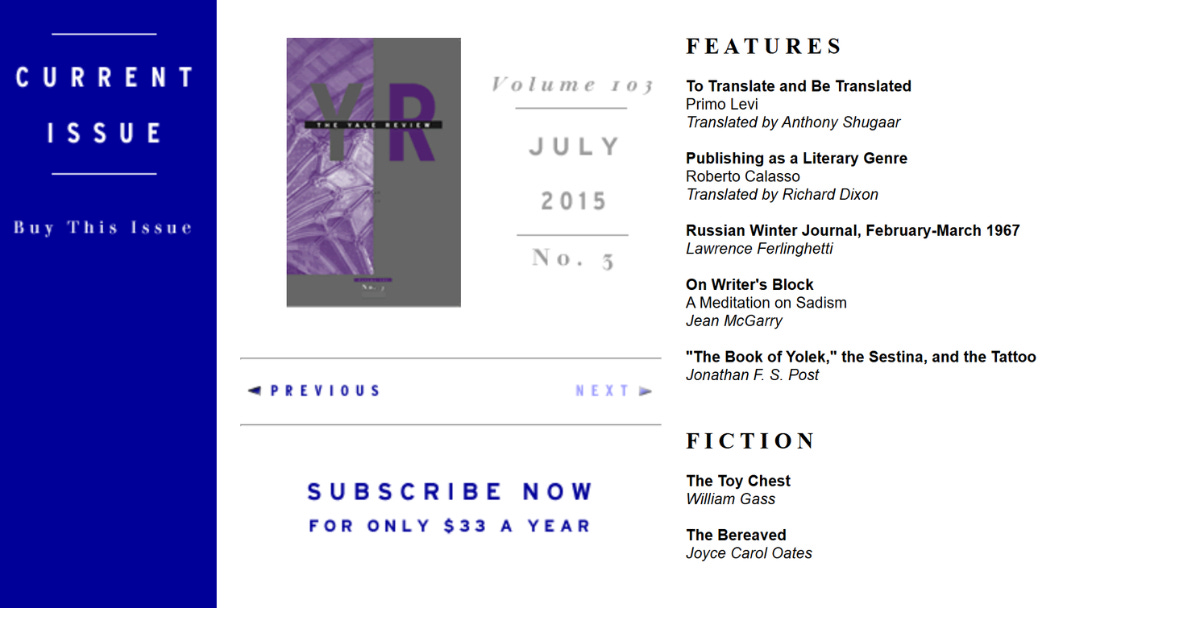
Ten years ago, when I first began submitting to literary journals, many of these journals had very forbidding websites. The site would be nothing more than a table of contents—a record of the pieces that were being published in some print journal.
And one of the most forbidding of these websites belonged to The Yale Review. This journal not only had a very minimalist site, but it also did not accept electronic submissions. If you wanted to be in this journal, you needed to print out your story and submit it to them by paper.
This is something I have done occasionally in my life (I sent paper submissions to Analog, Asimov’s, and F&SF for years before they moved their submission systems online), but I didn’t feel like doing it for The Yale Review.
Periodically, I’d check back with The Yale Review, and they always seemed unusually fusty and suspicious of the internet, even by the standards of this type of journal. Their website had essentially no content, and there was not even a whisper of an attempt to sell you on the idea that maybe The Yale Review would be a good journal to read.
Then at some point in the last few years, I started hearing about The Yale Review. Someone would text me a link to a piece like this one, by Audrey Wollen (“The Handbag Theory of Fiction”). And then I’d read the piece and think, hmm, this is pretty good, but more importantly, what is happening here? I thought this journal didn’t even have a website! I am almost positive that this journal used to have no content on its website!
Apparently, in 2019, The Yale Review named a new editor, Meghan O’Rourke. She graduated Yale in 1997, at some point became an editor at The New Yorker, then moved to Slate in 2001, where she was a culture editor until 2005, then became poetry editor at The Paris Review. (Surely being poetry editor at The Paris Review is not a full-time job! I had a very hard time parsing Meghan O’Rourke’s work history.) She is also a poet and a writer—her memoir about having a chronic illness was nominated for the National Book Award in 2022.
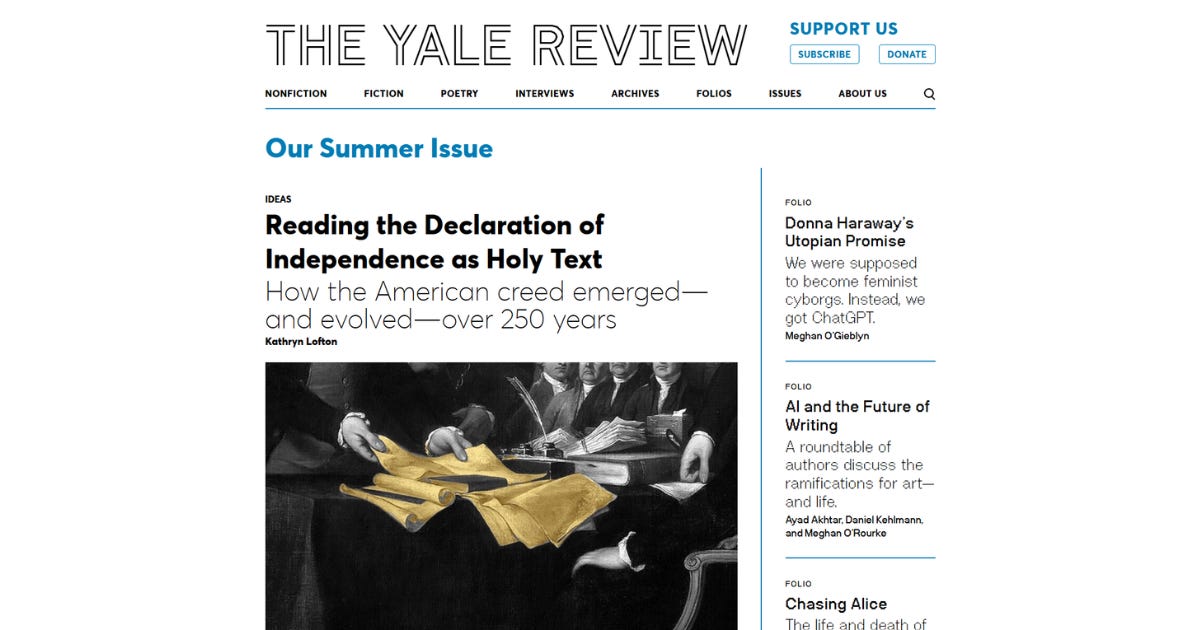
Anyway, under O’Rourke’s leadership, the magazine relaunched in 2021. And it’s clear that she must’ve had a mandate to radically remake the magazine’s image. Because, firstly, The Yale Review embraced the internet and made a very snazzy website that has no paywalls. Now almost all the content is just there, on the internet, for free.
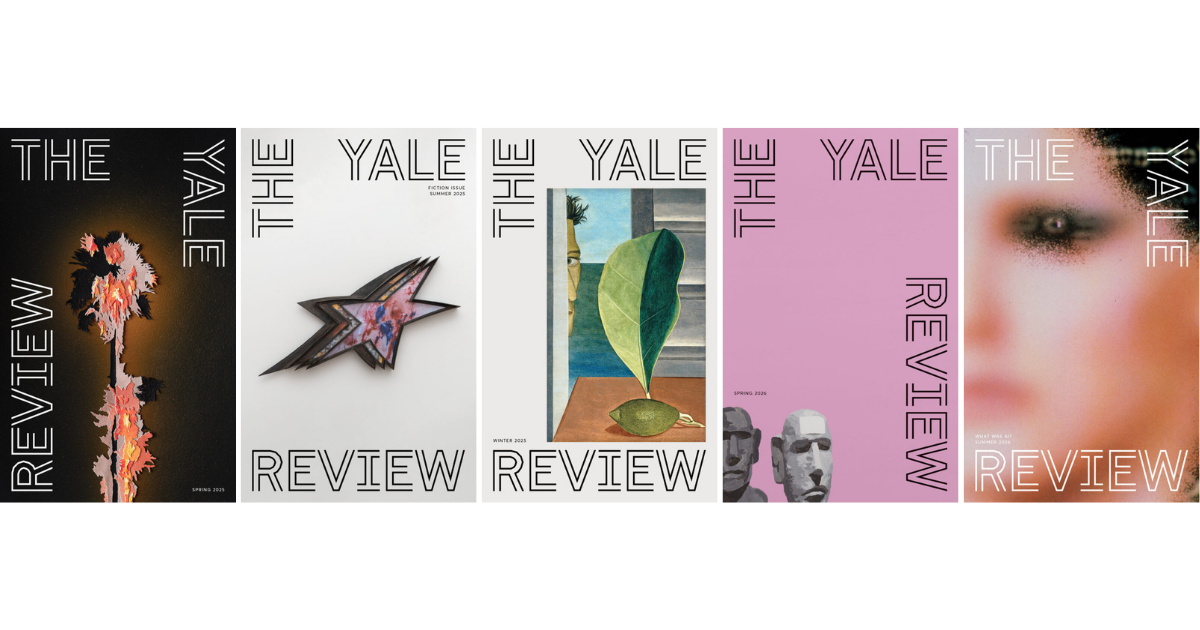
And, secondly, they redesigned the journal, putting it in this really attractive digest format, with crisp text on a white background. The digest format has fallen out of fashion for magazines, since it’s somewhat small and is only really suitable for text-heavy publications, but I think it’s really working here. The magazine is 5.5 x 8.5 inches, with thick covers and good paper-stock: it feels like you’re reading a trade paperback.
(Both redesigns were accomplished with the help of Pentagram, the design consultancy that also revamped The Baffler in 2016—here’s an article about The Yale Review redesign.)
As a result of these changes, The Yale Review really exists now in a way that it did not exist before. The Yale Review is two hundred years old, it was founded in 1819—I never heard a word about the contents of this magazine until two years ago, when suddenly people online started posting links to Yale Review articles.
This is really impressive. Surely most of the credit belongs to Meghan O’Rourke. But when it comes to a real shift in the organization, you also need buy-in from people up top. There’s some board of directors or somebody who decided that The Yale Review needed to be shaken up, and they were willing to put in some resources to make it happen.

The four types of magazine article
I’ve now read an unbelievable number of these little magazines, and I’m starting to develop a general theory of how they work. Essentially, each piece in these magazines falls into one of four categories:
Entertainment
Education
Provocation
Literary Art
If you don’t read these magazines cover to cover, then you tend to mostly be familiar with the third type: provocations. Many of these magazines have a way of subtly needling their reader, and often these are the pieces that go viral on the internet and win the magazine a broader reputation.
But I think if a journal is going to survive long-term, then it needs to put effort into the other three categories as well, because that’s how you create enthusiastic readers who are excited when the journal arrives in their mailbox.

Our first literary journal
The Yale Review is a bit different from the other intellectual journals I’ve read, in that it’s not primarily a journal of ideas. Instead, it’s a literary journal—a type of magazine that is heavily tilted towards literary art. The subtext to every piece in a literary journal is that you’re reading something that’s not just a product, it’s a work of literary art, and the author is a literary talent.
This format is a difficult one for me. The thing about a literary piece is that it usually succeeds by creating its own rules. This means that when I, as a reader, walk into a piece, I don’t really know what to expect. These pieces operate without what Jonathan Franzen would’ve called a “Contract” with the reader. They’re not promising any particular sort of experience.
Literary pieces are hard to evaluate, because there’s no ready framework that lets me say whether the author achieved their aims. If I enjoyed the piece, that’s one thing. But if I didn’t enjoy it, then it’s always possible I just didn’t understand what the author was trying to achieve.

The talented writer
The bulk of The Yale Review, at least in the five issues that I read, was given over to fiction and to memoir. (There was also a substantial poetry section that seemed much better than the poetry in many of these small journals, but I don’t feel qualified to critique that.)
What was striking about these fiction and memoir pieces was that I recognized the names of most of the authors.
In America, there is a broader world of arts and letters that anoints people as talents. Somehow, through a mixture of awards and review coverage and word of mouth, the literary world is able to convey to me that certain authors are the leading lights of our age.
Most of these small journals primarily publish emerging writers—people who haven’t yet secured a place as a talent. But The Yale Review is different—they seem to publish a lot of writers who’ve reached a fairly secure middle-to-upper tier in this status game. I read five issues of the journal, and I recognized a lot of names. There were pieces by Sheila Heti, by Jhumpa Lahiri, by Garth Greenwell, by Nathan Englander, by Rachel Cusk, by Sigrid Nunez.
Many of the pieces in the journal seemed to rely, implicitly, on the author’s reputation. This was particularly true for many of the nonfiction pieces. For instance, I was very game to read Jhumpa Lahiri’s essay about re-reading Thomas Hardy’s Jude The Obscure. But the writing was quite dry and academic:
What is it about the wavering nature of water that fixes and transfixes us? Unlike Eve and Narcissus, deceptively doubled by water’s reflective properties, Jude observes only that quivering, distant disk. Though he doesn’t see himself, this is the first time the reader is allowed to see him. We can read Jude’s peering into the well as a form of visual katabasis: traveling with one’s eyes, and in one’s thoughts, to the underworld.
There is no way on Earth I would’ve kept reading this if I hadn’t known it was by Lahiri. As it is, this six thousand word essay taught me surprisingly little about Jude The Obscure, but a lot more about how Lahiri thinks.
I also gave many of the fiction pieces much more leeway because I recognized the author’s name. For instance, I had never read a Sigrid Nunez fiction before, but I liked her story about a hotel maid who’s trying to describe her job to her kids and grand-kids (“Rabbit’s Foot”):
[Her daughter] would never understand….What she wanted to hear was that Carmine had hated the job and resented the way she had been treated. But that was not in Carmine’s character.
Similarly, although I’ve read several of her novels, I have never read a Cusk short story. There was something very pleasant about making this glancing contact with so many eminent writers.
And I think that’s essentially what The Yale Review is offering the reader. That’s their version of entertainment: it’s offering you the chance to feel connected to many writers who’ve been acclaimed as great talents.
This is not necessarily something any of the other little magazines I’ve reviewed are able to do.

I got bored
But although I thought that I was excited to see more Lahiri and Cusk and Heti and Greenwell…over time I began to feel a sense of weariness whenever I picked up this journal. It was just too…serious. Too eminent. Too literary. I don’t know…I cannot explain it. Part of the problem was that it published so much fiction, and all the stories felt quite weighty—every issue felt like you were reading The Best American Short Stories. Sometimes I think these magazines would benefit from a little more oomph. Like…can’t there ever be a murder? Or a sci-fi story? Or just something fun! Like somebody falling in love! Or somebody having an affair!
Once upon a time, there used to be a genre of story called ‘the magazine story’. These were simple stories that were meant to be entertaining: Contract stories. This type of story usually opened with some clear difficulty that the protagonist needed to work through, and the pleasure of reading the story came from seeing how they worked through that difficulty in some unusual way.
There are even some writers (Kurt Vonnegut, Ray Bradbury, F. Scott Fitzgerald) who managed to complicate the magazine story in ways that granted these writers an enduring reputation.
Nowadays, the short story is an endangered species, and, in response, fiction editors have doubled down on Literary Art. They tend to publish stories that pointedly refuse to give us a clear conflict and a protagonist who works through that conflict. If your journal is primarily a showcase for individual talent, this makes sense. It’s a difficult task to hold a reader’s attention for a formless story, like Rachel Cusk’s “Into The Light”, which is about an artist’s three marriages and her austere, Bohemian life, so if you can manage to do it, then you must be a real talent.
But the failure rate for this kind of story is very high. For every piece like “Into The Light”, there were two exhausting, confusing stories like Samantha Hunt’s “Hangman” or Samanta Schweblin’s “Welcome To The Club”. And, over time, I just stopped getting excited about the fiction in the journal.
And it really didn’t need to be this way! I just feel like the mix is off. It’s okay to have exhausting, confusing stories, but they shouldn’t predominate. The balance should be more heavily waited towards stories like Emma Copley Eisenberg’s “Lanternfly”.
This is about a young transmasculine writer who takes a job assisting an elderly sci-fi writer. What makes this story so great is that the elderly writer is such a character! He is an incredible sex-addict, and he tasks the protagonist with going on Grindr and procuring him some hookups:
Sex, [the elderly writer] said finally. I’ll need to have some. A lot, actually. Sometimes several times a day.
I looked at the linen shirt he was wearing, white with orange stripes, and imagined removing it from his back. Unbuttoning the buttons, folding it neatly. He would see my feet. Perhaps he would touch them.
Not with you, obviously, he said. There’s an application, as I understand it. On the phone. But I’ll need your help.
I was riveted, because there’s narrative tension (will the protagonist have sex with elderly writer???) that keeps you reading.1
If you’re going to have a fiction journal, I’d say 75 percent of the stories ought to be simple, fun stories like this, and maybe 25 percent should be more arty and literary.
It might seem like you’re serving your readers by weighing the fiction section down with Literary Art, but I think the magazine would be better if more of the stories were Entertainment. If that was the case, then I’d come into every story with more of a presumption that I was going to get something out of it, and even the literary stories would benefit from that presumption.

Wanted more entertainment and education
The first three types of pieces I identified—Entertainment, Education, and Provocation—are all Contract pieces. And nonfiction section of The Yale Review is too genteel to reliably give me provocations, I understand that. But I didn’t see why the journal needed to contain so few Entertainments or Educational pieces.
If I searched really hard for Entertainment, the closest thing I could identify would be the reminiscences that tended to be at the back of the book.
For instance, I really liked Bryan Burrough’s piece about how he got paid $500,000 a year by Vanity Fair:
I’m probably breaking some unwritten law of publishing, but here it is: For twenty-five years, I was contracted to produce three articles a year, long ones, typically ten thousand words. For this, my peak salary was $498,141. That’s not a misprint—$498,141, or more than $166,000 per story. Then, as now, $166,000 was a good advance for an entire book. Yes, I realized it was obscene. I took it with a grin.
And I loved Elena Gosalvez Blanco’s piece about her harrowing few months working for Patricia Highsmith:
…the hardest rule to follow was her mandate that I keep the lights off at night because she thought electricity too expensive. That’s why she used a flashlight and gave me one to use too. I had gotten used to fearing her flashlight reflecting across the patio, but I dreaded total darkness because of what that could mean. I found it puzzling that the most basic expenses worried someone who had so much money
But entertaining pieces like this were the exception.

What about education?
The review section, also at the back of the book, tended to have some very good Educational pieces.
Of these, the best was a study of Cavafy by Langdon Hammer (“Why biographers can’t pin down Cavafy”), which talked about the ways that this author carefully managed his literary reputation, despite never publishing a collection. I particularly loved this paragraph:
Cavafy’s approach to publication was highly unusual. Although his poems appeared in periodicals, he never published a conventional commercial book. Instead, he had his poems printed individually and gave them to friends as loose broadsheets. In 1904, he selected fourteen poems to be printed in a run of one hundred copies. In 1910, he produced another bound edition of twenty-one poems with a run of two hundred copies. After this, he reverted to distributing his broadsheets by hand in ad hoc collections. The broadsheets were stacked in an “improvised ‘bindery’” or “scriptorium” in his apartment, where he would prepare selections particular to the recipient. Through this oddly private mode of publication, he ultimately distributed at least twenty-two hundred handbound collections of his poetry.
What an incredible way of distributing your poetry! Is there any another 20th-century poet who achieved a worldwide reputation through such ersatz publication?
I also really liked Jonathan Griffin’s piece on photorealism—an artistic movement I’d never heard of, where you make paintings that look like photographs—and Bilge Ebiri’s piece on the lasting influence of the director Terrence Malick.

The essays were also afflicted by artiness
The nonfiction section suffered from its own literary ambitions. And this took two forms. The first was slightness. There were a lot of pieces where the content was thin, and it felt like the piece was trading heavily on the author’s name. I’ve already mentioned the Lahiri piece as a culprit, but there was a whole section of the journal, Objects of Desire, that was nothing more than well-known authors giving brief reflections. For instance, Vincenzo Latronico wrote about his insomnia and Jonathan Lethem wrote about his mother’s ashtray.
But many pieces had the opposite problem. They weren’t slight, they were too heavy. They were a fair number of nonfiction pieces that would’ve been much better if they had eschewed Literary Art and aspired to Entertainment instead.
The worst culprits were Anahid Nersessian’s “When Does A Divorce Begin?” and Dale Peck’s “Dogsbody”. Both were entertaining, but both suffered from the same problem, which is that they were told in this choppy style, with quick cuts, that made it hard to figure out what was actually happening. And both pieces withheld information to create an artificial layer of complexity.
For instance, in the Nersessian piece, the author writes (late in the essay):
Over the course of my romantic life I’ve cheated, been cheated on, and occupied the role of that stateless person, the other woman. The circumstances of my own divorce involved a combination of these experiences too convoluted (and too personal) to describe here. There were obvious and less obvious forms of betrayal, and all of them hurt, though I can’t correlate any of them with abuse, let alone understand them as predictors of mass murder. Infidelity means faithlessness.
Okay, but…isn’t this the heart of the matter? It feels like this essay really dances around the fact of the divorce, but doesn’t go into whether either or both partners expected sexual fidelity from this marriage. It’s totally fine to not want to reveal the details of your personal life, but I cannot celebrate it. The whole point of memoir is that you’re revealing something—if you withhold core details, then that’s not a good work of memoir.
If we leave aside the memoiristic pieces, The Yale Review also contained a fair number of literary-critical essays.
I liked Garth Greenwell’s genteel response to a Substack essay (on fatphobia in Miranda July’s All Fours) by Emma Eisenberg. This Greenwell piece was a standout because it is rare in the extreme for articles in these small journals to respond directly to other articles. The thing we do so frequently in the blog world (respond directly to each other) is quite rare in this little-magazine world that is supposedly so much more intellectually serious. So it was nice to see Greenwell taking part in an ongoing conversation. Greenwell writes:
Much of July’s novel plunged Eisenberg into a kind of Barthesian jouissance, its beauties reminding her “how wondrous and painful and precise and flummoxing is the work of living.” Wondrous, painful, precise, flummoxing—a perfect description of readerly cathexis. And it’s because Eisenberg was so moved by the novel that she experienced a fairly late scene in it as a betrayal.
But other essays in the literary-critical vein did a lot less for me. I gained little from Namwali Serpell’s examination of how Toni Morrisson handles Native American writers or Jhumpa Lahiri’s reminiscence about her experiences reading Jude The Obscure.
Overall, much of the nonfiction in the journal was hampered by the authors’ commitment to seriousness. In the case of Nersession and Peck, these writers aimed too high and didn’t allow themselves to fully deliver the juice. And with Lahiri and Serpell, the authors are too dignified to deliver entertainment, but they didn’t feel compelled to write the essay in a way that created long-lasting educational value for the readers.

Wollen
The Yale Review did have one writer, Audrey Wollen, who was good at delivering essays that were ever-so-slightly more provocative than the typical Yale Review piece.
I liked her “A Unified Theory of the Handbag”, which posited that the first human technology was not the weapon, but the handbag:
What would prompt our transforming minds to fashion a new object from a found material? To alter the verdant consensus of our surroundings? Did we need a spear, a blade—for what? The pipe dream of killing an elephant?…No. What we needed was much more urgent. We required a flexible container, allowing us to roam, to hold on to what we encountered, every precious morsel from our explorations, and to carry our beloved, screaming eggplants alongside us. We needed to move around with our babies and keep our hands free.
(Audrey Wollen also delved into provocation with a review of W. David Marx’s Blank Space.)

The two best nonfiction pieces
Out of the five issues I read, only two nonfiction pieces really stood out as operating at the highest level. They were both from the most recent issue, which had a forum on AI.
In this issue Christopher Sorrentino wrote a piece called “How LLMs Set My Fiction Free” about his experiments using AI to write. This piece was so good! Because…it was essentially trolling. The author (and the journal) are not fools—they know that most writers are extremely anti-AI, so they had to know that the piece would provoke a negative reaction, but it is written with such a straight-faced, ingenuous tone that is absolutely perfect—as if the piece has no idea why anyone could possibly be offended:
Yet whatever potential hazards and unintended consequences flow from AI’s mass adoption, my own experience using it contradicted much of what I was being told. One fear is that these systems will strip prose of style, idiosyncrasy, and that elusive element “voice,” but I found that they could do the opposite, introducing the unexpected, the “wrong,” the uncanny disjuncture between the realistic and the oneiric.
Excellent piece! I highly salute the author for their courage in writing it, and The Yale Review for commissioning it. The essay deserves all the attention it’s gotten.
I also liked Lauren Oyler’s piece in the same issue “My AI Boyfriend”, about her attempt to bond emotionally with an AI chatbot (in order to write an article about it). It doesn’t aspire to be more than a humor piece, which is exactly why it’s good:
I received a text message from my editor: “Um, is it unethical to ask you to get an AI bf?? You can prob say no.”
Resentment. Contempt! Sorrow. Unease. I love text messaging. I have text message exchanges with, let’s say, fifteen people per day. If you want me to do something, you should ask via text message. My editor knows this. She also knows, though it’s more complicated, that I love boyfriends. An AI boyfriend is a boyfriend who always, only texts back, immediately.

Verdict
I am impressed by the degree to which The Yale Review has transformed itself. They have embraced the internet and really made some waves, gotten much more attention. They have a great mix of established and emerging talents in their pages, and when you read their fiction and essays, you’ll see plenty of good pieces and some great ones. They are doing fine. Meghan O’Rourke should be congratulated! And other university-backed journals ought to hire their own O’Rourkes and follow her lead in embracing the internet.
I remain dissatisfied with the journal, but I don’t have any clear prescriptions on how to improve it. I understand that The Yale Review is too genteel to engage in (much) trolling or provocation, but I wish it had more of a sense of fun. I’d love if there were more pieces like the Eisenberg story or the Oyler AI-boyfriend piece. These are both literary writers, whose books are published by prestige imprints, but they also know how to make a promise to the reader (“You will enjoy reading this piece!”) and how to deliver on that promise.
But maybe it’s not in The Yale Review’s interest to be reader-oriented. After all, they’re funded by Yale University, and I don’t know if the university would get excited about funding a magazine that’s full of entertaining essays that give me the salacious details of how some writer cheated on her husband. They are in the business of funding Literary Art. So, for the sake of their own future, the journal needs to make sure they’re broadcasting This Is Art at the loudest possible volume.
And yet there’s a paradox. The overall mien of the journal is extremely serious, so whenever a piece has genuine joie de vivre, as is the case with Emma Eisenberg’s story or Audrey Wollen’s essays or Lauren Oyler’s piece, then the work tends to really stand out and win a lot of attention for its author.
Meanwhile all the really serious pieces just tend to get ignored.
I am sure that, to the authors of these pieces (and perhaps to the editors of this journal) this is just evidence of the reading public’s indifference to quality. But really their takeaway should be the opposite.
What I’ve noticed is that the journal’s bar for regular pieces is much higher than its bar for literary ones. The Yale Review will publish a literary piece that is extremely slight, so long as it’s by Jhumpa Lahiri or Namwali Serpell, but if a piece is intended to be entertaining or educational or provocative, then it has to be genuinely good. The solution is obvious: just push Serpell or Lahiri a little harder, and maybe they’ll turn in something that’s both literary and fun to read.
This is the seventh in a series where I review contemporary intellectual journals. Here are links to previous pieces on The Baffler, N+1, Liberties, The Drift, The Hedgehog Review, and The Whitney Review of New Writing.

I was on CSPAN
Six weeks ago, my nonfiction book, What’s So Great About The Great Books?—a defense of reading classic literature—was released into the world. My New York launch event (where I was in conversation with Clare Frances) was filmed by C-Span’s Book TV, and they just released the video, which is available here.
Order a copy of What’s So Great About The Great Books? from Amazon or from Bookshop. There’s also a pretty good chance it’s at Barnes and Nobles or your local bookstore. People have been sending me pictures of the book from stores around the country, so it’s definitely out there!

Take the little magazines survey!
My little magazines phase is coming to a close! But before that happens, I want to write a summary article about ‘the little magazines’, and I’d love to get some reactions from the subscribers to these journals. I am particularly interested if you’re a subscriber to one of the following:
N+1
The Drift
The Baffler
The Point
Liberties
The Yale Review
The Hedgehog Review
The Believer
To respond, just fill out this Google Form. Thanks so much for your time! The survey will close on August 15th.
The sex-addict older sci-fi writer is clearly based on Samuel Delany, who was Eisenberg’s colleague at Temple University. I wonder how much fiction Delany has inspired! He is such a character.
"Can't there ever be a murder?" is what I think every time I open a lit mag, and every time I'm about to submit to one. From the submitting side the incentive is plain: a story that promises the reader enjoyment reads as unserious, so you learn to withhold. The mix isn't only an editorial choice, it's trained into what gets sent in.