
When I tell my friends that I am reading N+1, they all say the same thing: it’s not what it used to be.
Most of you, my readers, have never even heard of N+1, so you must find it strange that I have a circle of friends who all have a strong opinion about this journal you’ve never heard of. And, moreover, this opinion is always the same.
I was telling one of these friends, “People feel oppressed by the existence of N+1. They want it to be bad, so they can justify avoiding it.”
That’s because this small, Brooklyn-based socialist periodical strikes terror into the hearts of millennial writers. Whatever this magazine achieved, it’s something that a lot of us would also like to achieve, but we haven’t yet managed it.
The journal was founded in 2004 by a group of people who (I am told) all knew each other from doing undergrad at Harvard. During the next twenty years, it published some amount of writing. I occasionally read those pieces when they went viral online: I definitely remember reading “The Feminist” by Tony Tulathimutte. In other cases, I can’t actually remember if I read the pieces when they happened, or if I was only linked to them in the following years.
What I vividly recall was that during the 2010s, you’d see periodic eruptions onto the literary scene of some bright talent: Elif Batuman, Andrea Long Chu, Wesley Yang. They would make such a splash, suddenly everyone was talking about them. And I’d become vaguely aware that they had gotten their start publishing in N+1.
N+1 doesn’t launch star talent anymore. It’s unclear why. It would be very difficult for me to explain why suddenly N+1 no longer has ‘it’. Why people talk about the magazine like a silent film star left unemployed by the arrival of the talkies. “Oh she isn’t what she was!” they said. “You shoulda seen her when she was young.”
Personally I quite enjoyed N+1. What I am realizing is that with these journals there are two issues: a) the performance itself; and b) how much I personally enjoy that performance.
In this case, the performance is superb, and I have to think that if my politics were more aligned with the journal, I would’ve loved it much more.

The first-person essay
On a physical level, N+1 is defined by its comparison to The Drift. N+1 looks and feels cheaper. The cover is glossy, not matte, and the paper feels thinner, more pulpy. I did not enjoy the physical feel of the magazine as much, and I wished that it felt a little more like The Drift—according to its 990 forms, N+1 has twice as much money as The Drift, so I have no idea why the magazine feels cheaper.
(It’s hard not to compare N+1 and The Drift because the magazines have a similar readership, format, tone, and political orientation. The Drift is the younger magazine, it was founded in 2020—also by Harvard grads—in an attempt to emulate and supersede N+1.)
N+1 begins with an editorial entitled The Intellectual Situation, where the magazine speaks in its own voice, summing up the times. Then comes Politics, a set of short briefs on current events. The bulk of the journal is given over to fiction and essays. And then there’s a Reviews section.
I read the four latest issues of the journal, and the format of the essays was quite distinctive. Almost all of them were first-person, and they were usually about people with leftist beliefs who were narrating something about their work or their lives.
The standout piece in these four issues was Hannah Zeavin’s “Struggle, Unity, Struggle”, narrating her time as a teenager in a far-left cult, RevCom, centered around a figure (who I had never heard of) named Robert Avakian. She did an incredible job describing what made this group appealing, and how she spent one spring of her life assisting in their efforts to organize a large protest against the 2004 Republican National Convention.
What’s striking about this piece is that it leaves open the question of whether and to what extent the group was actually preying on her. It didn’t seem like the group wanted to exploit her sexually, but it did want and expect her to devote her life to meaningless revolutionary struggle. And what made the piece so good was that she tried to narrate what exactly made this group feel pointless.
Energy was dwindling. The war we wanted would never arrive, and we were stuck with the war we hated…
[We had lost] the contest for revolution, but why? RevCom self-critiques tend to go as follows: We failed to generate a mass party because of our petit bourgeois individualism — our fears of struggle, our allergy to commitment, and our aversion to the masses we wanted to join. Or, relatedly, we failed because we didn’t want it badly enough, didn’t work hard enough, weren’t in the struggle enough. But I was the very picture of devotion, and so were my coms. If we didn’t win, I knew it wasn’t because we didn’t want it enough. It had to be something else. (And it was — it was history.)
In her subsequent life, she didn’t abandon these principles, but she realized that if she devoted herself solely to revolutionary struggle then…well…then she would just waste her life without bringing the revolution one iota closer.
This was one of the first long pieces I read in N+1, and I texted all my friends to be like, “Wait why is this journal supposed to be bad?”
None of the other pieces in these four issues of N+1 quite matched the heights of the Zeavin piece, but at least one other was very good. I really respected Lily Scherlis’s piece on group therapy. You might recall that Scherlis wrote an article about DBT for The Drift that I really didn’t enjoy. The Drift seems quite hostile to first-person essays (they state in their guidelines that they’re not interested in ‘personal essays’), which I am realizing now is a way of purposefully distinguishing themselves from N+1. As a result, The Drift’s DBT piece is written in a very polemical voice, in which a certain hostility to the practice emanated from the writing itself—an affect that I found mystifying.
In the N+1 essay, Scherlis participates in a very high-intensity form of group therapy, at the Tavistock Institute for Human Relations, in Britain. And because the piece is in the first-person, she’s able to make it clear that she’s participating both as part of the research for her dissertation and because she’s trying to process her experiences in the student encampments that protested the Gaza war.
I found this piece just as mystifying as The Drift piece, but in a much more productive way. In this case, I did not really understand why anyone would undergo the form of group therapy that Scherlis is describing. It feels quite involved, very high-intensity, and doesn’t seem to have any clear therapeutic benefits. Essentially, a group of participants just talks to each other, endlessly, for two weeks, during which time they’re encouraged to comment upon the various group dynamics that they notice between themselves, in this very tiny group. Scherlis describes a sample interaction:
“I feel defensive of Carl,” says Patty. “It is extremely difficult to be a white man right now.”
“I feel annoyed,” I say.
We will go on like this for two weeks, some of us losing our minds through sheer proximity to other people. The conversation eventually devolves into a kind of libidinal dodgeball; we pelt each other with hurtful mischaracterizations and pleas for connection.
The piece is anchored by the fact that it really happened. Scherlis really did choose to go through this experience for some reason. It is a bizarre thing to do, but the first-person voice is a good anchor to hold bizarre experiences.
I understood now why so many people had built reputations writing for the journal. Many journals force their writers into a very constrained style that doesn’t allow them to showcase their literary talents. These first-person N+1 essays had more variation in voice and structure, so it always felt like the writer was developing their own vision. Thus, if a piece was good, it felt like it was good because the writer was talented.
(As an aside, in my run through these journals I’ve noticed that they vary in how tightly they throttle the writer’s individual style. Liberties is another journal where more individuality shows through.)
The “So What?” Factor
The failure state for these first-person essays was the “So What?” factor. Not infrequently, I’d be deep into reading about someone’s experience, which they portrayed with a great deal of care and craft, and then I’d wonder if there was really any larger story here. Sometimes I wanted more analysis—I wanted the piece to justify itself more.
The worst offender was Emily Callaci’s “In The Wages For The Housework Archive”, which was a ten thousand word article about a very internecine dispute between two 1970s feminists who both claimed they had authored an important and very seminal article. Callaci’s account was very aimless and never cohered: it sounds incredible to say it, but I read ten thousand words about this article from the 1970s—“Women and the Subversion of Community”—and never gained any understanding of what was actually in this particular article and why it was important. All I got was that feminist writers can sometimes squabble over credit.
In this case, Callaci is a professor who is writing a book about this group, Wages For Housework, and it feels like she contorted her research to fit this first-person format. So she narrates her time chasing down the truth of this authorship question, without considering whether it really matters to the reader.
Elias Rodriguez’s “Lifetime Achievement” falls into a similar trap. It’s nine thousand words about an art exhibition that was canceled due to fears of Trump administration retribution. The piece doubles as a profile of the artist, Andil Gosine, but it’s too focused on the narrative of this man’s life and what happened to his exhibition, and there’s no broader discussion of significance. Yes, it is obviously bad to be censored by the Trump administration, but this piece doesn’t make a forceful case that the exhibition had any particular aesthetic merit.
Iman Mersal’s “Our Butterfly Effect” is told as a series of diary entries, and I sometimes found myself a bit confused. I gathered that the author’s son was diagnosed with bipolar disorder and eventually this broke up her family, with her son perhaps having to live elsewhere. Eventually he ends up in an institution—I understood that much—but some of the intervening story (which takes place on three continents) was unclear. It was a hauntingly sad tale, but quite difficult to parse. The piece was translated from Arabic, so I assume the magazine had no ability to ask for edits.
With these three pieces, you see the downside of the freedom the journal gives its contributors. If the individual vision isn’t there, then the pieces can feel very self-indulgent and aimless.
Sometimes these first-person pieces weren’t bad, they just didn’t reach the heights of the Zeavin piece. Some pieces were not that ambitious: Sarah Miller’s “Pirates of the Ayuahuasca” (about an ayuahuasca lodge in Peru) or Mina Tavakoli’s “Wish You Were Here” (about a cruise for celebrity-impersonators) aimed to serve up a series of amusing grotesques, and they succeeded admirably in that aim.
The rest of the magazine
The first section, The Intellectual Situation, was usually superb. In this section, the editors would comment, in the first-person plural, on some current cultural or political preoccupation. They had a kind of genius for picking problems that are of approximately the right scope. For instance, in “Sinophobic Sinophilia” they comment on America’s love/hate relationship with China. We fear them in direct proportion to the way we envy them:
The questions feel as inescapable as they do unanswerable — so we must keep asking them. What political vocabulary can we use to understand this contradictory, globally unparalleled system of Leninist-inflected state capitalism: a repressive government that is also the main counterpower to US empire, an economy that has eradicated poverty by proletarianizing most of its population, a state that disciplines capital without democratizing it, a country that both builds more electric vehicles and burns more coal than any other?
The review section was also consistently great. It felt like they really allowed individual reviewers the right amount of leeway to write about the individual preoccupations, but still didn’t allow them to lose sight of the book in question. For instance, in “The Martian Ideology”, Matthew Porges writes about several books (including Samantha Harvey’s Booker Prize-winning Orbital) that deal with space exploration. Porges is a space enthusiast, loves the idea of space travel, but allows himself some skepticism towards the idea that ‘mankind’ as a whole can triumph over space:
At least since the start of the cold war, space has functioned in part to launder earthly political commitments through humanist universalism. It is a de-ideologizing dream.
As for the other sections, they were less consistently good.
The Politics dispatches were best when they had some element of reporting, as with this anonymous dispatch from a career fair expo, where the reporter talked to people who were considering taking a job with ICE. The pieces were less good when they attempted genuine political commentary, as in this obituary for Dick Cheney. Yeah, of course N+1 is going to say that Dick Cheney sucks. They are absolutely correct that he was a bad person, but it’s not particularly interesting to watch them go through the motions of demonstrating it.
The fiction was fiction. I did not recognize any prevailing aesthetic, which made it less interesting to me. It felt like I could just as easily be reading the fiction in The Paris Review. There were a few stories that I enjoyed reading, but the enjoyment wasn’t nearly as consistent as with The Drift. The magazine publishes far too many stories, sometimes as many as four in an issue, and they felt like filler.
The glory years
This review could’ve ended right here. It would’ve been short and sweet. I could’ve said, “They have this one product, the first-person essay that mixes narrative and explanation. When that product is good, then it’s really good, and it feels like you’re witnessing a new talent being birthed. And that’s what N+1 is! If they’re not as successful as they used to be, then so what—they’re still pretty decent.”
But then I had this lingering thought, “Why don’t I actually go and read some past issues of N+1 to see for myself.” So I decided to be scientific. I would pick one random year from early in their run and read the first issue they published that year. I picked 2006.
They only published one issue that year: issue four. Their fourth issue.
And the moment I opened the issue, I frowned, because it had one essay that I recognized: an Elif Batuman piece where she takes down the contemporary American short story. Shit, that was an iconic essay. Nothing in the recent four issues of N+1 could really match it.
But I kept reading, and then my job got harder and harder. Because this issue of N+1 was incredibly good. Essentially, it was a symposium on the state of American letters. They had:
Elif Batuman on the short story
Stephanie Burt on poetry
Caleb Crain on criticism
Rodrigo Fresan on how American writing is received abroad
Keith Gessen on money
Gerald Howard on publishing
Benjamin Kunkel on the novel
And that wasn’t all. They had some other good stuff too. They had Mark Greif on how, in our culture, child-like attributes are sexy and, at the same time, the worst thing you can possibly do is have sex with children (“Afternoon of the Sex Children”). Mark Greif also had a polemic on how nobody should ever earn more than $100,000 per year (“Gut-Level Redistribution…”)
The best was Kunkel’s piece on the novel, which begins with a description of what he calls the perennial novel—the main type of novel, which hasn’t changed in 150 years.
Most novelists work in a formal tradition so conservative as to feel like second nature, and fiction as practiced as an art form over the almost two centuries since Austen and Stendhal has altered strikingly little in comparison with painting and sculpture, popular as well as classical music, poetry and even the theater, not to mention the young arts of photography and film. Considered as a form, the novel is not very accommodating to the new, and probably the most recent book to change the practice of novelists in general was Madame Bovary; it begins with Flaubert that today most writers suppress direct authorial commentary and avail themselves on occasion of free indirect discourse.
It is so good! I loved this piece so much. It was provocative, and yet as the piece developed, it just seemed unmistakably true. And this piece is also a perfect example of the high style that characterizes these N+1 polemics. Somehow they all have this supercilious galaxy-brained consciousness that situates itself far above immediate temporal concerns. In reality, the pieces are meant to be provocative and to needle people, but they affect a stance that somehow this isn’t what they intend, and they are merely pointing out a few simple facts about the world.
They’re so po-faced. They play it so straight. I both hated them and loved them. What a fantastic reading experience.
I read issue #4, and then I decided to read another random issue from early in their run, Issue #7. It wasn’t quite as fun, but it contained two iconic pieces: Keith Gessen’s interview with an anonymous hedge fund manager who purported to walk us through the reasons behind the 2007 recession (I had actually read this interview when it was republished in book form a few years later) and Elif Batuman’s “Summer in Samarkand”, which I likewise read when it was collected in her book, The Possessed. So two iconic, unforgettable pieces right there. Then it also had this fun takedown of the idea of healthy eating (by Mark Greif) and a takedown of Roberto Bolano. And it had a good piece in what I now recognize as N+1’s classic first-person narrative style—the type they still use—a piece by Jace Clayton about being a DJ at raves. All in all, this issue, #7, was also much better than the four recent issues I read.
What changed?
You know, I have really been procrastinating on writing this review, because I wanted to come up with some narrative about why N+1 got worse. Don’t get me wrong, it is still very good and worth reading, but these two early issues were really electrifying in a way that the current run cannot match.
What made the early N+1 so enjoyable was that you had these polemical pieces which were all written in essentially one voice. I am not saying that the various writers weren’t distinctive, but they all tended to have this same shabby-genteel sensibility, like they’re aristocrats who’ve lost all their money and are now forced to write for magazines, and they pretend like they’re writing for a readership of other aristocrats but secretly they know they’re not.
There is something shockingly unrestrained about this early N+1. For instance, in his article about money, Keith Gessen talks about how he really doesn’t think many writers can make it by working odd jobs:
Odd jobs—usually copyediting, tutoring, PowerPoint, graphic design; I don’t know any writers who wait tables but probably some exist—seem like a better idea in terms of one’s intellectual independence. But these can lead to a kind of desperation. What if your writing doesn’t make it? How long can you keep this up? You have no social position outside the artistic community; you have limited funds; you call yourself a writer but your name does not appear anywhere in print. Worst of all, for every one of you, there are five or ten or fifteen others, also working on novels, who are just total fakers—they have to be, statistically speaking. Journalism at least binds you to the world of publishing in some palpable way; the odd jobs leave you indefinitely in exile. It would take a great deal of strength not to grow bitter under these circumstances, and demoralized. Your success, if it comes, might still come too late.
I think he’s being very smart here. He’s saying that if you’re a journalist, at least there is some public recognition that you’re a good writer. But if you’re just a waiter who writes novels, then it’s really hard to keep up hope.
When I posted this on Notes, several people harrumphed and said, “I have known many writers who wait tables.” Great, good for you. The point is: Keith Gessen didn’t, and he was unafraid to say that he didn’t. He probably knew this line would get a rise out of people, but so what—he wasn’t afraid of getting a rise. It’s a beautiful performance. And most of the articles are like this, they’re full of insight, but they also needle the reader and dare them to be uncool and say, “That’s not how it really is!” Well okay, screw you then, start your own magazine.
Now…how did the editors of N+1 get together so many talented people, convince them to write in this same voice, and produce such consistently amazing and subtly annoying work? I have no idea. It is incredible. The story really needs to be told. Someone should do a book, someone should do a magazine piece. How did it happen! My impression is that all these people basically knew each other from Harvard, and they were in a subculture that really admired The Partisan Review—a mid-century little magazine—and they decided to get together and do the same thing, just do another Partisan Review. And…it worked.
Now…why did it stop working? Well…it had this group of original editors—Mark Greif, Benjamin Kunkel, Allison Lorentzen, Marco Roth, Keith Gessen, and Chad Harbach—and somewhere between 2013 and 2015, all the original editors left, and some new people took over, Mark Krotov and Dayna Tortorici. These people have been running it ever since. And now it’s a nonprofit, it gets grant-funding (it has a budget of over a million dollars a year), and it probably can’t afford to be as annoying and piss off as many people as it used to. It also doesn’t help that N+1 increased its frequency from one to three issues per year—it’s hard to maintain quality and increase production at the same time.
But that’s just another way of saying the obvious: good things get worse. It’s called regression to the mean. No organization can perform at a high level for long. The year after a team wins the championship, they’ll probably do well, but they won’t win everything. Ten years later, they won’t even be contenders. A company that posts record-breaking growth one decade probably won’t break records in the second decade. I am extremely tall (99% percentile), my daughter is only 95% percentile. Her daughter will probably be even shorter. That’s how life works. Good things get worse.
But what a joy to have experienced the good thing! Truly I am so happy that I went back and read these two earlier issues of N+1. I highly encourage you all to read at least Issue Four, if you can.
As to whether N+1 is still worth reading in the present day…I dunno. I am torn. Now that I’ve seen what it can be, I kind of miss the annoying polemical style. That’s exactly what’s missing from contemporary N+1. All of that polemical energy has been taken over by The Drift, which has the same mission—the same desire to be annoying in a galaxy-brained, elitist way.
However, The Drift is missing these bravura first-person essays that N+1 did really well. The Drift doesn’t quite have a format, yet, that can showcase a writer’s individual talent. As a result, The Drift doesn’t launch new superstars in the same way that N+1 did. Right now, both journals possess something the other journal lacks, and surely they know it! These are journals that’ve clearly studied each other closely—one of them ought to get over its pride, imitate the other’s strengths, and annihilate the opposition.
This is the fifth in a series where I review contemporary intellectual journals. Here are links to previous pieces on Liberties, The Drift, The Hedgehog Review, and The Whitney Review of New Writing.
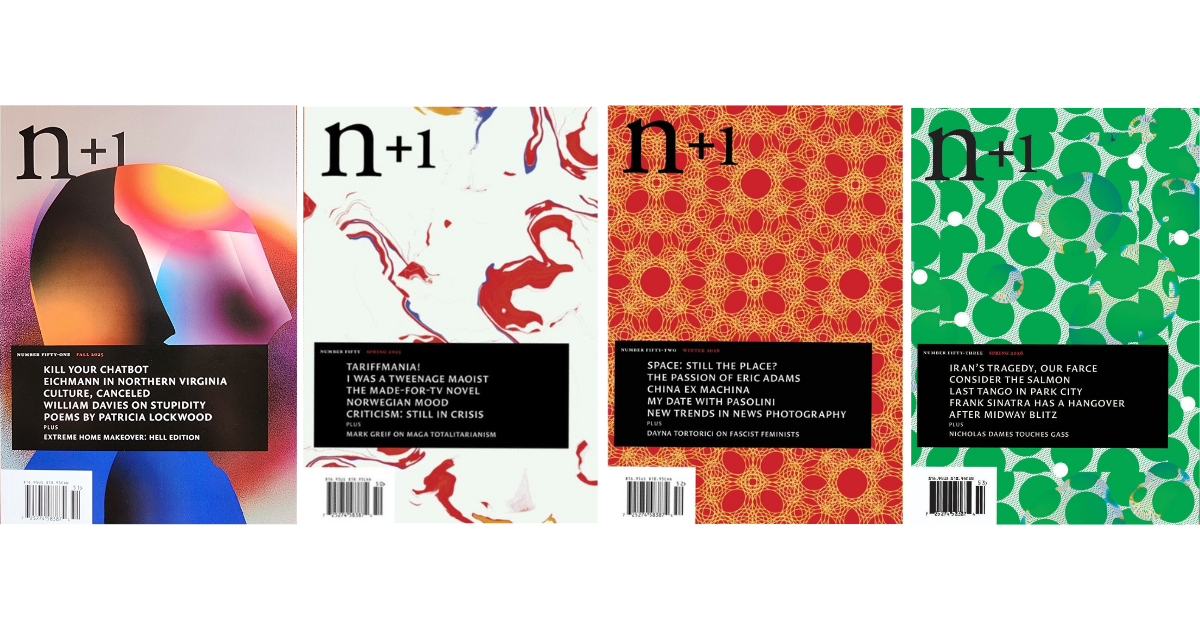
"The Drift is missing these bravura first-person essays that N+1 did really well"
So is n+1, I'm afraid. Personally I think most of their perceived decline is just the decline of this whole thing - it's not clear that there's such a thing as a star essayist who wasn't grandfathered in from an earlier era. I also think though that, as tiresome as people will find this, n+1 has been really badly hurt by their narrowing range of acceptable political views. My two favorite essays of theirs ever are Yang's "Face of Seung Hui Cho" and Eli S. Evans's "Don't Say No" - neither of which they would ever publish today.
Oh man, when I was in college (2012-2016) n+1 really made an impression on me and there was a set of essays I'd frequently re-read until just the last few years (at some point the shock wears off I guess). The Intellectual Situations "World Lite" and "Against the Rage Machine" were just exactly how I wanted to be able to write. I spent so many years following up on writers approvingly mentioned in "World Lite". Sarah Nicole Prickett was writing for them sometimes those days and her essays "The Ultimate Humiliation" and "The Stanford Letters" are still for my money the high point of the era's online feminist writing. (I don't get the sense she was launched by n+1, but wow. So great).
Jeanne-Marie Jackson's "The African Novel of Ideas" was honestly a bit hard to get through but she's the real deal, immersed in literary traditions in multiple languages, and I was glad they published her. Mara Smith on the 2016 primary is basically the only thing I've read about it that felt nontrivial. "The Tax Man" by Imraan Coorvadia about....corruption in South Africa, the ANC, and his family, is one of the best things I've ever read. I always really respected the sense that n+1 wanted to not be provincial, and wanted readers to know something meaningful about countries they probably didn't know much about. And the sense of humor! n+1 is *funny* - I loved "Editorial Debates" and "The Rest is Indeed Horseshit" series for reactions and behind the scenes.
There were definitely more inert pieces - I remember a long one on Tao Lin that only had one line I liked, Tortorici's piece on instagram I saw people recommending on twitter but I didn't get anything out of it, and a first person essay called Rhodocycles felt like a total waste of time. Much later when I had a stable address and salary I subscribed to the print edition; the main thing I remember from that was "Good Night, Boa Vista", an amazing first person essay about refugees, economic migrants, and the relationship between Venezuela and Brazil. Battistoni's first person piece about grad student unionizing is a bit overrated for me - too long, too meandering - but "Your job as an organizer was to find out what it was that people wanted to be different in their lives, and then to persuade people that it mattered whether they decided to do something about it. This is not the same thing as persuading people that the thing itself matters: they usually know it does. The task is to persuade people that they matter: they know they usually don’t." is....fantastic.
Tl;dr I started reading n+1 probably after the peak but while it was still an electrifying introduction to the contemporary writing world