
The Baffler
their specialty — this is actually a magazine — the early baffler — the source of their money
The Baffler is the prettiest magazine that I’ve reviewed so far. It is perfect-bound, 130ish pages in length, with matte covers, uncoated white paper and many full-color images (including some photographs) inside. It looks and feels like an issue of The New Yorker, but thicker.
The moment I opened the magazine, I thought…where does the money come from? When I wrote about this online, a few respondents said, “What do you mean, The Baffler is a popular magazine! They get their money from their subscribers.” But believe me, I’ve looked at enough of these magazines’ financial disclosure forms to realize none of them are fully supported by their subscribers. Almost always, there’s some grant money or some charitable donations. But even with that, most of these magazines look worse than The Baffler, which makes me think the latter must have A LOT of money.
Indeed, when I looked up their 990 forms on CauseIQ, I saw they had a $2.5m budget, more thn twice what N+1 has (The Baffler also publishes five times per year, in comparison to N+1’s three, but The Baffler has shorter issues so maybe that’s a wash).
Opening The Baffler put me in a good mood, just because it’s such a beautiful magazine. It’s got these great illustrations, the font choices are nice, and there’s good contrast between text and paper, so it’s easy to read. You’d be surprised how many of these magazines don’t have good contrast, so my old eyes have to squint to read them.
(For more on The Baffler’s excellent design, you can look them up at Pentagram, the studio that redesigned the journal in 2016. This studio is also responsible for the beautiful design update for The Yale Review in 2021.)

Their specialty is reported pieces
I was a little skeptical of the content, because The Baffler seems to contain a lot of reported essays, and with these small magazines I always wonder if they have the budget to really do a good reported feature.
But the pieces were great! My favorite was “Stop The Presses,” which is about a long-running newspaper strike. Basically there’s a family-run paper in Pittsburgh that is run by some extremely stubborn people, and for three years they’ve been refusing to come to a deal with the striking journalists. As Tadhg Larabee puts it:
The fact that the strikers are still standing is the product of a once-in-a-generation collision between an exceptionally dedicated union and an eccentric family unwilling to accept anything short of the union’s dissolution.
It was a fascinating look into the ways that pride and personal feelings become a factor during strike negotiations.
The Baffler’s reported stories were unusually nuanced. Because it’s a leftist magazine, I always thought I knew the angle, going in, but then I’d read the article and discover that it was relatively fair to all the sides. Like, in this instance, this is a family-run paper, owned by a family with deep roots in Pittsburgh—a family that cares about Pittsburgh. At the same time, this family is basically a bunch of local rich people, right? They are local gentry! And the reason that the Block family is fighting the union, even though it would cost them only about $66,000 a year to settle, is that they’re offended on a personal level that a union would try to interfere in their business.
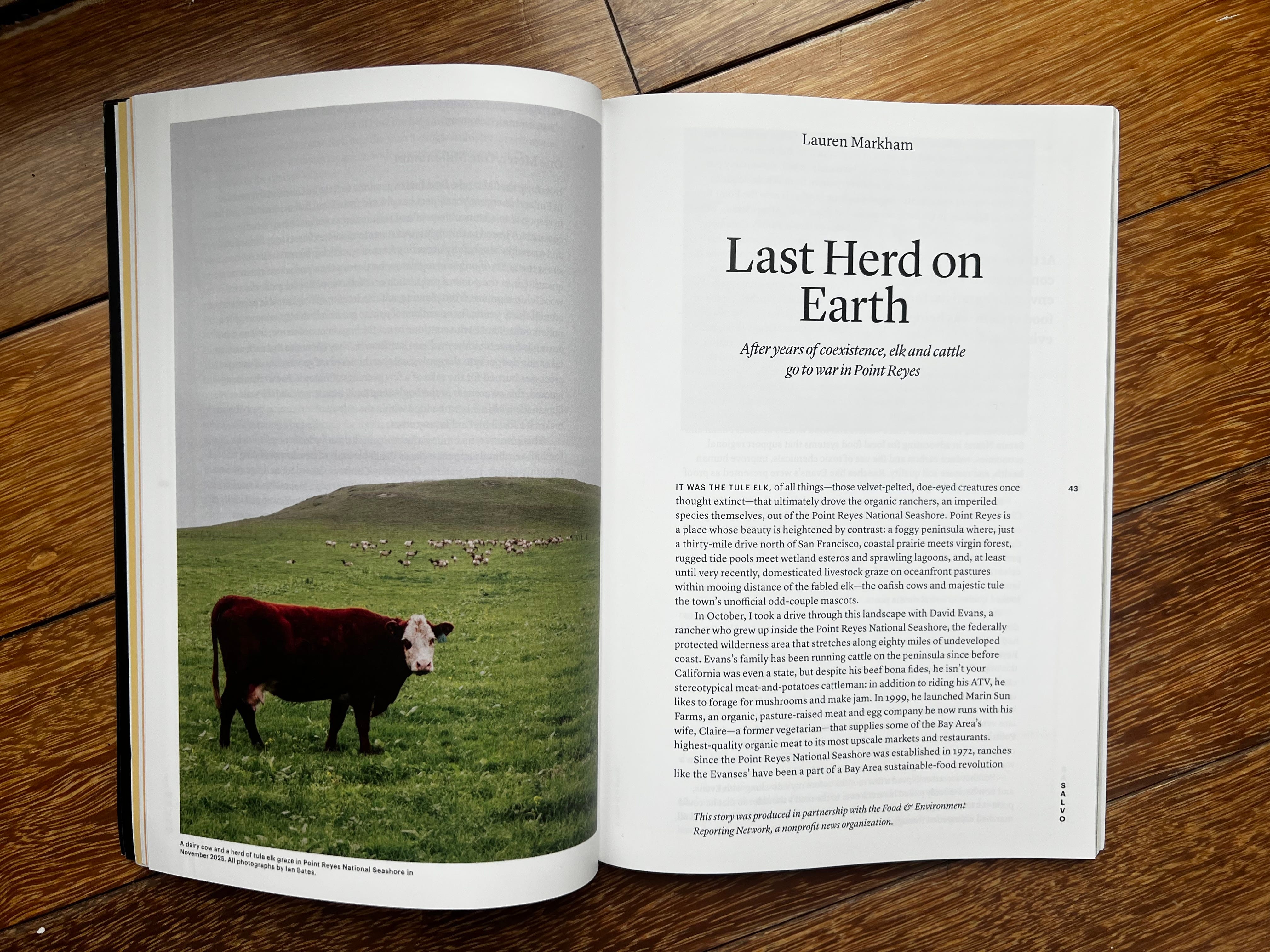
Similarly, there was a story in another issue (“Last Herd On Earth” by Lauren Markham) about how the National Parks Service kicked the cattle ranchers out of Point Reyes National Seashore, a federal park just north of me. Ostensibly, the ranchers were kicked out to make room for a herd of endangered Tule Elk, but when you read the story you see that things are complicated. It’s hard to say whether survival of these elk really depended on the departure of the ranchers. And it’s hard to know whether you ought to sympathize with the ranchers—who were paid $3m each by the government when it bought out their leases. The story is murky and complex, involving lots of different competing priorities.
I feel like The Baffler has a pretty good sense of when they’re able to do justice to a story, and they’re good at picking stories that other magazines might not be willing to attack at such length. I was impressed—they’re surely not paying writers more than 50 cents per word—but the results they’re getting are pretty good. Most of their best pieces, including the two I mentioned above, show evidence of original reporting: these writers didn’t just google and summarize other pieces, they went out and talked to people.

Other notable sections
Some issues have a forum, where a half-dozen writers attack the same topic. The best-received of their recent forums was the one about writers who have day jobs: The Profession That Does Not Exist. The best of the pieces in this forum was Phil Connors’ complaint that his editors expected him to prioritize writing over his day job (as a fire lookout), even though his day job was much more pleasant and the pay was a lot steadier.
Oh no, he said. You’re done being a fire lookout.
Excuse me? I said.
We’re paying you real money to be a writer, he said. We need you available for every marketing opportunity that comes along. What if CNN calls and wants a wildfire expert on short notice, and you’re out of pocket?
The fiction section was also quite good. I say this even though the stories tended towards the surreal and weren’t always to my taste. For instance there’s a very absurd story (“Interviews With Certain Vegetables” by Anelise Chen) about a woman who can talk to vegetables. I really didn’t get the story and didn’t enjoy it.
However, there was only one story per issue, and the stories were usually quite short, so I was always willing to give them a try—there wasn’t that same frustration I sometimes have with other journals, where they’re giving me four mediocre stories. Here I felt like the journal really stood behind each story and was making a good-faith attempt to sell me on its merits.
The one I liked best was “Detachment” by Lauren Rothery (about a pack of children who play at being wolves):
…when the children were asked rather innocently, “What is happening now in your game?” a child answered, coldly, “The alpha needs a new mate.” And when you pressed the child, when you said, perhaps, “Oh dear, what happened to his first mate? Is that his wife?” the child answered, suddenly energetic, “She died and only the alphas are allowed to breed because the gene pool must be kept pure and it is almost January and all the females will soon be in estrus.”

Criticism
The cultural coverage in The Baffler tends to have a showy quality. Every review feels like a display, like a statement. Sometimes this led to a certain tendentiousness: for instance, Gabriel Winslow-Yost’s piece on Disco Elysium (an incredible game) seemed to circle around and around the subject—including a long discussion of its politics and of a novel published by the game’s creator—without getting to the heart of what the game great.
But in other cases, I found the cultural coverage to be enlightening. I liked Nicolas Medina Mora’s piece about “The Nafta Novel,” Apparently there is a cohort of writers who were born in Mexico and write in Spanish, but who have immigrated to the U.S. and work at American universities. This is a phenomenon I was vaguely aware of, but it was interesting to learn more about it. Not having read any of the novels in question, I cannot say whether these novelists encode the logic of neoliberalism in their work, but it’s certainly plausible.
Adrian Nathan West is a frequent critic for The Baffler. As I mentioned in my Bernhard piece, I have a fondness for West’s takedowns. I am a takedown artist myself, so I admire others who are good at the game. What’s great about West’s work is that it is so sincere: he genuinely detests the work of the authors he takes down, and he has a strong desire to destroy their literary reputations. A takedown shouldn’t just be an exercise—it should be a crusade.
But in the issues that I read, he had a great non-takedown piece, “I Will Disrespect You”, about Philadelphia drill rap: a genre of music where you advertise the fact that you’re going to kill someone, or that you have indeed killed them. As West puts it, it’s not implausible that this musical genre has led to a number of murders:
I cannot prove that drill music incites violence in the same way that no one can prove anything, because causation is inductively observed and cannot be deductively verified; but if drill music celebrated real instances of child abuse or ethnic cleansing instead of the socially fraught issue of violence in poor communities, there would surely be less opposition to the notion that these people mean what they are saying.
Nate’s style is very maximalist. All his pieces have so many big words! Not all critics in The Baffler write the way he does, but it definitely feels like The Baffler would love if more of them did.

This is actually a magazine
The Baffler is different from the other magazines I’ve reviewed. Most of these ‘little’ magazines are primarily commentary—writers are giving their take. Sometimes that take is informed by a lot of expertise and research, but it often feels like a take. The Baffler, in contrast, feels more like magazine journalism. When you open this magazine, you can read the type of pieces that you might read in Harper’s or The Atlantic or The New Yorker.
Which does prompt the question: Why not just read Harper’s instead?
It is a valid point. If you subscribe to Harper’s, you get something essentially very similar to The Baffler (off-beat reported features), but where The Baffler only gets you 5 issues for $50, Harper’s will give you 12 issues for $25—an astonishing value.
If you’re an aspiring writer, the answer seems obvious: it’s probably a lot easier to write for The Baffler than it is for Harper’s. And, after reading four issues of The Baffler, I’ve gotten a pretty good idea for what kinds of pieces they like—they seem to have much clearer and more straightforward needs than most journals. If you are someone who is geographically adjacent to some under-reported story—something where you can go somewhere and take pictures and talk to people—then I think you have the beginnings of a good pitch for The Baffler. Anecdotally, they also just seem more open and less cliquey than some of the other little magazines—so aspiring writers should absolutely be reading this journal
However, I wonder whether the journal has anything to offer non-writers. This is honestly the case, for me, with many of these little magazines. Who are they for? Why do they exist?
With some journals, I get the strong sense that they’re filling some perceived void. For instance, Liberties is a journal very strongly dedicated to defending the Beltway political consensus and extolling 20th-century literature. That’s a combination that I can see many people wanting.
But with The Baffler, it feels like their commitment to nuance and good reporting gets in the way of their left-wing political commitments. When I read a Baffler article, I might learn a lot about this complex situation involving ranchers and preservationists, but is this really what little magazines are for? If what I wanted was high-minded fairness, I’d read The New Yorker. Whereas if I am reading an avowedly leftist magazine, then there’s a part of me that wants agitprop—a part that wants to be riled up—a part that wants to get angry at someone. And that’s a pleasure that The Baffler, to its credit, steadfastly refuses to indulge.
What I am realizing is that these little magazines tend to rise or fall on the basis of their ability to deliver red meat. Unless a magazine is capable of getting people angry, it’s hard for it to make an impact in this space.
But of course it’s bad to make people angry, so you need to veil that desire in various complex ways. As I learned from reading the early N+1, there’s a whole technique to getting people riled up while pretending you’re not trying to do that. But it’s only the rare magazine that can really master this style of polemical writing.

The early Baffler
The Baffler has a long history. It was founded in 1988 by Thomas Frank and Keith White, and it was initially headquartered in Chicago. Between 1988 and 2000, it put out thirteen issues. Then between 2000 and 2010, it put out only five. I didn’t go to the early issues in any systematic way, but when I glanced at them, my impression was that the magazine had a Gen-X vibe that was very much against corporate bullshit of all sorts.
Take, for instance, this piece from 1993 on musical acts signing with a major label (“The Problem With Music” by Steve Albini). The piece begins:
Whenever I talk to a band who are about to sign with a major label, I always end up thinking of them in a particular context. I imagine a trench, about four feet wide and five feet deep, maybe sixty yards long, filled with runny, decaying shit. I imagine these people, some of them good friends, some of them barely acquaintances, at one end of this trench. I also imagine a faceless industry lackey at the other end, holding a fountain pen and a contract waiting to be signed.
This is a lot more strident and exciting than anything I’ve read in the more recent Baffler. I imagine the situation is very similar to N+1, where you’ve got a scrappy upstart journal that made a splash during its heyday, and then it was taken over by other people, and now it’s settled into a respectable middle age.

The source of their money
But with N+1 there was a lot of continuity between the founding teams and the current management, and the hand-off was relatively slow. In The Baffler’s case, I think the transition was rockier. After publishing only intermittently in the 2000s, the magazine was relaunched in 2010 by Thomas Frank and moved to Cambridge, where it had a deal with MIT Press, who promised to provide $500k a year over five years (this deal wasn’t renewed and this MIT Press relationship no longer exists). Then, in 2011, the founding editor, Frank, left the magazine.
In 2015, The Baffler named Noah McCormack as its publisher. Noah’s father, Win, is an heir and has funded lots of literary projects: he owns The New Republic and used to own Tin House. Starting in 2015, Win became a major benefactor to The Baffler, a relationship that continues to this day—in 2024 he gave $1.3m to the magazine.1
Win McCormack has recently suffered some highly-publicized money troubles after his chauffeur stole $34 million from him—a reversal that may have been the impetus behind his sale of Tin House to Zando. However, his financial support for The Baffler is probably more robust, because the magazine is run by his son.

Verdict: Undecided
It is hard for me to criticize a magazine if the product is consistently good. In this case, the magazine is beautiful, and the articles are high quality. The criticism and fiction sections have a distinctive style.
On the nonfiction side, the reported pieces were the stand-outs, however even the pieces without original reporting tended to be well-written and informative. For instance, I enjoyed Jasper Craven’s article on Pete Hegseth’s vendetta against women serving in the military and Corey Pein’s piece on Saudi Arabia’s acquisition of EA games. I almost never got to the end of a piece and thought it was a waste of time.
The down side was that the nonfiction could feel generic—many pieces felt like they could’ve been equally at home in a different magazine. But they were usually important stories that were well-reported, so it’s hard to fault the magazine for not putting more of a distinctive spin on them.
I don’t know. I’m still not entirely certain what I think of The Baffler. The ambitions of the magazine seem quite limited. They want to do reported pieces, but they don’t necessarily have the ambition to expose wide-ranging injustices that nobody else is talking about. I never read a piece in The Baffler where I thought, “Oh my god! The world needed to know about this!” Instead, I always thought, “Hmm, that’s interesting.”
They do have some desire to cause a stir. In the issues I read, there was a polemic by the publisher, Noah McCormack, called “We Used To Read Things In This Country”. This piece framed ‘the literacy crisis’ as a class struggle. In McCormack’s telling, it’s the middle-class that prided itself on its literacy, and now literacy is decreasing because the upper-class has decided to make war on the middle class:
Of the American elite who see continuing value in literate thought, they are, for the most part, happy to create a society where a small “cognitive elite” dominate the rest. Poor kids spend an extra two hours on the black mirror every day, while rich people send their kids to private schools where no electronic devices are allowed
It was an interesting take! I wished there was more stuff like this in The Baffler, and that the journal had a better sense, more generally, of whom it was against.
But I don’t want to give the impression that I am taking down the magazine. They’re making precisely the magazine they want to make, and they’re doing an excellent job—who am I to say that their aims are overly modest? For my part, I am happy to be a subscriber and will continue to read them with interest.
This is the sixth in a series where I review contemporary intellectual journals. Here are links to previous pieces on N+1, Liberties, The Drift, The Hedgehog Review, and The Whitney Review of New Writing.

Help me understand!
After two months spent reading ‘the little magazines’, I still have some lingering questions about this intellectual scene. Namely: who are these journals for?
What I understand completely is that these magazines are a good credit for writers—they professionalize many writers, teach them how to pitch pieces and provide them with legible credits that’ll be impressive (perhaps) to agents, editors, and to bigger journals. From a writer’s perspective, it makes a lot of sense to pitch these journals.
But I keep being told that it’s not about careerism. In fact, many of these journals are adamantly against careerism. Supposedly you write for these journals not to benefit your career, you do it to reach a small-but-sophisticated audience.
In theory, I understand this, because I also write for a small-but-sophisticated audience. However, when it comes to these journals, it feels like there’s an incredible outlay of money (The Baffler has a two and a half million dollar budget!), but I almost never hear anyone talk about the pieces. This makes me wonder who’s actually reading and what they’re getting out of them.
So if you are a regular reader of one of the following journals, I’d love to get your thoughts:
N+1
The Drift
The Baffler
The Point
Liberties
The Yale Review
The Hedgehog Review
The Believer
If you’re interested in educating me, I made a Google Form. Thanks so much for your time! The survey will close on August 15th.
Credit goes to T. Benjamin White for helping me find this section of The Baffler’s financial disclosures.
The Baffler was the first magazine I ever subscribed to. When I graduated from college in 1999, it felt very "adult" to have a magazine subscription. It would come with my name on a sticker on the cover (or on the plastic wrapper), and that was pleasing to see when it finally arrived. It felt that *I* had arrived.
I chose The Baffler, I think, because I had recently read and liked Thomas Frank's One Market Under God, which was basically about neoliberalism. I remember The Baffler seeming a bit more left-wing and hip, but it wasn't "edgy," as the current tagline says, "A Journal that Blunts the Cutting Edge." I think they're referring to irony? Rather than cut you with a rapier wit, they were going to wink at you and see if you got it. At least, that's what I remember--it's all so very 90s, in the "culture jamming" pocket, but not as obvious as Adbusters. I mean, much more distant, detached. If 90s Baffler were a band, they would be Pavement or the Silver Jews.
I just looked at their covers from the period I received issues--from late 1999 (#13) to 2003 (#16). I remember them so very clearly, in part because I displayed them atop my coffee table during those years, and also because they used such distinct colors for the covers.
I never ended my subscription. I moved the subscription from Chicago to Oakland. And then, after receiving 3 or 4 issues in California, I never received another one, even though I had just extended my subscription for another couple of years. It was like they ghosted me. Later, I heard rumors of a fire that wiped out their office or warehouse in Hyde Park (Chicago)--and destroyed all the subscriber information. I'm not sure if this is true, but the internet tells me there was indeed a fire, and they didn't issue #17 until 2006.
I occasionally read pieces in The Baffler, but that's because I was looking for a particular author and I happened to find them there. Even though they're now based in New York, they seem to have retained a bit of their Midwestern quirkiness?
Once in a while, I think about contacting them and asking about the issues they owe me...
"I almost never got to the end of a piece and thought it was a waste of time."
I had to read this sentence twice to get that you meant the exact opposite of what you first appeared to say!