
He wanted more attention
Three months ago, I read Zoe Dubno’s Happiness and Love. And I really adored this novel, which is about a young woman, a writer, who goes to a dinner party full of trendy artists and scenesters. The woman sits in a corner, brooding to herself about how everyone at this party is a fake, until one of those fakes, an actress in a streaming show, gets angry at the others and calls them out for being pretentious. Somehow this rant emancipates our silent protagonist—she’s able to escape into the outdoors and release her anger.
This Dubno novel had many fascinating stylistic quirks. It was written in one long paragraph. It also had this weird habit of italicizing certain words or phrases, giving them a sort of hissing sound. And there’d often be a pattern of repetition, where the narration would circle around some motif for several pages, chewing on it, before moving on.
I was all set to write a great review of this recently-released novel by a talented young writer, but then I figured that I ought to read Thomas Bernhard’s Woodcutters (1984) since this book apparently inspired the Dubno book.
And that’s when I got a surprise, because this Austrian novel, Woodcutters, was remarkably similar to Dubno’s book. Look, I understand the concept of doing a remake or a retelling, but usually the remake is in a different style: Percival Everett’s James is a retelling of Huckleberry Finn, but it’s not written in the same voice as Huck Finn.
Dubno’s retelling was different. Its style was closer to the original than any retelling I’d ever seen.
Moreover, the story was very similar too. Virtually every character in Woodcutters had an analogue in Happiness and Love, and the latter book moved dutifully through the exact same story beats as Woodcutters.
It’s true that the Dubno novel had updated the action, so it took place in contemporary New York instead of 1980s Vienna. And a few of the themes were different. The narrator of Woodcutters excoriates his old friends for taking government money (i.e. selling out their youthful ideals), while in Happiness and Love the fakes get excoriated for making art that’s enabled by their nepotistic connections and inherited wealth.
But I wondered whether this level of close imitation was actually a good thing to do.

The Bernhard Cult
When I wrote online about the similarity of these two novels, someone said, “Oh yes, this is a thing! It’s very common for contemporary writers to copy Thomas Bernhard.”
And my respondents pointed me to several books by Geoff Dyer, Mark Haber, Sebastian Castillo, and Emily Hall, and to several articles that discussed this trend of Neo-Bernhardian imitations.
I was a bit astonished!
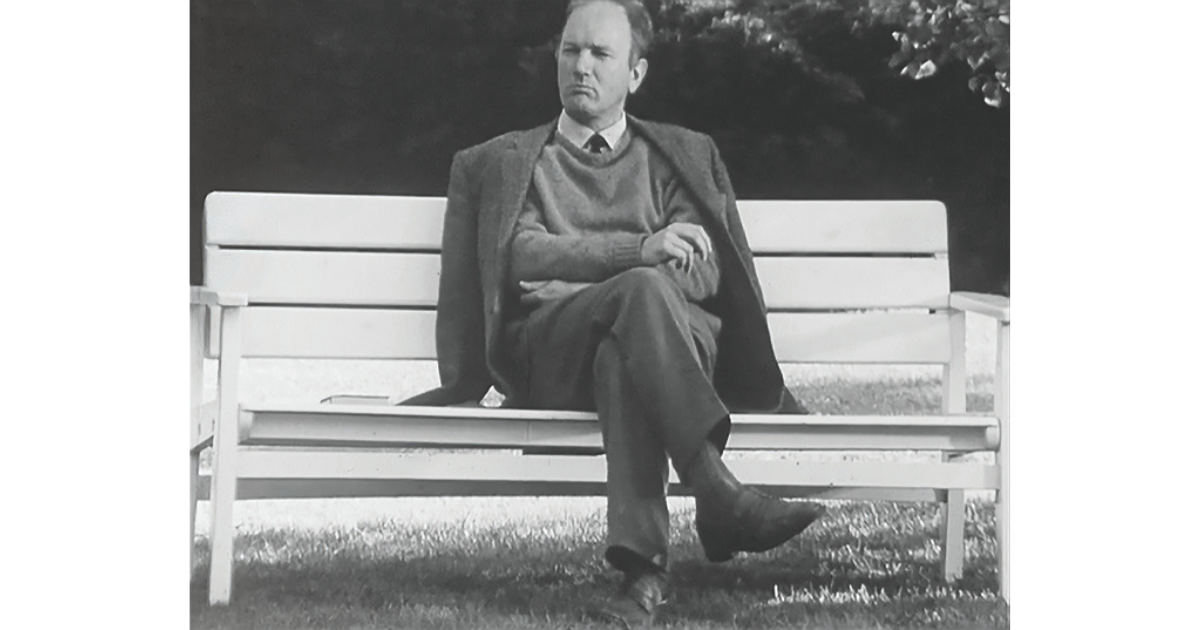
Thomas Bernhard writes in an extremely distinctive style. His most famous novels contain only a single paragraph, and the books are often composed of looping, vituperative rants where a thwarted artist castigates other people for their deficiencies.
Moreover, Thomas Bernhard is not that well-known. I read one of his novels fifteen years ago, The Loser, and it didn’t really make a strong impression on me. Certainly I had no idea that he was the central figure in such a strong literary cult. He’s a well-respected author, but, as Gideon Lewis-Krauss noted for N+1, German and Austrian people are often surprised by his reputation amongst a subset of the American literati.
Against ‘traditional realism’
When I looked deeper into the Neo-Bernhardians, I learned that these writers love to talk trash about contemporary American literary fiction.
For instance, Sebastian Castillo criticized literary fiction’s obsession with craft, with lyricism, and banal middle-class concerns (“It’s like this beautifully written story about a guy who’s divorced who goes on a cruise for a weekend”). He said when you read literature in translation, “there’s a lot more playfulness,”
Mark Haber said a “literary-type NYC novel” is unlikely to last ten years because “those books are only speaking to the author and their inner circle.” He also said: “this idea that a person who wants to be a writer [will] naturally attend grad school or an MFA program has always seemed sort of safe and sanitized to me, even self-defeating. Creating literature is not something that can be taught—I don’t believe that. It’s a fire.”
Here’s Mauro Javier Cardenas, another author who is stylistically indebted to Bernhard:
I’ve been mocking traditional realism for so long that it feels too easy to continue to put on that variety show. For instance: hey you’re replicating the same narrative conventions that companies have repurposed so you’ll purchase their cures for your corns. Or: so you wrote another poetic pantomime of your suffering, eh? Or: how come your style is tied to the tenure requirements of the University of Southern Corn? And so on.
Lee Klein imagines that Thomas Bernhard, if he posted on Twitter, would spend his time excoriating the pretensions of contemporary writers. Lee says Bernhard would call out the:
excrescence of a literary culture consisting of promotion and cronyism and tired bougie considerateness and/or mild condescension at most, all of which combines to smell like the sweat of something essentially human degraded thanks to overexposure to the scent of its own stink.
I could go on. There are so many quotes like this.
Given this iconoclastic rhetoric, it is quite fascinating that these authors have made a career (including, in Dubno’s case, what was probably a six-figure advance from Scribner, a large publisher) from imitating another writer’s style.
Diving into Bernhard
I decided to read all of Thomas Bernhard’s novels, so I could understand the hype. As a result, I read Frost, Gargoyles, The Lime Works, Correction, Yes, Concrete, Wittgenstein’s Nephew, The Loser, Woodcutters, Old Masters, and Extinction. I also read three of his plays, Minetti, Eve of Retirement and Heldenplatz, and his volume of memoirs, Gathering Evidence.
It was fascinating to see the evolution of his style over time. The first four novels (Frost, Gargoyles, The Lime Works, Correction) show a strong debt to Kafka’s The Castle. They take place in the countryside, and three of them feature protagonists haunted by decaying homes or castles. Frost (1963) is traditionally paragraphed, and I found it so dull that I won’t bother to describe it—this was, by far, the worst of his novels.
However, I really enjoyed Bernhard’s second novel, Gargoyles (1967), which was about a son accompanying his father, a doctor, on his rounds around the Austrian countryside. It’s full of grotesques, like a woman who is keeping her brother (a dwarf) in a cage in her house because she thinks he is violent. The ending of the book is a hundred-page single-paragraph monologue by a Prince who is wandering around a castle (we are told the Prince is insane, but he does not seem particularly insane to me) ranting about how his son will someday tear down this castle when he inherits it, and how maybe tearing down the castle is good, and it should happen.
The next two novels, The Lime Works (1970) and Correction (1975) are both told in walls of unparagraphed text. They’re both about men who are keeping women penned up in bizarre, Gothic constructions (in one case, a man has his wife trapped in a Lime Works that is painted all in black and, in another case, a man is building a giant Cone in the middle of the forest to trap his sister). And they both end in the deaths of those women.
In his third novel, The Lime Works, we see the signature Bernhard style come together. It has a few paragraph breaks at the beginning, but the bulk of the novel consists of a single 150-page paragraph. The novel is told at one remove from the action, by a narrator who is relating a story about another man. You are told, right at the beginning of the novel, exactly what happened—a local man, Konrad, murdered his wife. This man’s words, often reported third-hand through several intermediaries, are looping, obsessive and angry, and he dwells on certain italicized preoccupations:
....Konrad is supposed to have said, I serve no public function, I serve no function whatsoever, certainly not a public function, he even hated the word function, there was nothing he hated more bitterly than the word functionary, a word it nauseated him even to hear, because nowadays everybody was a functionary, all of them were functionaries now, they all functioned, there are no human beings left, Wieser, nothing but functionaries... (trans. Sophie Wilkins, 1973)
The novel has a loose structure. For its first third, it dwells on the physical layout of the titular Lime Works, where Konrad lives. Then it describes his work, his family life, his relationship with his wife—it’ll focus for a few pages on one part of his life, talking without a lot of specificity, but with a lot of energy and emotion, and then it’ll move on.
These early books are definitely accomplished: I am impressed that each book held my attention for its entire length. The one-paragraph style, with its unending block of text, is essential to the functioning of the book, because there’s no way to stop, no way to quit reading, no clear break between sections. It’s just one stream of experience, and the experience is so intense that you, as the reader, are pushed through the book until it’s over.
This one-paragraph technique, which Thalia Vacha called ‘the Extremely Long Paragraph’, is a core part of Bernhard’s style. All of his novels, from this point on, contain single paragraphs that often span more than a hundred pages. In some cases, entire novels consisted of just a single paragraph. Bernhard did not invent this technique, he probably drew it from the first section of Samuel Beckett’s Molloy (1951), but Bernhard was the first 20th-century writer to repeatedly employ the Extremely Long Paragraph technique.
However, despite their energy and readability, these early novels felt insubstantial. They were about such baroque, outrageous situations—these bizarre Gothic buildings and these madman protagonists—that it was hard to take them seriously.
And I have to think that the world generally agreed with me. Bernhard’s first novel, Frost, was his most conventional. This book sold the best and got the most attention; each subsequent novel sold correspondingly fewer copies. And Bernhard didn’t want that. He didn’t want to write these constrained one-paragraph novels that were gently ignored.
He wanted something more.
Bernhard explores realism
These first four novels came out from 1963 to 1975. After that year, Bernhard veered left into realism, when he began publishing his memoir, Gathering Evidence, which came out in five volumes between 1975 and 1982.
Bernhard’s grandfather, Johannes Freumblicher, was from a bourgeois family, but instead of making money, he devoted himself to writing novels and to socialist agitation. In 1904, the grandfather ran off with another man’s wife, and they had children out of wedlock. The grandfather’s wife and daughter went to work (as a midwife and a maid, respectively) to support Freumblicher’s artistic efforts. The daughter, Bernhard’s mother, was raped (many believe) by Bernhard’s father, a petty criminal, which led to Thomas Bernhard’s birth in 1931. Bernhard never met his father (the man died by suicide in 1940) and was never adopted by his stepfather, the man his mother married, who always referred to himself as merely Bernhard’s ‘guardian’.
Bernhard had difficulties in school. His memoirs recount his experience wetting the bed at a Nazi summer camp, and his later experiences at a Nazi boarding school. He left school at age fifteen (”one day...I decided not to go to the grammar school, but to the labor exchange instead”), an experience he describes as being extremely freeing.
However his apprenticeship at a grocery store was interrupted by a lung complaint, for which he spent three years in various sanitaria. At the end of this period, when he was 19, he met an older woman, Hedwig Stavianicek, thirty-four years his senior, who became his (probably non-sexual) companion and, to some extent, supported him financially. They were together until her death in 1984—it’s hard not to see her as the inspiration for the frail wife whose existence oppresses Konrad in The Lime Works.
After leaving the sanitarium, he studied acting and then worked for a few years as a reporter. His literary career began with the publication of his first novel in 1963, when Bernhard was thirty-two years old.
He starts acting out
As I said, his first novel, Frost, was fairly successful and was well-received.
But when this novel won the Austrian State Prize, in 1967, he delivered a very angry acceptance speech, the first in a series of awards-ceremony tirades against the literary world.
What is striking about these speeches (and a lot of Thomas Bernhard’s work) is that they’re very vacuous. As with all of Bernhard’s rants, there is what he says, and then why he says it. In this case, his actual speech is a vague diatribe (“We’re Austrian, we’re apathetic, our lives evince the base disinterest in life”).
But a decade later, he wrote that in reality he was upset because he’d won the so-called Small Prize (for an individual work) instead of the Big Prize (for lifetime achievement): He claimed when he spoke to people about the award, they “assumed I had naturally been awarded the Big Prize, and I had to explain the one in question was the Small Prize, which every scribbling asshole had won already.”
The same pettiness is on display in his much-repeated description of being awarded the Grillparzer Prize in 1972. On this occasion, he got angry because nobody greeted him when he showed up for the ceremony.
He related this incident later in Wittgenstein’s Nephew, an autobiographical work:
…I actually thought it likely that I would be received outside the building, as seemed appropriate, and with the appropriate respect. But there was no one there to receive me. I waited in the entrance hall for a good quarter of an hour with my friends, but no one recognized me, let alone received me, even though my friends and I spent the whole time looking around. No one took the slightest notice of us as hordes of people streamed in and took their seats in the crowded assembly room.
He goes on like this, perseverating on this incident for pages and pages. He feels like it’s somewhat empty to give someone a prize, when you don’t actually know what that person looks like.
An academy that gives me a prize and doesn’t know me from Adam…deserves to be treated with even greater contempt, I thought.
That makes sense, but it still seems very toxic to continually call out people whose only crime is giving you an award. The level of vitriol is deranged.
These hateful acceptance speeches really outraged the Austrian media, causing lots of tumult. In one case his threat to deliver an angry speech resulted in the outright cancellation of the awards ceremony—they quietly mailed him the prize check instead.
Bernhard learns how to really annoy people
In the 1970s, he discovered the theater. He began to write plays: nineteen of which would be staged over the next two decades.
And the controversy surrounding these plays was a major part of Bernhard’s public image. Nowadays, this controversy gets reduced to two plays, Eve of Retirement (1979) and Heldenplatz (1988). In both of these plays, characters state, outright, that most Austrians are still Nazis. As one crypto-Nazi puts it in the former play:
The majority thinks like us and must do so secretly
Even if they insist on the contrary
they still are National Socialists all of them (trans. Gitta Honegger)
The controversy here seems straightforward. But with Bernhard’s plays there’s always another layer—some shade of meaning that the audience would understand, but which is lost to us today. In this case, one character, a judge with a Nazi past, is based on a West German politician, Hans Karl Filbinger, who’d been a judge in the Nazi regime. And Filbinger responded to the provocation, saying the play’s producer, Claus Peymann, was a supporter of terrorism.
Most of Bernhard’s plays were not as direct in referencing the Nazi past, but he employed a variety of other subtle provocations that, honestly, are too complicated to explain right now. Some of them involved casting actors that had Nazi pasts and employing them in roles that subtly highlighted that past. Other provocations took advantage of the fact that many of these plays were staged in Stuttgart, which also had a prison that, at this point (in the mid-70s) was housing members of a notorious left-wing terrorist group, the Red Army Faction.
There were many levels on which Bernhard’s plays were divisive. Yes, some people were offended by his characters’ sentiments. But many people just...didn’t think the plays were very good. As Bernhard’s biographer, Gitta Honegger put it:
Producing his plays was always a risk. None of them was a popular success. Opinions remained deeply divided. If they were not crowd pleasers, Peymann’s productions nonetheless gained much attention, thanks to his exquisite directorial imagination and his knack for producing the cultural drama around the theatrical event.
Personally, I found his plays to be quite boring. Very stilted and lifeless. And from what I can tell they are rarely staged today. Honegger says they don’t translate well, and that they’re in a dialect only Austrians can appreciate (i.e. even Germans can’t really ‘get’ these plays), but the more likely explanation is that they weren’t really intended to entertain people, they were intended to provoke them and create a lot of free press.
Basically, Austrians are very proud of their theater scene. And they’re particularly proud of the Burgtheater, the venerable institution that staged many of these plays. So they were highly offended that the Burgtheater played host to so many of these horrible and (often subtly-offensive) plays.
As Honegger put it:
When people walk out of shows, it’s not a public relations disaster (theaters are generously subsidized [by the state] anyway). Their responses validate the play’s view of them. And the show goes on in one way or another.
Bernhard wanted attention
This seems like the most simple and obvious fact about Thomas Bernhard. This was a man who craved attention. That’s why he constantly did all these outrageous things designed to provoke people and make them angry: he wanted their attention.
Of course he also feared attention. He spent a lot of his time building and inhabiting a series of houses in the countryside. He was reluctant to give interviews. And, as I mentioned, he made a big show of not wanted these prizes (that he kept receiving anyway). He claimed to dislike all of that literary careerist apparatus (“If you accept a prize from someone then you are allowing them to piss on you”).
But that was basically the performance. Like, that’s how it worked. He did and wrote outrageous things in order to provoke comment, and then he claimed: Actually I don’t want this attention.
It is so wildly transparent. I am impressed that Austria put up with it.
But that was Bernhard’s genius. He understood that Austria had this guilt about the Nazi past. They had committed genocide. Vienna was full of folks who were living in other peoples’ apartments—the apartments of people who had died in concentration camps. This country was full of people who had cheered for Anschluss.
And he understood that these people wanted to be castigated for their past. But you had to do it in a careful way. What made him palatable was that he was not a leftist. He did not pair his critiques with any sort of actionable program. He did not critique Austrians because they were Nazis, instead he said that Austria was a horrible place, and the Nazi regime was just one manifestation of Austria’s badness. Because his critique was so all-encompassing, it felt curiously safe. If all Austrians were Nazis, then there was really no solution, because you can’t punish everyone.

The Established Outsider
Although Thomas Bernhard was controversial, the Austrian establishment saw a lot of value in publicly supporting him. As Dagmar Lorenz puts it, “[E]ven though frequently declared a nuisance, [Bernhard’s ouevre] could clearly serve an alibi function…Bernhard was proof that righteousness and soul-searching went on amongst Austrians.” Lorenz called Bernhard, “the Established Outsider” and noted that, despite his provocations, he never lost the patronage of the Burgtheater and “was one of the most prominent and successful authors of his generation.”
This becomes more understandable if you realize that Bernhard was not the only Austrian writer who critiqued the country’s past. There were other writers who made similar point, but they often made them in a much more far-reaching and politically-destabilizing way.
For instance, Elfriede Jelinek was an Austrian dramatist (and, later, Nobel Prize winner) who wrote a play called Burgtheater. This play also called out Austrians for being Nazis, but it called out a specific family of Austrians performers who had prospered under the Nazis and continued to be prominent after the war. Her play also led to controversy, and it led to her being labeled as a Nestbeschmutzerin, a defiler of the homeland (a similar term was also often applied to Thomas Bernhard).
But when her play premiered in Germany in 1985, it harmed her career in a material way. She said: “That was the beginning of my decline in Austria as an author.” Her play wasn’t staged in Austria until 2005.
Bernhard suffered no such consequences. Despite any amount of controversy, he continued to be staged at Austria’s Burgtheater. Why? I think it’s because Elfriede Jelinek had a vision of complicity that was personal: she felt there were specific people who had benefited from the Nazi regime and who ought to be punished (she was from a Jewish background, which added another uncomfortable layer to her critique). If you listened to Jelinek, then it meant some people might lose their jobs. Listening to Bernhard entailed no such suffering.
How he handled ‘Austria’s Nazi legacy’
When you read about Bernhard, you are likely to hear him discussed as a writer who called Austria to account for its Nazi past. For instance, Ruth Franklin wrote in The New Yorker that “he spent his career alternately mocking and mourning Austria’s Nazi legacy.”
But these statements are a bit confusing, because Bernhard is most famous (today) for his novels, and there is almost nothing about Nazis in any of these books aside from his final one, Extinction (even in this book, references to Nazism are much more glancing than its reviews would lead you to believe). His direct references to the Nazi regime, at least in the works I read, were in his memoirs and his plays—works that are rarely-praised and rarely-staged.
Nonetheless I believe that his success comes from his references to the Nazi regime. I believe that his literary reputation derives from the fact that he successfully called Austria to account for its complicity.
But think about what it means to say ‘Bernhard was known for calling out Austria’s Nazi past.’ It means this was a country that felt so guilty and ashamed that even some glancing references to Nazism, in some plays that nobody saw, were enough to drive an entire literary reputation!
Personally, I do not think Bernhard himself actually cared specifically about Nazism or the Holocaust. I think he was just a very angry man. He felt like there was something the world hadn’t given him. It’s right there in his tirade about that awards committee that hadn’t greeted him at the door. They hadn’t recognized him. He wanted something that nobody could give him. He wanted to have had a happier childhood. To have been less tormented at school. To have been less lonely. To have been recognized more for his talents.
But he couldn’t say that, because it would sound pathetic, so he concocted this performance designed to give him the kind of attention that he wanted.
The middle-period books don’t quite work
As Bernhard’s spiteful, embittered public performance grew larger and larger, his prose grew softer and softer. During his middle-period, which began with the publication of the first volume of his memoirs, in 1975, he began to root his work more firmly in the real world. In his memoirs, and in his middle-period novels Yes (1978) and The Cheap-Eaters (1980), he wrote about people and places that felt more real, as if they could actually exist.
These middle-period works tend to have less of that signature Bernhard perseverating style. Unlike his early-period books, these middle-period books have more images, more events, more descriptions, more narrative progression.
For instance, his memoir begin with his long solo bicycle ride, at age eight, to visit his aunt in a nearby town. They proceed through his experiences at school, at a Nazi summer camp, at a Nazi boarding school, and the horror of living in Salzburg during the Allied bombing in WWII. There’s a density of detail in these memoirs that seems a lot closer to what you’d expect from a work of realism.
However, as I read through his memoir, I got a little exhausted. When combined with the one-paragraph style, the relentless profusion of details and events was hard to take. What was nice about his early-period books was that they were so singular in their purpose: the narrator was angry and wanted you to feel angry. With the middle-period, there was a slackening of that anger, but it wasn’t necessarily replaced by story, just by passages like one from his memoir Gathering Evidence:
Sometimes she would sit by my bed reading a book while I read another. These were the most enjoyable of my mother’s visits. She told me about her childhood and youth, which had been no less difficult than mine, and she talked about her parents, my grandparents, telling me many things I did not know about... (trans. David McLintock)
It’s nice to see a Bernhard narrator who isn’t as venomous and resentful, but...it still doesn’t quite work somehow. The realistic passages feel too inert.
(On a sidenote, the best of these middle-period books is Wittgenstein’s Nephew [1982], a reminiscence about Bernhard’s friendship with Paul Wittgenstein, the philosopher’s nephew. Wittgenstein is charming, but criminally insane and a danger to society—he periodically threatens to kill or strangle his relatives. Nonetheless, Bernhard is touchingly fond of him, which comes through clearly in the book. I highly recommend this work.)
Forget about all those books
However, none of these preceding books or plays are a major part of Thomas Bernhard’s literary reputation today in the United States. He is not known for any of them. Instead, he’s known three novels—Concrete (1982), The Loser (1983), and Woodcutters (1984)—that seem to find a middle-ground between the absurdity of The Lime Works and the realism of Wittgenstein’s Nephew
The best of these novels, and certainly the one that got the most attention and sold the best during his life, was Woodcutters. In this book, the narrator sits at a corner during a dinner party, and he broods endlessly on how the other guests at this party are such huge posers and fakes.
It’s a scathing portrait of a group of formerly-radical artists who’ve risen into middle-age and become tools of the state. For instance, speaking about two attendees at the party, the un-named narrator says:
At an early stage...[they] applied themselves instead to the loathsome art of exploiting literature as a means of ingratiating themselves with the state; all three applied themselves with the same abhorrent zeal to the cultivation of various city councillors, ministers, and other officials concerned with cultural affairs, so that as far as I was concerned they suddenly died overnight in the early sixties of their innate feebleness of character and became precisely the kind of sickening, revolting figures they had always accused others of being and spoken of with such supreme contempt. (trans. David McLintock)
Bernhard’s lucky break was that one real-life composer, Gerhard Lampersberg, saw himself in the composer, Auersberer, who was the host of this dinner party. Lampersberg sued for libel, resulting in all of the copies of this book being taken off the shelf in Austria. As a result, people went over to neighboring Germany, where it was still available, to buy it and see what the fuss was about. Within six weeks, the book had sold 60,000 copies, more than doubling the sales of Bernhard’s previous best-seller (his long-ago first novel, Frost).
Woodcutters was the most astringent of Bernhard’s late-period novels—the one that feels most directly like an attack on contemporary society—but it’s actually a much lighter read than The Lime Works and Correction—the novels of his earlier period. Those earlier books were also about spiteful, embittered mediocrities, but the heroes of those novels had a kind of Gothic grandeur. They tormented their loved ones—Konrad actually murdered his wife, and the hero of Correction built a colossal Cone whose terrifying ambiance causes his sister to drop dead. These are very powerful men.
The narrators of his later novels aren’t like that. These characters are quite powerless. The hero of Woodcutters never speaks or acts. The hero of Concrete sputters impotently at his sister, who keeps interrupting him while he’s on the verge of beginning his masterwork, his long-awaited essay on a composer, Mendolssohn Bartholdy. As a result, these novels have a humorous quality that is not present to the same degree in Bernhard’s earlier work.
There’s also a hint of perspective. For instance, in Concrete, the narrator, Rudolph, gets so mad at his sister that he flounces off to Mallorca. While there, he recalls the time he met a German woman, Anna Härdtl, whose husband had died mysteriously (possibly from suicide). Remembering this woman’s plight, he’s awakened, briefly, from his self-absorption, and the novel closes on a softer note:
And instead of starting work on Mendelssohn, as I had been fully determined to do, having believed at half past three that I had in fact suddenly got the ideal conditions, all I could think of when I woke was Anna Härdtl (trans. David McLintock)
Woodcutters has a similar ending, where the narrator raises his head and awakes briefly from his reveries. The narrator hears a speech from an actor who’s in attendance at the party. This actor makes a philosophical point about fate (he essentially says he wishes that his fate was to be a woodcutter, left alone in the forest, but unfortunately his fate was to be an actor.) And the narrator is so struck by this statement that he’s filled with warmer feelings towards the party guests:
I hated them, yet found them somehow touching—I hated Vienna, yet found it somehow touching—I cursed these people, yet could not help loving them—I hated Vienna yet could not help loving it (trans. David McLintock)
The unbearable lightness of Thomas Bernhard
Because of these works, people often say there is a lightness and a joy in Bernhard (Mark Haber said, “There are dark ideas in Bernhard, but his writing is energetic and life-affirming. It comes from a place of deep affection”).
But at the same time Bernhard was writing and publishing these ‘life-affirming’ works, he was also staging these very provocative plays that subtly called out Austria for its Nazi past (in ways that infuriated the establishment). And he was giving these awards speeches that were so biting and caustic.
In his final years, he delivered two of his finest provocations. First, he was asked to write a play to commemorate the hundredth anniversary of the Burgtheater, and he delivered a work about a Jewish man in contemporary Austria, who unloads on the country, talking about how terrible it is (”a nation of 6.5 million idiots living in a country that is rotting away, falling apart, run by the political parties in an unholy alliance with the Catholic Church”).
Even before this play, Heldenplatz, was staged, it became very controversial. There were protests, and many called for the show to be canceled. The provocation was perfect, because the characters are Jewish, so what are you going to do? Are you really going to ban them from the stage? (The remaining Jewish community of Austria was apparently somewhat offended by the play, because the last thing they wanted was to be portrayed as essentially anti-Austrian).
Bernhard was supposedly hurt by this reaction, which is perhaps one reason that when he died, a year later, his will said that none of his plays could be staged and none of his books republished in Austria for the duration of the copyright:
I emphasize expressly that I do not want to have anything to do with the Austrian state and that I reject in perpetuity not only all interference but any overtures in this regard by this Austrian state concerning my person or my work. After my death, not a word shall be published from my papers, wherever such may exist, including letters and scraps of paper (trans. Gita Honegger).
Another incredible provocation! When he wrote this, Bernhard was already dying, so he knew this intention would be carried out shortly. This is so insane! I have never heard of another author doing something like this. Most authors are terrified that their published work will be forgotten: Bernhard did something that, theoretically, would ensure that his work would be forgotten.
In reality, Austria is neighbored by Germany, a much larger country where people speak the same language, and in this much-larger country, his books would still be available and his plays still staged (by some accounts, Bernhard was more popular in Germany than Austria). But still...it is a pretty outrageous thing to do, to snub your home country. This guy (who was obsessed with wills—they feature in many of his stories) must have loved composing this document. It is such an amazing move.
This deathbed snub is a testament to the fact that Thomas Bernhard wasn’t motivated by a desire for anything that anyone could actually give him. He was just angry. He was furious. He wanted to get back at the world. And he realized that the largest group of people that he could effectively bedevil was his home country, Austria, so he set forth to infuriate as large a percentage of its inhabitants as he possibly could.
I have joined the cult of Bernhard
What a genius! It is truly awe-inspiring. I mean that sincerely. I have learned so much from this engagement with Bernhard’s life and his work. What was most fascinating was seeing how his purposes were most effectively served through very subtle provocations. Like, that book, Gargoyles, which had the sister keeping her brother in a cage—nobody was offended by that. Nobody was offended by the husband murdering his wife in The Lime Works. These early works often feature broadsides against Austria (for instance, in The Lime Works, a character says “here in Austria...every genius has frittered himself away, everything extraordinary has ended in self-destruction.”) But nobody got upset by these sentiments, because the novels were so Gothic and unrealistic that you couldn’t take them seriously.
He learned, over time, to increase the sting. In his memoirs, he started mentioning Nazi stuff. In his plays, he threw in some Nazi stuff too. But he also tried many other provocations. He hit at socialists, at Catholics, at museums, at art critics, even at fire marshals. He learned what got a rise out of people. And he learned that you couldn’t go too far, get too specific, get too political, and yoke your complaints to any actionable policy, or people would stop listening.
Instead, his gripes were so nonspecific. He just wanted people to feel bad and to suffer. And people read his books precisely because these people agreed that they should suffer, because of the horrible crimes their country had committed—crimes he only infrequently alluded to. If he had done more, they would’ve suffered too much, and they would’ve stopped listening, the way they stopped listening to Jelinek. But he did just enough.
And it was such a multi-pronged attack too. He published these novels that were outwardly fairly light—didn’t mention Nazism at all—but in his plays he did a little bit more, and the plays really attached an emotional charge both to his name and to his novels.
Not really novels of the first-rank
Thomas Bernhard is a writer who’s had a far-ranging impact on European literature, and he will always be important because of that impact. But even his best novels feel somewhat slight. There is a singularity of purpose to his books—they’re so relentlessly driven by anger and pique—that although I read them and enjoyed them, I was often left wondering, “Is this it?”
Woodcutters is a perfect example. I do not understand what made the people at the dinner party so bad. I understand that the narrator thought they were bad, and that they were sell-outs for taking government money. But this didn’t feel like the true source of the narrator’s anger. Instead, the narrator’s complaint felt somewhat personal—the narrator had fallen out with them some time ago, in his twenties (just as Bernhard fell out in real-life with Lampersberg, the guy who sued him), and this personal vendetta is the true fuel for the rant.
So I was left observing the character’s anger, without really sharing it—something of a perplexing experience. But I am wise enough to know that if Bernhard’s narrator had stated, outright, that he hated these people because of some sexual imbroglio (Honegger says that in the 1950s both Lampersberg and his wife were in love with Thomas Bernhard) then it would’ve lessened the impact of the book and made it easier to dismiss.
Honestly, I think Bernhard learned something from publishing his memoirs. I think he hoped his memoirs would make a huge splash, but he discovered that people tended to ignore these books, because his difficult, painful childhood made his anger seem too explicable, too easy to dismiss—oh yes, this guy was a failure in school so obviously he hates school.
What makes his later novels work, to the extent they do, is that they never bother to explain why the narrator is so angry.
Bernhard’s whole life was a testament to precisely the kind of ambivalent anger that he documented in his books. He really wanted the attention and respect of these cultured Austrian people, but then no amount of respect they gave him was ever enough. It’s not enough to get the award, now it’s also insulting that they didn’t stand up and say hello when you walked in the door. There was always some obscure way that they were doing exactly the wrong thing. Because...he really had an absence in him, some lack, that could never be filled.
But he turned that absence into art. He turned it into boring plays that I don’t recommend reading. He turned it into excellent, if somewhat-light, novels that I do recommend. He turned it into a very touching reminiscence, Wittgenstein’s Nephew, that surely nobody would read if he wasn’t famous for his other work. Mostly, though, he turned his inner emptiness into an incredible life that I feel highly amused by and that I really, really appreciate. Thank you, Thomas Bernhard, for all you did. Especially for your will, which is incredible (his heirs broke it ten years after he died, and now his plays can be staged again in Austria, though surely nobody actually wants to.)

2. The Neo-Bernhardians
Okay, but what about Zoe Dubno. What about Happiness and Love?
Now that I have read Woodcutters and spent three months learning all about Thomas Bernhard, I have to say that on a purely experiential level, I enjoyed Happiness and Love much more than I enjoyed Woodcutters.
That’s because Dubno has more awareness of traditional embodied storytelling. She cares more about describing things, and she places her characters in a web of signifiers: you know what things look like, how people live, how they’re sitting—all kinds of specifics that Bernhard isn’t particularly interested in, at least in his late-period novels.
For instance, compare the openings of the two novels. Dubno begins:
While everyone was waiting for the actress to arrive from her premiere, I sat in the corner seat of the white linen sofa at Eugene’s with my legs crossed, watching the rest of the party and regretting my decision to attend.
White Bernhard begins:
While everyone was waiting for the actor, who had promised to join the dinner party in the Gentzgasse after the premiere of The Wild Duck, I observed the Auersbergers carefully from the same wing chair I had sat in nearly every day during the fifties, reflecting that it had been a grave mistake to accept their invitation.
Dubno has done an MFA. She’s been schooled in how to write domestic literary fiction, and she’s gonna give you a few visual details. The narrator is on the corner seat. The sofa is white linen. Her legs are crossed.
It sounds small, but every sentence has a few visual gestures like this, and it really adds up, creating a world that’s much easier to visualize and understand.
Moreover, I understand the relationships much better in Happiness and Love. The dinner party in Dubno’s novel is hosted by two artists who are very rich. There’s a photographer, Eugene, who’s the ‘talent’, and his wife, who inherited some money, and is known as a collector. They’re very empty and have no true taste, but they use money in various complex ways to create the appearance of being talented.
However, even with all their money, they’re still somewhat on the outside, which is why they’re waiting all night for this C-list Netflix actress to come over (she’s the one who delivers the final call-out, in this version of the book).
This was much more comprehensible to me than the relationships in Woodcutters. That’s probably, in part, because I just don’t understand 1980s Vienna as well as I understand downtown New York in 2025. But still...it doesn’t change the fact that I found Happiness and Love to be easier and more enjoyable to read.
However, in praising this book, it is hard to ignore that ninety percent of its value belongs to Bernhard. The degree of similarity is very striking. There is a one-to-one concordance between the characters. For instance, the odious ex-boyfriend Alex in Dubno’s novel is the equivalent of Jeannie Billroth in Bernhard’s novel.
The two books also move through the same story beats in roughly the same order. The novel is also written in a very distinctive voice, full of italicized words and hissing repetitions, that is just like how Bernhard wrote Woodcutters.
It does feel like stealing.
Not in a legally actionable way: I assume it’s not legally actionable plagiarism. But still...it’s really close.
And the degree of resemblance makes Dubno’s book very hard to praise.
You know, I thought that I wasn’t hung up on the concept of originality. I don’t care about who did something first. That doesn’t matter to me at all. I think it took a lot of talent to create such an impressive transposition of Woodcutters to America. It really captures what made the original great, without losing much. Yes, there are minor differences in worldview between the two books—ultimately, because of the way the climax is handled a little differently, Dubno’s book feels less fatalistic than Bernhard’s, much more accepting of the idea that there is honor in making art, even mediocre art, that people actually enjoy. But I personally enjoyed this change.
Still...the book is very hard to praise.
I was all set to write a post, three months ago, saying Dubno’s book was incredible. And then when I read Woodcutters, I really felt disillusioned. I felt lied-to. And it didn’t feel good. I just think if I’d written that post, where I praised Dubno’s novel without reservations, and then later read Woodcutters, I would’ve felt like...like I don’t know...I would’ve felt like such a fool.
What’s funny is that last year, the same year Dubno’s book came out, there was a breakout novel, Vincenzo Latronico’s Perfection, which is also an uncanny imitation of a mid-century European novel, Georges Perec’s Things. Latronico’s novel is a very close imitation, in just the same way as Dubno’s novel is a close imitation of Woodcutters. One reviewer, Adrian Nathan West, commented on this, and he tried to excuse it. He liked Latronico’s novel, but didn’t like Dubno’s, and he spun a lot of verbiage about why Latronico’s remake was homage, while Dubno’s was empty imitation. This engendered a brief controversy (as documented by Jasmine Vojdani for Book Gossip), because the review felt sexist: why is he excusing in a man what he’ll criticize in a woman.
But West was right. It does feel different, and I think it’s because...Perec’s Things is not a well-known book in America. I had heard of the author before, but I had never heard of that book. Woodcutters is different. It is Bernhard’s most famous book. It is a well-known book in America. I had definitely already heard of it, even if I hadn’t read it.
If I am at a party, telling everyone about this great novel I just read, the likelihood that they will say, “Oh but isn’t that just an imitation of Things” is basically zero. But the likelihood they will say “Oh that’s just an imitation of Woodcutters” is not zero. Plenty of people have read Woodcutters. Not many, but enough people that if you’re going to rip off this book, you need to try harder to make it transformative.
I can’t explain why that is, but there is definitely a threshold, and Woodcutters is beyond it. Like, in the critical economy, as it exists in America, I think critics are going to be reluctant to praise a book when it’s such a close imitation of a relatively well-known book.
And that’s why this book hasn’t really broken out the way its author surely hoped. It got a big advance and there was a lot of press for the book. But success didn’t quite arrive for this book. Some of that is bad luck—most books don’t arrive. But in this case, the book deserved to fail. It is just not good to trick people.
This is not Dubno’s fault: if I was in my twenties and just learning to write a novel, I could imagine trying to imitate a book that I loved. And if you can get the imitation published, then great, good for you.
But...something about this book just doesn’t feel good. Like, it feels cynical. As if the publishers thought: somehow critics aren’t going to know, aren’t going to check. They thought we were just going to praise this book without reading the original, when the original is a well-known book that we’ve all heard about. It shows a lack of respect for us, for the type of reader that you need to convince if you’re going to make this sort of book into a big release.
Dubno is very talented, and it’s genuinely an impressive feat to retain the angry feeling of Woodcutters but situate those feelings in something that more closely resembles a domestic realist novel. I do think if Dubno continues in this vein and produces a book that feels more distinct, more fictionalized, then she could someday be the best of the Bernhardians. But this book isn’t it.
What it comes down to is that, yes, Americans might enjoy reading Happiness and Love more than they would enjoy Woodcutters, but if you read Woodcutters, then you’re reading a famous book, which has inspired many people, and which is connected to a man who had a really fascinating, weird life (and left a crazy will). If people want some version of this ‘angry person at a party full of posers’ experience, then they should probably just go ahead and read Woodcutters. And then, having read Woodcutters, if people want to experience the same thing again, but slightly better, they can choose to read Happiness and Love.

The literary movement with no name
But what about the milieu that gave rise to Zoe Dubno. After all, she is simply the most noteworthy manifestation of this recent plague of people producing imitations of Thomas Bernhard’s novels! What is going on there?
Well, the answer is that for the last fifty years there has existed a certain literary phenomenon in America. And this phenomenon doesn’t really have a name. Federico Perelmutter called it ‘brodernism’ in an essay last year for LARB, but the word is so pejorative that even though it’s a really useful term, I hesitate to use it for this piece.
The other potential term for this phenomenon is ‘world literature’. Basically, after World War II, America (and the English language) became the critical hub in the flow of literature around the world. If a non-Anglophone writer is going to achieve a world reputation, then usually what needs to happen is that they get translated into English and find an American publisher. This signals to the rest of the world that they’ve hit it big, and that there’s money in Italo Calvino or Yasunari Kawabata or whoever we’re thinking of. Then this author get translated into lots of other languages and proliferates across the globe.
Fifteen years ago, the editors of N+1 noted that contemporary ‘world literature’ has a certain shared sensibility. They wrote:
Much of the postwar European fiction, some of it very good, that we might read as World Literature — Perec, Bernhard, Nádas, Nooteboom, Jelinek, Marías, Sebald, now Knausgård — is extremely psychological in character and only vestigially social and geographical. Typically the narrator is a monologist, resembling the author, who tells of personal turmoil amid social stasis. He recognizes himself, with snobbish self-approbation, as a part of a stable polyglot pan-European elite; most other inhabitants of his country, as of the neighboring ones, are unthreatening idiots who turn on the TV after returning from work.
The editors of N+1 felt there was something sad about world literature’s pretensions. That it was just a recycling of the same gestures, but clothed in different cultures and languages.
Federico Perelmutter went even further. He said that the market for world literature was grounded by the figure of the ‘brodernist’: his name for a certain sort of American reader who didn’t actually care about what was unique or distinctive in various international literatures. Instead, they only cared about the appearance of difficulty, which they equated with ‘foreignness’.
....brodernist criticism interprets foreignness itself as “difficult.” The brodernist measures of “challenging” literature are a constrained series of attributes: winding sentences, explicit references to entropy and math and classical music, metanarration, anti-realism, lonely and existential male protagonists, brick-length tomes, cringey and misogynistic sex scenes, the stench of once having read Nietzsche, the words “psychedelic” and “oneiric,” half-hearted genre-play. Kafka, poor guy, gets thrown around a lot. The problem, to be clear, is not these traits—honest-to-God masterpieces compose much of the brodernist corpus—but their reduction into a series of attributes to be repeated as kitsch. Not the literature of exhaustion but an exhausting, at times exhausted, literature. A zombie avant-garde.
I do think we can see from the quotes I gave at the beginning of this piece—where various Neo-Bernhardians explicitly situated Bernhard against ‘traditional realism’ or ‘MFA fiction’—that there is an element of truth to Perelmutter’s critique. In America, there is an audience of readers that is hungry for an alternative to the prevailing literary culture in this country. And they tend to go looking for that alternative in a certain type of literature that’s largely been exported here from Europe.
Both Perelmutter and N+1 say that brodernism collapses or ignores the true cultural context that drove the reputations of many of these authors. In the case of Bernhard, this feels true. I believe his initial success was driven by shades of meaning that were very specific to Austria and Germany, and that we lose a lot of these shades of meaning when we read him in English translation.
Perelmutter would say that much of what people see in Bernhard—the overt difficulty and iconoclasm—is an illusion. And I would agree, to some extent. People in America read Bernhard and take him on face value when he says that he doesn’t want prizes, doesn’t want attention, doesn’t care about institutions or literary fame. But people in Austria understood that this was not totally correct. He was a writer who took plenty of money from institutions (right up until his death, his plays continued to be staged by Austria’s state-funded Burgtheater). He was not a writer with strong principles: he was someone who wanted to provoke people, wanted attention—Austrians tended to understand this, and it’s one reason he was so divisive.
So I do think there’s a degree to which contemporary Neo-Bernhardians are failing to understand a core part of Thomas Bernhard’s context, and I think it’s not unfair to say they’re attracted to Bernhard for fundamentally mistaken reasons.
What do I mean by ‘Neo-Bernhardians’?
It’s difficult to define the boundaries of this ‘Neo-Bernhardian’ group, because the influence of Bernhard has been incredibly far-reaching in ways that are often unacknowledged by the Neo-Bernhardian community.
For instance, Neo-Bernhardians almost never talk about Garth Greenwell. This contemporary novelist is quite avowedly influenced by Bernhard, and he writes in a style (including extremely long paragraphs) very reminiscent of Bernhard, but nobody ever mentions Greenwell when talking about Bernhard’s influence.
Bernhard was also a big influence on W.G. Sebald, who is an era-defining writer that has shaped the last fifteen years of American literature, and even besides that, Bernhard has influenced other writers in a number of ways. His book Wittgenstein’s Nephew was an influence on Ben Lerner, who writes his autofiction in a very similar register, with a similar level of pathos and a similar shaggy feeling, as if this story is a real story. And Bernhard had a collection, The Voice Imitator—I haven’t even talked about these very short stories, which are so excellent—that has had a long and far-ranging influence of its own, most notably on the fiction of Lydia Davis.
Some of the reason why Greenwell isn’t considered a Bernhardian (by this neo-Bernhardian crew) is that he’s too successful. He’s published by FSG (a big press), and he teaches at the Iowa Writer’s Workshop, and he publishes essays in The New Yorker, and he is generally considered a big talent. So there’s a kind of discomfort, because this group of people really defines themselves by being against careerism and against the MFA and against the literary establishment, but actually Greenwell has proven that these influences are very easily assimilable to the establishment.
However I think mostly the reason Greenwell isn’t considered a Bernhardian (by this group) is that he’s too sincere. He doesn’t have that spleen, that rage, that they most value in Bernhard.
And that anger, that anti-establishment vibe, is really what mostly seems to unite the neo-Bernhardians. So when I write about the neo-Bernhardians I really mean ‘writers whose anti-institutional stance seems inspired by the work of Thomas Bernhard.’
What did the Neo-Bernhardians actually write?
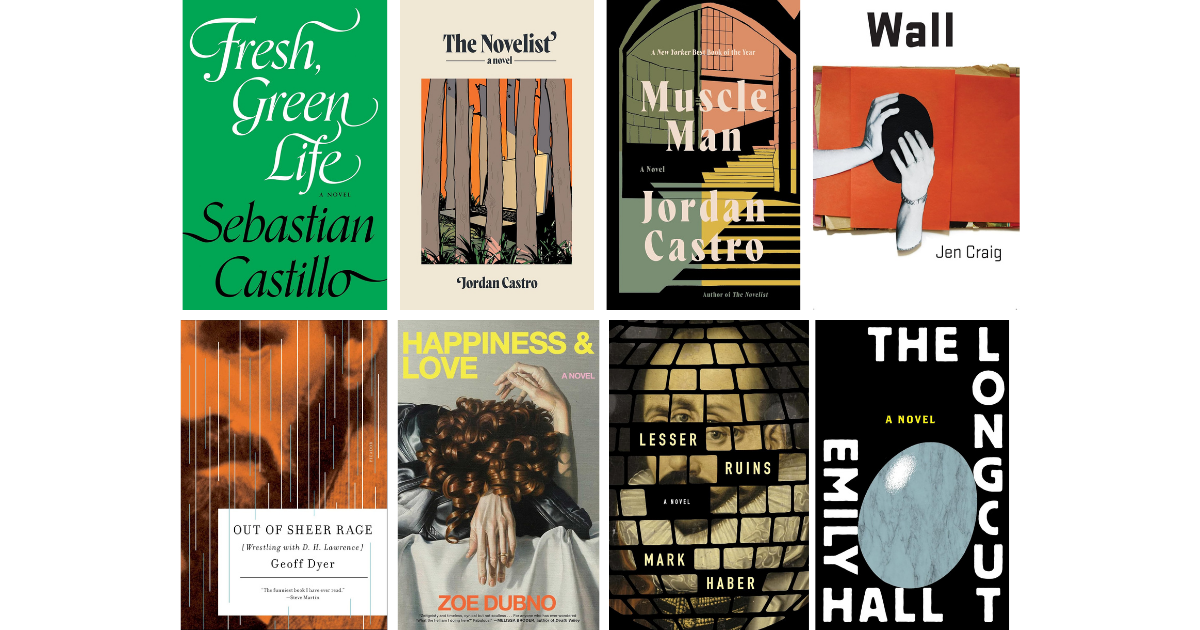
For this post, I read nine Neo-Bernhardian books:
Sebastian Castillo, Fresh Green Life (2025)
Jordan Castro, The Novelist (2022) and Muscle Man (2025)
Jen Craig, The Wall (2023)
Zoe Dubno, Happiness and Love (2025)
Geoff Dyer, Out of Sheer Rage (1997)
Mark Haber, St. Sebastian’s Abyss (2022) and Lesser Ruins (2024)
Emily Hall, The Longcut (2022)
There is a certain ecosystem that publishes and praises books like this. Castillo and Castro are published by Soft Skull, a small press (owned by heiress Elizabeth Koch). Haber and Hall are published by Coffee House and by Dalkey Archive—nonprofit presses. Both Coffee House and Dalkey are well known for publishing difficult, avant-garde writers like Karen Tei Yamashita and William Gaddis (respectively). Soft Skull is a bit more commercial, but they still publish books that are intended for a small, cult audience.
And these books tend to get reviewed by a small set of magazines and websites that see themselves as only covering the best and most interesting books: Brooklyn Rail, The Chicago Review of Books, The Cleveland Review of Books, Bomb Magazine.
Neo-Bernhardians love this one novel
In reading these books, I was fascinated to find that four of them are heavily inspired by the same Bernhard novel, Concrete. This is his 1982 novel about a guy who has spent many years preparing to write an essay about a composer, Mendolssohn Bartholdy, but hasn’t yet written the first sentence. Bernhard’s novel begins:
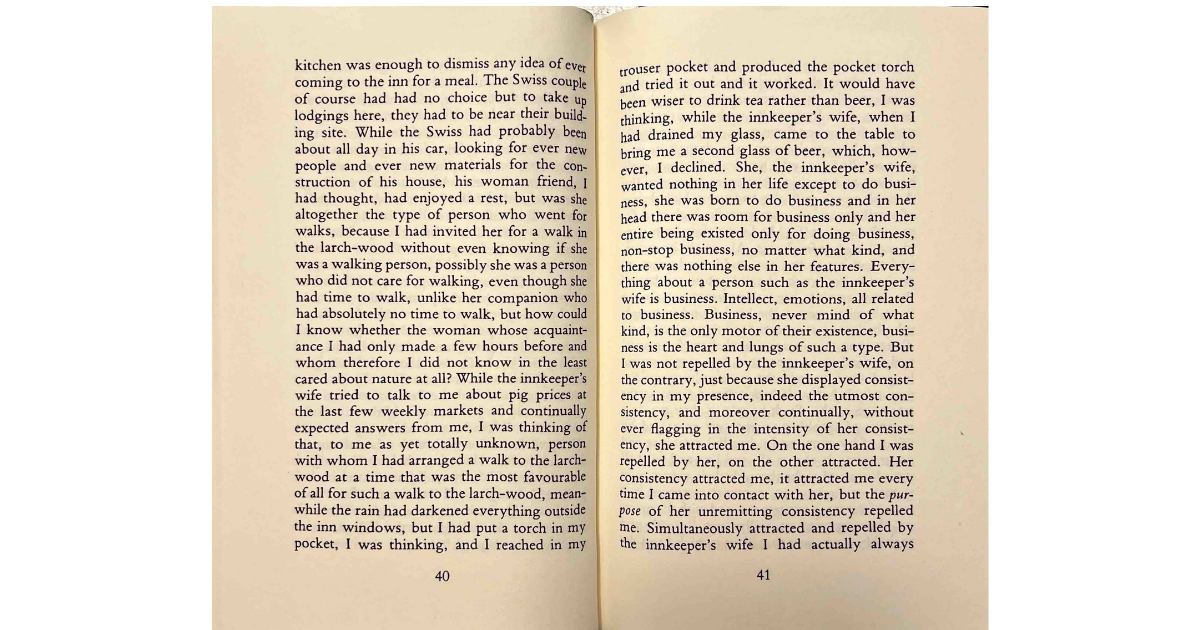
From March to December, writes Rudolf…I assembled every possible book and article written by or about Mendelssohn Bartholdy…It had been my intention to devote the most careful study to all these books and articles and only then, having studied them with all the thoroughness the subject deserved, to begin.
Now here are four other books that contain opening lines that are, to varying degrees, an explicit throwback to Concrete.
“Looking back it seems, on the one hand, hard to believe that I could have wasted so much time, could have exhausted myself so utterly, wondering when I was going to begin my study of D. H. Lawrence...”
— Geoff Dyer, Out of Sheer Rage
“I was always asking myself what my work was, I thought as I walked to the gallery. As an artist I knew I should know what my work was...”
— Emily Hall, The Longcut
“Anyway, I think, she’s dead, and though I loved her, I now have both the time and freedom to write my essay on Montaigne, an essay requiring not only extraordinary focus and intellect but also time and freedom...”
— Mark Haber, Lesser Ruins
“Nothing at all between me and this Wall I’d been planning to construct for well over a decade now...”
— Jen Craig, Wall
(A fifth neo-Bernhardian book, Castro’s The Novelist, is also about a writer who is failing to make progress on his novel but Castro claims he hadn’t read Concrete when he began.)
These books differ in various ways. Geoff Dyer’s book is the most traditional, it’s told in conventional paragraphing, without much Bernhardian repetition. Jen Craig and Emily Hall’s books have very long paragraphs and are repetitive and deeply-interior, but aren’t single-paragraph books. Only Mark Haber’s novel is a one-paragraph novel.
Out of these, I’d say Haber’s Lesser Ruins held my attention the best, because it’s both the funniest and the warmest. It’s about an essentially-comic situation (writer’s block), and Haber doesn’t expect us to feel any sympathy for his narrator’s ineptitude. He’s also upfront about the fact that more is going on here: the narrator’s wife has recently died, after a long illness, and he’s got strained relations with his son. His son, even more comically, can only talk about electronic dance music. The son appears periodically to deliver long, hilarious voicemails about electronic dance music that leave the protagonist flummoxed and confused and, yet, oddly touched.
Marcel’s voicemails are extraordinary, some lasting well over ten minutes where Marcel, accompanied by the distant clamor of his roommates, dispenses muddled soliloquies on the culture of dance music and turntablism as well as the vibrant tenacity of dub.
Haber’s book is a very close imitation of Concrete, but it’s different enough. There is no exact analogue between the characters in Lesser Ruins and those in Concrete. What I am saying is that Haber did the work that Dubno didn’t do, to make the book different enough, but still similar. I appreciated the effort.
Looking into Haber, I realized...this is just a guy who’s found the thing he likes. It’s very, very hard to write a novel. Haber was having a lot of difficulty writing traditional novels. He said, “All the planning and plotting I tried in my twenties and thirties never worked very well” But then one day it occurred to him to just do the one-paragraph thing and something clicked:
...by putting this style (unbroken text) upon myself it actually freed me and allowed me to express myself, go all over the place, forward, backward, everywhere, which, of course had its own separate challenges, but honestly, giving myself that formal guideline was the most freeing thing I’d ever done.
Mark Haber’s books are funny and propulsive. As a result of these great qualities, Haber also has the best career that a Neo-Bernhardian can expect. He gets interviewed by The Believer and by Bomb Magazine. He gets reviewed respectfully by people who care about experimental literature, including Becca Rothfeld in The Washington Post. And he’s published by an avant-garde press that has a seemingly endless appetite to put out his books (his fourth, Ada, will appear in a month)
Yes, he sometimes says the kind of stuff the other neo-Bernhardians say, about how MFA programs are passe (he doesn’t have an MFA) and how domestic realism is tired, but...it seems to lack conviction. There’s a good-natured quality to Haber. He’s just a guy who’s found his thing, and he’s happy with that.
If you criticize brodernism or devotees of ‘world literature’ or the ‘zombie avant-garde,’ then you’re essentially criticizing Mark Haber. But why would you ever do that? To say ‘Mark Haber is a bad writer’ would just be an obviously incorrect statement.
Piggybacking on Bernhard’s genius
The closest anyone’s come to taking down Mark Haber is Oscar Dorr, writing for House House, who wrote about the neo-Bernhardian phenomenon in general:
...directly aping a great writer in hopes of piggybacking on their genius is simply ineffective, a waste of talent. It makes for a bad read.
I thought a long time about whether I agree with this statement, and I have to say...I do not think so. I believe what the Neo-Bernhardians are doing is good and praiseworthy, and is no different from what Bernhard himself—or any great author throughout history—has done.
When I look at Bernhard, I see an author who is heavily indebted to those who have come before. His three early novels—Gargoyles, The Lime Works, and Correction—take the feel and setting of Kafka’s The Castle and combine it with the looping, deeply-interior style of Beckett’s novels. Bernhard was basically just a guy who found his thing—he found a style, a mix of influences, that really worked for him. And then he spent his life refining that style.
And I think if you are an aspiring writer, and you really respond to the work of some famous author from the past, then you should imitate them, and then, over time, you should see if you can improve upon their work.
What Dorr failed to see is that many Neo-Bernhardians are attempting to improve upon Bernhard. I’ve already talked about how Zoe Dubno moved Bernhard a fractional inch closer to domestic realism.
There’s another neo-Bernhardian, Jordan Castro, who uses a different method of bringing Bernhard closer to the domestic realist novel. Castro’s two books, The Novelist and Muscle Man, both take place over short spans of time, two hours and one day (respectively), and he guides us carefully through the protagonist’s day, with plenty of attention to setting and the characters’ movement through space. So the characters still rant and perseverate, but they’re also rooted in a certain body and a certain place.
In both Dubno and Castro’s cases, there’s something they like about Bernhard, but there’s also something they think can be improved. And that is precisely the process that Bernhard himself used. He had this basic one-paragraph technique that he got from Beckett, but he tried many different variations, which really varied in their approach to realism, until he hit this middle-register that he used with Woodcutters, where the story felt somewhat anchored to reality, but still had a hazy, nonspecific quality. And that was really the version that stuck.
I see no reason to think that, when we look back at Dubno or Castro or Haber, we won’t see some similar evolution. It’s totally possible that they’ll find some version of this style that really clicks, and then they’ll just suddenly break out and be everywhere.
Brodernism is good
I’ve now been exposed to so much verbiage over the relative merits of different types of novels. On the one hand, you’ve got the neo-Bernhardians, who say there’s something called ‘traditional realism’ that is played out, boring.
On the other hand, you’ve got a group of critics who talk about ‘brodernism’ or ‘world literature’ and say it’s a bunch of empty gestures, that are played out, boring—a ‘zombie avant garde.’
Who is right?
And...I would say...after thinking about it for a very long time...that my sympathies are with the Neo-Bernhardians. Because they have something that they love, which they are really excited about.
Whereas other people, who are against ‘brodernism’, against ‘world literature’, against ‘the zombie avant garde’, against ‘aping a great writer’s style’, these people really have nothing to offer. Oftentimes these critics of the Neo-Bernhardians are just people who think that everything written today is bad, and that we are in civilizational decline. Oscar Dorr, in this House House article, says it openly:
Now, we concern ourselves with the re-generation and re-production of signifiers until they no longer signify anything at all, and then, bored without meaning, we move quickly onto whatever’s next. It would seem that contemporary culture moves too fast for literature to keep pace.
The question that remains for would-be writers is how (why?) does one write a novel for the age of algorithm-culture?
That’s fine. I know many people who think literature is in terminal decline, and there’s no point in writing novels anymore. It’s certainly a very defensible perspective. Even the Neo-Bernhardians believe some version of this. They think most types of novels are pointless, and now the only kind of novel you can write is the kind that’s about how it’s impossible to write a book.
But at least that’s something!
As Geoff Dyer put it, in his book-length work about a failure to write a study of D.H. Lawrence:
...the alternatives to giving in and giving up are never as simple as they seem....Give up one thing and you’re immediately obliged to do something else.
Dyer closes by saying:
One way or another we all have to write our studies of D. H. Lawrence. Even if they will never be published, even if we will never complete them, even if all we are left with after years and years of effort is an unfinished, unfinishable record of how we failed to live up to our own earlier ambitions, still we all have to try to make some progress with our books about D. H. Lawrence.
That is smart and wise. All these books are written by people who, for whatever reason, feel compelled to write novels, but who also think there is no point in writing a book. Somehow, by copying Thomas Bernhard, they have found a way to successfully write a novel-shaped thing. So...they have solved a very real problem.
Now, why should anybody else care?
I am positive that after ten thousand words, you, my reader, have absolutely zero desire to read any of these Neo-Bernhardian novels.
And it does seem to me that there’s an issue here. Basically, the neo-Bernhardian novel is a genre. It’s just like, say, domestic thrillers (i.e. the genre composed of Gone Girl ripoffs). But the difference is that there’s a big market for mediocre Gone Girl ripoffs. If you tell me a novel is just like Gone Girl but only half as good, I’m like...okay, I am still excited to read that.
But there’s no similar market for mediocre Bernhard pastiches. That’s because these books are a subgenre of experimental or avant-garde fiction, and the core myth of this style of fiction is that it’s doing something new—something I haven’t seen before. That I’ll open up this novel and be really excited because I’m seeing something completely different from anything else.
This avant-garde genre has basically been the same for the last hundred years. Its aim is to upset the reader’s expectations. Those expectations tend to be drawn from regular novels (what Benjamin Kunkel called ‘the perennial novel’). So avant-garde fiction does the opposite of regular fiction: it has minimal characterization, no plot, surreal situations, characters who behave in absurd or seemingly motiveless ways—these avant-garde novels contain strange and surprising gestures that you don’t typically find in regular novels.
And, for the last hundred years, there’s been a small pool of people who are very excited about these gestures. They are connoisseurs of these avant-garde gestures, and they believe something radically new will come from their corner of the literary world.
But they’re stymied by the much larger pool of people who are suspicious of these gestures. This pool is composed of upper-middlebrow people like me, who’ve read Ulysses, but feel like…once was enough. We like regular stories. We like regular novels. We like reading about fictional people and their quotidian problems.
The challenge, for the avant-garde, is always the same: in order for an avant-garde novel to really succeed and really gain traction, then it needs to win over some percentage of people like me, New Yorker readers. People who think we have taste, but who are not gonna waste our time reading a bunch of these avant-garde books. We just want to read one of these books every five years and satisfy ourselves that we read the best and most interesting of the recent avant-garde.
But because we are relatively sophisticated, it is difficult (and perhaps increasingly difficult) to convince us that any given avant-garde book is sufficiently better than all the other ones.
That’s what it means when critics talk about avant-garde literature feeling played out. They’re describing the suspicion that people like me feel towards this genre.
The avant-garde is finished
My personal opinion is that nothing is new, and nothing has ever been new, and the notion of the avant-garde is bankrupt.
There was a book called Blank Space (2025) in which a critic, W. David Marx, diagnosed the world as suffering from cultural stagnation, caused, in part, by ‘retro-mania’ (the tendency of artists to mine the past for influences instead of doing something new).
And I think Marx is accurately describing the fact that it’s hard for anything nowadays to seem new. That’s because we now have unprecedented access to the literature of the past—in five minutes, I could download all of Thomas Bernhard’s books to my Kindle—and as a result I am able to directly compare Bernhard to his imitators. Because of this, I can also compare Bernhard’s own work to Beckett’s Molloy. And I know that Molloy was in turn inspired by the final chapter of James Joyce’s Ulysses. And Joyce was likely inspired by his deep learning, which had exposed him to many works throughout history, like Richard Burton’s Anatomy of Melancholy (1621) that contain very long paragraphs. (And if you go back even further, to the Augustan era in Ancient Rome, there was no blank space on the page at all, not even between words. Every text was just a mass of closely-spaced letters.)
Culture hasn’t stagnated. What’s happened is that now we can accurately perceive that it’s very difficult to for anything to be truly new. That’s because every author throughout history has iterated upon what’s come before. They didn’t invent anything de novo. In many cases, their formal achievement only appears singular, because we are not familiar with their influences (oftentimes those influences have been lost or simply aren’t read).
So, to me, the avant-garde just means you’re writing stories using a bunch of techniques that’re intended to interfere with the pleasures I normally get from a novel. And I know the promise is that these techniques will give me some higher and better enjoyment, but I oftentimes have a lot of trouble believing in that promise. And, because of readers like me, the Neo-Bernhardians tend to have a lot of trouble in reaching any audience that’s larger than the two thousand people who buy a typical Mark Haber book.
However, this problem has a simple solution.
More imitation!
And the solution isn’t to imitate Bernhard less. Instead they should imitate Bernhard more. And, to be exact, they should imitate the aspect of Bernhard that is captured least well by his novels—his overweening desire for attention.
Many Neo-Bernhardians already imitate the affect of Bernhard. They openly disdain institutions, especially universities and MFA programs.
In this, they’re only parroting Bernhard, who constantly claimed he disdained attention, disdained prizes, disdained the literary world. But somehow, despite this rhetoric, Bernhard seemed to get attention anyway! As Dagmar Lorenz noted, he was the ‘established outsider’ who got lots of state support even though many people hated him.
Now a lot of people (myself included!) are very inspired by his example. What an amazing trick, to get so much attention precisely by claiming you didn’t want it!
Because that’s the thing. It’s obvious that all these neo-Bernhardian writers actually do want to receive prizes and want to be acclaimed as talents. They want recognition. That’s why they’re always talking about how this Neo-Bernhardian style is the only thing that’s alive and really working in contemporary American literature.
When Bernhard made these claims, he secretly wanted recognition too. And he actually got it! But somehow the same trick doesn’t work for Bernhard’s imitators.
And the reason is that Bernhard’s success didn’t lay in his writing. It lay in his life. At one point in his life, he really tried to channel his anger directly into his writing, and that didn’t work, because it resulted in these very dark, gloomy, Gothic novels that are readable, but hard to truly love.
Then he started allowing that anger to seep into other parts of his public life. He let it manifest in his prize speeches and in these stage plays. And that seemed really fertile for him, because it took the pressure off his novels, freed those books to be lighter and more joyful.
His angry public persona supported his novels. They were a perfect fit. The novels weren’t quite as angry as he was, but, because of that, they were more widely-read, more effective, and (in the case of Woodcutters) ultimately more wounding.
The most important thing you can learn from Bernhard is just that if you really want attention, then you can get it by probing relentlessly for weak points until you figure out something that your readers are secretly ashamed of. And then you push on that weak spot just enough to release some steam, but not so much that you get scalded.
Bernhard didn’t just strike at Nazis. He also hated on socialists, Catholics, aristocrats, proletarians, the bourgeois, artists, art critics, rural people, the Viennese, the Swiss, Salzburgers, and all kinds of other groups. And sometimes he drew blood unexpectedly. For instance, in one of his books, Old Masters, he went on a tirade against museums, and the Minister for Culture, Herbert Moritz, said Bernhard was a case for science, not literary studies.
Whenever Bernhard got a response, he knew that he’d hit a weak point. In Austria, one of their weak points was their worship of their own culture. And whenever you worship something, you secretly suspect it’s no good. So by insinuating that Austrian art was bad, he really got people upset—that’s why he was constantly denigrating Austrian artists, musicians, writers, and actors. These sorts of attacks got him just as much delicious attention as his attacks on Nazism.
Seen in this light, the real problem with Dubno’s Happiness and Love was its lack of desire to truly wound anyone. It attacked these vapid born-rich downtown artists that everyone already hates. This was amusing, but not enough to cause real scandal. If it’d hit out at someone bigger, some previously unskewered sacred cow, then I wouldn’t have gone into the book expecting genius, I would’ve just been looking for the sight of blood.
Bernhard’s true heir
Out of the current crop of Neo-Bernhardians, the person who understands Bernhard the best is Jordan Castro.
Castro’s writing style isn’t very similar to Bernhard’s, but I think Castro has learned most deeply from the master. He’s the only person who seems to understand this relationship between public persona and the work, and the ways in which being really annoying, and being annoying in a very particular way, can get you the attention you secretly desire.
To understand Castro, you need to know that many people absolutely despise his affect.
For example, there is a critic named Adrian Nathan West who always pops up when I google Neo-Bernhardian authors. He has something of a Neo-Bernhardian vibe himself: he seems thwarted and angry, and he writes takedowns in The Baffler of all these writers. (I appreciate the effort. I enjoy reading the takedowns.) In his review of Castro’s latest novel, West wrote:
To the person who takes a book like Muscle Man seriously, and objects to it because it is unserious, the stock response…has been that it is irony, and it’s your fault if you don’t get the cascades of meta-ness that sustain it....This question is doubly acute in the case of Castro, whose earnest expressions of his philosophy and opinions, say in his word salad denunciation of cynicism in the online journal Praxis (“a home for the brave, who strive for virtue and wisdom”), are nearly identical to the kvetching, pontificating, and bluster that crowd his novels. Castro himself affirmed that The Novelist was “unironically” written in the “lineage” of Shakespeare and Dostoevsky, so I suspect there is no recondite mirror-play here, and this is actually what he thinks good writing is.
Jordan Castro has written two novels, The Novelist and Muscle Man, about angry men who feel they’re better than other people. I found these novels intriguing—I think that I enjoyed reading them—but I also questioned many of his narrative decisions. However, I wondered if maybe that questioning was the point. Like in The Novelist, the protagonist takes a shit and then dwells upon taking a shit, and I thought hmm, maybe I am just a prude, because I don’t like this! Maybe this taking-a-shit scene is how you stick it to the bourgeois in 2026. It felt like the novel was daring me to say that it was gross and unpleasant to have a scene where you take a shit.
(I know in Ulysses a character takes a shit, and I didn’t enjoy it there either.)
Castro is a veteran of several alt-lit intellectual circles and scenes that I know nothing about, and he relentlessly calls back and hearkens to these scenes.
As West put it:
His ratio of performance to production is quite high, with the articles, interviews, profiles, and podcast appearances lying heavier in the scale than the writing itself, and in all of them, he consciously sculpts the Jordan Castro persona: ex-junkie from Ohio, friend and protégé of author Tao Lin (“Tao is like Gucci Mane, and I’m Waka Flocka Flame,” he told the Wall Street Journal), friend and protégé of deceased independent publisher Giancarlo DiTrapano, lover of Jesus, husband of novelist Nicolette Polek, guy who can quarter-squat four plates, and so on . . .
Castro’s latest book, Muscle Man, is also full of potentially-reactionary sentiments. The main character is a university professor who lifts weights and is obsessed with getting big and strong. He is very dismissive of both his fellow professors and his students. For instance, the protagonist thinks:
...most literary types did not act or reflect but rather brutalized and evaded: their action was inaction and their reflection was avoidance. There was no risk, and no reward.
This protagonist feels disgust for his fellow professors. He thinks they are unmanly and incoherent. But, as with Bernhard, there’s no political ideology or worldview. He’s not a Republican or MAGA or even anti-woke. He’s just a hapless guy who hates his job.
Harold himself is so cowardly and annoying that it’s hard to say how seriously we’re meant to take him. As Adam Wilson put it for Bookforum:
Castro has cleverly engineered Muscle Man to let him have it both ways: an impassioned jeremiad against contemporary mores contained within a send-up of itself. Readers may find Harold repulsive, but this too is by design.
It feels, to me, like this ambiguity is working. We all know these books are good, but somehow feel reluctant to praise them, because there is something unsettling about the author.
The funniest review of a Jordan Castro novel was by Sam Kriss in The Point. He wrote:
I liked The Novelist. It’s genuinely funny; it plays around with the self rather than breathlessly insisting on it....But while The Novelist accurately diagnoses the problem with trying to produce fiction in the internet age, it doesn’t really offer up any new alternatives.
I didn’t really understand the review. If you liked the book, then it is a good book! Many reviews of Jordan Castro are the same. They say...there’s something here, but...it’s not a work of genius. He isn’t really reinventing the novel. He’s just doing what other avant-garde writers have done before.
However, that’s the beauty of provocation. Nothing succeeds like success. These avant-garde techniques are purposefully alienating to the average reader, which means if you’re able to write a book using those techniques and sell that book to fifty thousand people, and if those people are able to derive some enjoyment from the book, then, well, almost by default, that means you’re better than all the other avant-garde writers.
Now, maybe it’s the case—in fact it probably is the case—that these avant-garde techniques are actually good and are capable of providing genuine entertainment (certainly, I have been surprised how powerful and propulsive these one-paragraph novels are). So maybe your only accomplishment is that you somehow overcame the reflexive suspicions of upper-middlebrow people. But…that’s still a major accomplishment.
And if you can get fifty thousand people to read an avant-garde novel, then eventually some corporation will invest some money into marketing you, to the public, as a genius.
Bernhard was an industry plant
Thomas Bernhard was never a best-selling novelist, but slowly, over time, he learned how to really piss people off. And these provocations kept him in the public eye for long enough that eventually his backlist was brought over to America by an editor at Knopf, Carol Brown Janeway, who made a big bet on Bernhard and kept many of his novels in print for decades.
Then, here in America, divorced from a lot of this Austrian context, there were a bunch of young people in their twenties who were aspiring writers. These kids were bored by traditional realism, and they were looking for an alternative. Thomas Bernhard’s work was easily accessible, because it was published by a large press, Knopf. So they bought his books and were immediately struck both by the different typography (the extremely long paragraphs) and by the anti-institutional affect. Both things seemed to go together. Here was a writer who hated the literary world and who expressed that hatred by writing in a style completely different from traditional realism.
Why didn’t these young writers glom onto Beckett instead? Well...because Beckett’s novels never really broke out and found the readership that Woodcutters did, so there was no reason for any corporation to think that putting money into him would lead to good results. As a result, Beckett’s novels are published, in America, by Grove, a small press, with less distribution, less publicity.
There’s an element of luck that’s at play too. Over the years, Carol Brown Janeway had risen at Knopf and became their director of international rights. Due to her influence, Knopf reinvigorated the Bernhard backlist by re-issuing ten Bernhard books as paperbacks in the Vintage International line, between 2006 and 2011, giving them very eye-catching covers. This re-release effort led to a burst of Bernhard coverage, including the Ruth Franklin piece in The New Yorker that I linked to earlier. And it was during this 2006 to 2011 period that Bernhard came to the attention of most of the Neo-Bernhardians.
After a ten-year gestation, during which these writers assimilated this influence, they began releasing their own Neo-Bernhardian imitations between 2020 and 2025 (for similar reasons, I think we’ll see a spate of Osamu Dazai imitations in 2035).
These American readers were drawn to Bernhard, in part, because his work was such a strong contrast to ‘traditional realism’, but the reason he was available to read in America was because his provocations had created such a stir and won him an international reputation, which led to an editor at a large corporation taking an interest in him. Bernhard’s own reputation as an iconoclastic author is a constructed reputation—the result of a large corporation investing heavily in reissuing and promoting his work to an unusual degree.
(Elfriede Jelinek, the communist Nobel Prize laureate who also critiqued Austria’s Nazi past, is barely available in America, and only from small presses and university presses).
It can happen here
And, just like happened with Bernhard, I think it’s very likely that someday one of these Neo-Bernhardians will reach escape velocity and achieve some readership outside the avant-garde literature community.
All you need is for one of these weirdly-written Neo-Bernhardian imitations to piss off a lot of people. Then this will create a lot of free publicity. As a result of this publicity, fifty thousand people will read the book. These people will not care about Bernhard. They won’t be concerned at all about the avant-garde aspect. They’ll just be reading it for the controversy: “This book is insane! I never thought I’d enjoy a book where an unnamed writer shits on the chest of a thinly-fictionalized version of America’s most-beloved living President.”
Then this surprise-hit Jordan Castro novel, Commander in Briefs, will get republished in India, where some publishing house will get really into Jordan Castro and keep him relentlessly in print for decades. So now you’ve got kids in India who assume Jordan Castro is a major writer in America. These kids are tired of Arundhati Roy or whoever they’ve been told to like—Roy is done, she’s old news. So instead they start writing these highly-compressed one-day novels, with faintly-ridiculous, pathetic narrators who have sex with famous people, in the style of that great genius, Jordan Castro.
But something isn’t working. For some reason, none of these Neo-Castro novels is really catching fire with the reading public. And now these writers find themselves lambasted by critics, who tell them:
“You won’t get anywhere by aping a great writer’s style. Castro’s techniques were perfectly adapted to the internet era, but in these times we need something radically new, something radically different from these hackneyed gestures, this zombie literature, full of dead gestures, that’s a betrayal of the true originality and fearless institutional critique that was exemplified by the work of Jordan Castro.
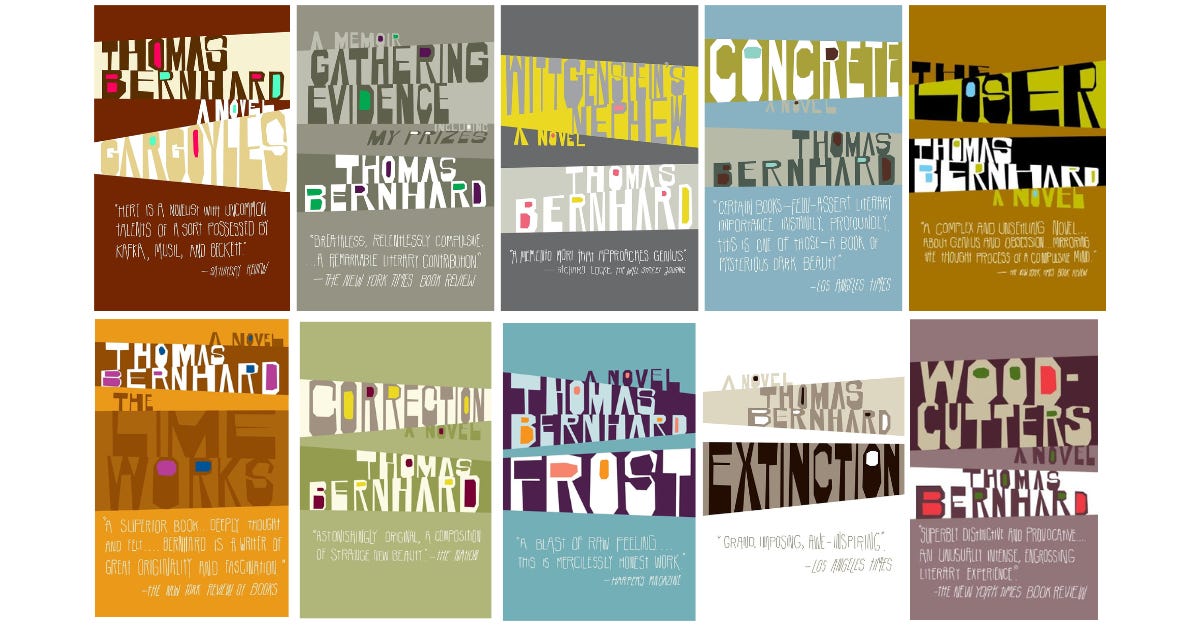
Thank you for such a thorough examination of both Bernhard's work and his influence on (some) contemporary American writers. The only comment I want to offer is that influence often has an inverse relationship to exposure, and Bernhard's influence on writers like Dubno and Haber is in part a consequence of how much they haven't, or have yet, been exposed to.
Focus inherently requires exclusion: focusing on one thing requires us to ignore many other things, and young writers often focus on a small slice of literature that resonates with them. Back in the 1970s and early 1980s, Brautigan and Vonnegut were such influences. Recently, it's Bernhard, Sebald. But, as you note, all literature is effectively a palimpsest of what's been written before, and a writer who really wants to understand a particular approach has to burrow back through those layers to understand where it came from and how it evolved, and too often, we're reading the work of a young writer who hasn't done much burrowing.
Well, one other comment: modern Austrian literature, including Bernhard, also comes from the legacy of a lost empire, which colors some of its resentment and bitterness. It may seem like Europe's Rhode Island today, but there was a time when it was Europe's Texas.
I really enjoy when you go long on a writer and the consequences of their work on later writers. Thanks for taking on Bernhard and his imitators.
Also, I strongly agree with the claim that aspiring writers should imitate artists whose work they love. I encourage younger writers to build for themselves a "personal pantheon." This short list should include authors whom the younger writers would be thrilled to be mentioned alongside. Then, the younger writers should identify qualities in all their personal pantheons in order to recreate and iterate on those qualities. Style is just a collage of work you love; a great style is one with obvious focus but whose precedents seem at least a little mysterious.