
A guide to effort-posting
Recently Ross Barkan wrote about a group of critics who make a practice of writing long, obsessive articles about authors or cultural phenomenon. He said this “New Cultural Criticism” was a form of online writing that “made a bid for history”.
This piece got a lot of pushback from the Substack community. Many people felt his assessment was too grandiose.
However, I think Ross was correct to say there is a creative economy on Substack that rewards high-effort nonfiction pieces. Within this economy, it’s possible for a piece to break out and increase the author’s profile in some way that feels genuine.
Generally, the types of pieces that work well in this creative economy are long, and they often show visible signs of effort, as a way of building authority with the audience. The moment Ross described this type of piece, I knew what he was talking about, and he named a number of pieces in this style, by Alexander Sorondo, Henry Begler, Daniel Falatko, Chris Jesu Lee, Mo Diggs, Sam Jennings, and myself. Most of these pieces were published by The Metropolitan Review, Ross’s journal, but a few of the pieces were published on the authors’ personal newsletters.

Why was Ross’s post controversial?
The post elicited pushback from two types of people. The first was from media folks. I see these snide comments all the time, from writers with credits in The New Yorker or The New York Times, about how Substack is full of bad writing.
Oftentimes, these writers are subscribers of mine! They’ll say something about how Substack’s “platform dynamics” reward mediocre writing, and I’ll think...you are my subscriber! Who are you talking about if not me?
But there was also another species of pushback. And this came from writers whom I respect much more. A lot of smaller newsletter writers were also skeptical—I saw Quiara Vasquez, Max Larson, and T. Benjamin White were all dismissive of the term.
A lot of these writers found Ross’s framing to be self-important. Quiara’s critique was the most concise. She wrote:
What’s the meaningful difference between the (excellent!) pieces you call “New Cultural Criticism” and, e.g., Scott Alexander’s (equally excellent!) “The Dilbert Afterlife” ? And is “The Dilbert Afterlife” truly all that different in form or content from any given Slate Star Codex post from 2014? Color me skeptical, Ross.
I think this is a good point. But my response is, let’s say you’re correct and that bloggers have been effort-posting for a long time and seeing great results from effort-posting. In that case, it means the phenomenon is even more enduring and more effective than it initially seems, and it is even more important to describe it.
Looking through a lot of the comments to this piece, I realized that it was really this ‘New Cultural Criticism’ framing that was drawing the flak. People were fighting over whether these pieces had artistic merit, but they were missing the real point, which is that bloggers are able to find success, on this platform, by writing a certain kind of long nonfiction post.
So for the benefit of all the skeptics, I thought that I would write about the art of effort-posting.
This post is geared to two audiences: the magazine-writers and the bloggers. It’s tricky to balance this dual audience, because they have different understandings of what the typical newsletter-writer does, but I think that I can manage to speak to both.
What is an effort-post?
Ross provided a list of effort-posts in his piece, but I actually don’t love his list, because it’s weighted heavily towards pieces that were originally published in his journal, The Metropolitan Review. And it also includes two writers, Henry Begler and Alexander Sorondo, who aren’t really effort-posters.
Henry Begler does not write particularly long. He writes pitch-perfect London Review of Books summaries of authors’ careers (e.g. this post about Salinger). They’re well within the length limits for an LRB article, and you could easily imagine seeing one of them in that journal without a word altered.
And Alexander Sorondo is not a critic. He is a reporter. He does in-depth author pieces on well-known authors, in which he interviews dozens of people to learn everything possible about that author, and then he puts together a full-length profile (e.g. his pieces on William Vollmann or on Alan Moore). His pieces run long, but they’re not that long for this kind of profile. With a little editing, you could imagine them running in a glossy magazine.
So instead of using Ross’s list, I wanted to make a list of five recent effort-posts that feel distinctly different from anything you’d read in a magazine. The pieces are.
“The New Yorker offered him a deal” by Naomi Kanakia
“God is in the Algorithm” by Daniel Falatko
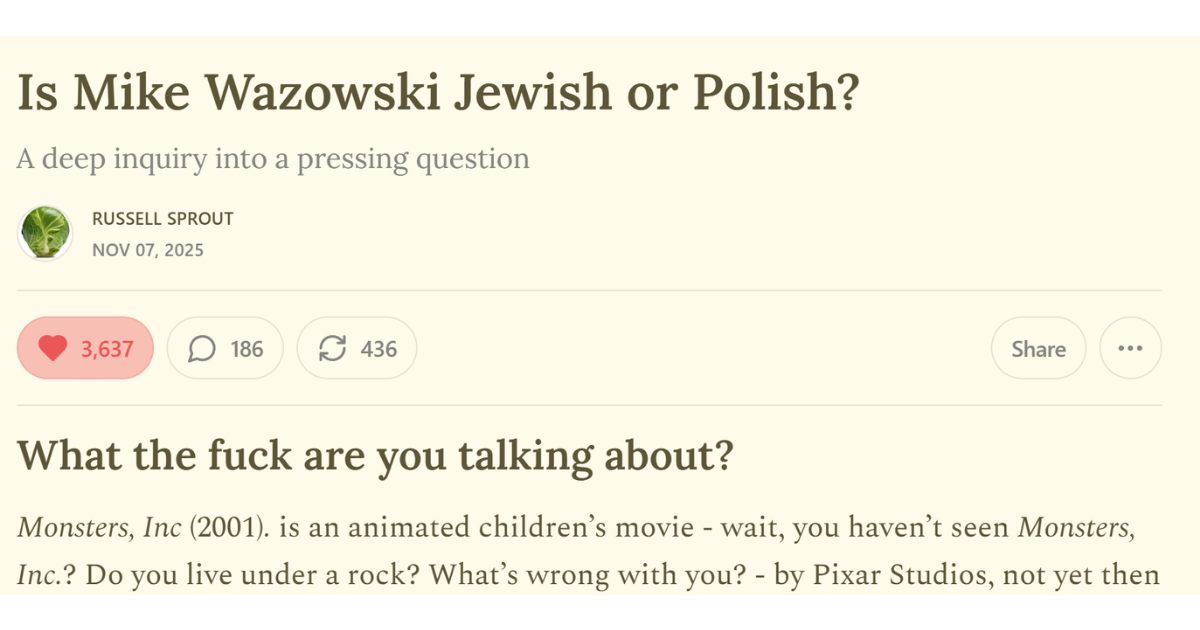
“Is Mike Wazowski Jewish or Polish?” by Russell Sprout
“The Anti-Cosmetic Surgery Essay Every Woman Should Read” by Father_Karine
“we’ve created a society where artists can’t make any money” by Celine Nguyen
All of these pieces were shared widely on Substack (and often through Reddit and link aggregators), in a way that appreciably increased the author’s public profile. All of them are quite long (I think the shortest is Sprout’s, which is about 5,000 words—an insane length for a post about the ethnic background of a cartoon character). All display visible signs of obsession: the author has clearly ruminated on this topic for an unreasonable amount of time, and they’ve usually done much more background research than you’d need for a quick ‘take’.
And none of these pieces feel like something you could read in a magazine. My New Yorker piece and Daniel Falatko’s Youngboy NBA piece are the closest to magazine pieces, since they resemble something that magazines publish—literary and music criticism. But my piece is much too long and not pegged to any hook. Falatko’s piece is in part about the fact that NBA is so toxic that no mainstream journalist is willing to write about him.
But these pieces also have a tone and structure that is much closer to a blog post than a magazine piece.
Nguyen’s work offers the best contrast, because her post is in part about how she pitched another piece, an article that was published in Asterisk magazine.
In the post on her personal newsletter, she begins:
I had never seriously thought about how writers made money, until I began writing myself.
In contrast, the Asterisk piece begins with a much more provocative opening:
I don’t remember reading any great novels in the ‘90s. Or listening to any good albums, either. It’s not the decade’s fault, it’s mine: I was born in 1993. By the time I could read books and choose my own music, things were already going downhill. The 20th century, apparently, was the last time we had great art, literature, or music. Although the current century was meant to be a Cambrian explosion of creativity — inaugurated by the internet, or the creator economy, or NFTs, or AI — nothing has gotten better, only worse.
The Asterisk piece is hooky—it’s meant to catch your attention immediately—and it’s pegged to a book she’s reviewing, W. David Marx’s Blank Space (which argues that culture since 2000 has been stagnant). But the piece on her personal Substack is discursive and chatty, running for many paragraphs before announcing any aims.
Both pieces are about the same thing—the consequences of a world where artists can’t support themselves. But Asterisk piece is much shorter and punchier.
Incidentally, because Asterisk republishes its posts on Substack, we can compare the two pieces head-to-head. The piece on her personal Substack is twice as long as the Asterisk piece, and it also has twice as many likes and restacks, even though it’s circulated for less than two months (versus almost six months for the Asterisk piece).
So are these pieces also ‘The New Cultural Criticism’?
For right now, let’s aside the question of whether these pieces can compete, in terms of quality, with the best magazine pieces of the past. From my perspective, effort-posts aren’t notable because they resemble magazine pieces (they don’t), they’re notable because of the ways they resemble regular blog posts.
All of these pieces (aside from Falatko’s piece) were published on personal blogs. When they were published, the authors had widely-varying readerships. In Sprout’s case, he only had a Substack account because he was a commenter and reader, but he’d never posted before. This was his very first—when it went viral, he gained a thousand subscribers in relatively short order.
Father_Karine is one of Substack’s funniest storytellers, but I am pretty sure she only had 5,000 or so subscribers before posting her epic rant last year. It went mega-viral, and in short order her subscriber count was above 12,000 (it’s now at 21,000). My result and Celine’s results were more modest, but in both cases, these posts performed three or four times better than a typical post.
Many of these posts give no initial indication that they’re anything besides a typical blog post. I started my post with a very unassuming opening:
Two months ago, I read a seven-hundred-page collection of short stories by John Cheever. But somehow that wasn’t enough. I went on to read seven-hundred-page retrospective collections from Mavis Gallant, Alice Adams, and John O’Hara. And I still wanted more!
This is exactly the way I have opened many posts in the past. There was no indication the post would be anything besides a short piece where I reacted to some of my recent reading.
Instead, it spiraled outwards for seventeen thousand more words.
Where do effort posts come from?
My theory is that most effort-posts start the same way. There is a blogger who is working on an article that they hope will be a reasonable length. They start writing, and they realize that doing justice to this topic is going to require a lot of words.
Sprout’s post is a perfect example. It feels like a throwaway joke, it’s about a character in Monster’s Inc. Is he Jewish or is he Polish? It’s a question that seems simple enough to answer, but apparently it’s not.
It’s the same with Falatko’s article: he’s asking himself why this extremely well-selling artist, Youngboy NBA, hasn’t been covered by the music media. And the answer initially seems simple. Youngboy NBA has a terrible history of violence behind him, so the media won’t touch him. But as he researches the artist, he realizes that the depth of Youngboy’s commercial success is big enough—it rivals Prince, Drake, or Beyonce—that it remains genuinely surprising he hasn’t been covered more.
Father_Karine’s post seems to have started as a hot take, but it grew and grew, until eventually she was raising and demolishing every possible argument in favor of the beauty industry.
I would surmise that all these authors at some point considered reducing the scope of their piece so that it would perform better for online readers, but then they thought, “I’ll just write it for myself.”
There is no length limit on a blog. You can post as much as you want. There is nothing stopping you from pasting ten or twenty thousand words into the Substack Content Management System. Yes, the email will get cut off in peoples’ email clients—if they want to quit reading they can. But what’s the worst that can happen? Your post gets ignored. So what? We are all used to being ignored.
Why did these posts succeed?
Except the post isn’t ignored. Instead, it gets engagement. A lot of engagement. For me, a typical post gets maybe eighty likes, a few restacks. But an effort post usually does several multiples of that, and they often pull in hundreds of new subscribers. I have also observed that these posts tend to circulate much longer than other posts. I have effort-posts that are still being shared a year after I wrote them. Each effort-post becomes a source of passive subscriber growth.
I know many will say “Long blog posts are nothing new”. But I found effort-posting to be a revelation. I’ve been told so many times that attention spans are short and that 90 percent of readers will get fewer than 500 words into a story. I heard once that Substack was thinking of instituting a feature, for creators, where they inserted a red line to show when most people had stopped reading your post, but they didn’t launch because the results were too depressing.
Effort-posts are often four or five times the length of a regular post. Yet they’re seemingly read by many more people than a regular post. So what is going on? How can this be possible?
The answer, I think, is that an effort-post is not necessarily read by a greater percentage of people who receive it, but that the people who finish an effort-post tend to like it much more. If they make it to the end, they usually feel impressed and pleased, and they’re much more likely to share your post. This means your post gets distributed widely, landing in front of more eyeballs (which ultimately means more readers).
So is effort-posting the best way to grow you blog?
No. The downside to effort-posting is that it’s a lot of effort.
Sometimes, as Father_Karine found, these posts can go viral in a big way and really increase your readership, but usually that doesn’t happen. My biggest posts are not my effort-posts. My New Yorker post took three months of work and brought a few hundred subscribers, but my biggest post was a fable I told about the male novelists. It took a day to write and netted me three hundred subscribers (back when I only had 600 subscribers).
If all you care about is increasing your subscriber count, there are two types of posts that are easy to write and that will bring more growth.
Discourse posts — Some topic is trending, and you have a take. By latching onto that topic, your piece gets injected into a broader conversation and can sometimes trend widely. I’ve done a lot of discourse posting, but a fairly recent example was my review of Ocean Vuong’s second novel.
Service pieces — These are pieces that tie into something that a large group of readers care about—some area where they are considering trying to improve their life. I would include link aggregation, explainers, and self-help in this category. My most successful attempt at this sort of piece is “A creative writing degree can be quite useful”.
For many people, including myself, it’s these types of pieces that drive the bulk of our growth.
Then, once you’ve brought in subscribers, you also need to get them familiar with your voice. Usually authors have some variety of ‘Regular Blog Post’ that is easy and enjoyable to write, but not particularly high-growth (for me these regular posts are my book reviews and non-discourse-related tales).
Regular Blog Posts are usually no problem to write. If you didn’t enjoy writing them, you wouldn’t be blogging at all.
But it can be difficult to consistently produce Discourse and Service pieces, and oftentimes writers have diminishing returns with these pieces over time. That’s because they’re cheap fuel. They’re content that anyone can write, but they’re also difficult to write consistently without coming across as inauthentic.
Discourse-posting is particularly troublesome to maintain, because it often relies on an oppositional, anti-establishment attitude. And it’s hard for an author to stay angry for years at the same high pitch.
Furthermore, the number of people who really care about niche online discourse isn’t very high. It’s true that some people care a lot, and they will love you for posting about this stuff and speaking truth to power. But beyond that group of diehards, there’s a cap. And if you consistently post that kind of stuff, you’ll turn off people who aren’t invested in online discourse, which will ultimately limit your growth.
Service pieces are easier to produce consistently. But they can be boring to write. If your blog is about a topic that people care about a lot, and you heavily monetize your blog, then it can be worthwhile to keep writing service pieces just to pay your bills. But I don’t know that anyone really wants to write them for free.
And service pieces aren’t a springboard to bigger things, especially if your aim is write for magazines or do book-length work. You often see novelists complaining that their newsletter isn’t helping their book sales, and in many cases that’s because these writers built a big audience doing service pieces (often about craft of writing or about the publishing industry). This means they have a lot of readers, but not necessarily a lot of fans, since the avuncular nature of Service writing doesn’t do much to convince an audience that you’re also a talented fiction writer.
Can’t you just do Regular Blog Posts?
There are many writers who don’t do any of Discourse or Service posting. Some writers (like Sam Kriss and Meaghan Garvey, have achieved great success with weird, unclassifiable pieces. Others, like Lincoln Michel, have found a way of doing Service and Discourse pieces in a way that feels unique and sustainable.
But there are a lot of writers who are plugging away, doing great work (oftentimes writing book reviews or other forms of niche blogging), but who aren’t experiencing a lot of growth. It’s not that these writers are too dumb to see that different kinds of content gets growth online, but for various ethical (or boredom) reasons they don’t want to do Discourse or Service posting.
And I think there are even more writers who do have an audience of some sort, but who are feeling frustrated by how their Regular Blog Posts are received. Yes, you can write whatever you want, but you often find that even when you’ve worked hard on a Regular Blog Post, the piece gets little engagement, while hastily-written Discourse posts get you lots of new subscribers.
This is a lament you often see online—how can I get people to read my more-serious posts? This happens because most writers would prefer to be praised for their RBGs, but they’re finding that actually it’s their Discourse and Service pieces that attract the most attention.
For some authors, this plea curdles into a sense of contempt toward their own audience. Many writers go on Substack Notes (the Twitter-like social network that’s accessible through the Substack app) and post about how their readers don’t have good taste and prefer discourse slop to real, substantive writing (Rob Henderson wrote a note like this recently).
I understand this plea, but I think it misunderstands the nature of online engagement. Discourse and Service pieces draw more engagement because they provide an entry-point for the reader. These are things that the reader is already thinking about, and it’s easy to share or comment, since the reader can just add their own opinion to the mix.
But a Regular Blog Post has no entry-point. The reader might appreciate it, but they don’t feel called-upon to interact with it. Furthermore, it’s a regular blog post. Some RBGs might be better than others, but it’s hard for the reader to explain this distinction to other people (”Oh wow this book review is better than their other book reviews on this site!”) Some people will do it, but only a few of your readers will be superfans like that.
And many of your readers are actually not fans. They’re just readers. They don’t think you’re a talent, and they’re not interested in your thoughts about non-Discourse or non-Service topics. They’re curious about your work, but not fully sold.
I find that readers are very resistant to any sense of self-importance on the part of a blogger. They do not want to feel like they need to massage the blogger’s ego.
And the truth is, many readers aren’t really looking for a serious reading experience from your blog. They’re just looking for a distraction. There is a reason they’re reading a newsletter instead of The New Yorker.
Readers come to magazines looking for big ideas. That’s why every magazine has a cover story. A lot of people will flip to that headline piece and commit to giving it their attention. And magazine features tend to be written in a way that emphasizes the importance of the subject.
Magazine features almost always emphasize the subject’s timeliness—the now-ness of the story. For instance, this week’s New Yorker has a story about how doodles have taken over the Westminster Dog Show. The subheading of this story is: “Poodle crossbreeds have grown overwhelmingly popular, sparking controversy in dog parks and kennel clubs alike.”
Even in an article about dogs, the magazine tries to sell you up-front on the importance of this story. There is a change in the dog world, and this change has sparked controversy!
But in a blog post, that immediacy is off-putting. Almost none of these effort-posts begin that way, because it would feel insistent, like a demand on the reader’s attention.
So how should an effort-post begin?
When you’re writing an effort-post, you need to write completely differently. You can’t be so magisterial, because you’re writing for people who already know you. They know your name. They like you, but they don’t necessarily respect you. And if you come off straight away with a really authoritative tone, then it’ll be a turn-off, like you’re putting on airs.
Your greatest advantage is that people don’t actually know how long a newsletter is going to be. It’s all just scrolling on a phone, right? They start reading the piece, and then the scope of the piece slowly expands, and they’re pulled in.
At some point, the piece begins to show signs of effort, but it’s still best to be unassuming. For my New Yorker post, after writing about four hundred words, I said, “All told, I’ve probably read five hundred New Yorker stories over the last three months.”
In other cases the display of effort is even more subtle. Often it happens through the introduction of sub-headings. In Sprout’s case, he uses a new level of sub-heading, bigger than his previous sub-heads, and the reader realizes, oh...this is a real article! It’s got sections.
Father_Karine was the most up-front about her aims. After writing three hundred words, she said:
I’ve organized my thoughts on this subject into ten parts. It is a 30 minute read but it may very well change your perspective entirely. If I am found dead shortly after publishing this piece, please know that I did NOT kill myself. But only because “cool but rude” Substack juggernaut Freddie deBoer said it was cringe.
My theory is that after five hundred or a thousand words, a good number of readers are already committed. At this point, if you start to display signs of effort, then they get more interested, more likely to read to the end.
People scroll on their phone for distraction, but too much scrolling creates an empty, anxious sensation. Reading an effort-post has the potential to quell that emptiness. It feels somehow better, higher. Most of your readers don’t make it to the end of an effort-post, but the people who do finish usually feel good about it, much more enthused than they feel after reading a regular piece.
Because of those good feelings, they’re motivated to circulate the post in group-chats, on Reddit, on Substack Notes, and (sometimes) on link-aggregation newsletters. This creates an outsized amount of growth, because it exposes your work to people who don’t normally see it. So although a smaller percentage of readers finish these pieces, the pieces also circulate widely and grow your newsletter much more. Furthermore, this is good growth. Effort-posts bring you new readers who respect your work and see you as being a bit different from other newsletter writers.
How should I structure an effort-post?
All of the features of the effort-post—the unassuming introduction, the length, the overt display of effort—are a product of this need to slowly beguile the reader into reading something that’s more ambitious than it initially seems.
The hardest part of effort-posting is balancing the casual tone with the need to structure the piece so that it makes a coherent argument.
I find that many effort-posts begin with a simple proposition, and then they methodically attempt to prove this proposition. Quite often, effort-posts are structured as an implicit conversation—the writer tries to anticipate the reader’s objections as they occur, and to answer each in turn.
In my own effort-posts, I usually start with something that I really love, and then I ask, “Why is this good?” Usually, my answer is that the work is good because it came from a specific milieu that imposed certain expectations on the author, but the work managed to fulfill those expectations in a way that was surprising and yet completely satisfying.
To do this, I usually start by going backwards, to the beginning of whatever tradition gave rise to the work, and I examine one archetypical writer in that genre. For the New Yorker story it was Sally Benson, and for my effort-post on the Western it was Zane Grey. Then I show how other writers attempted to emulate or subvert this early master, and how their effort were often only half-successful, either because they seemed derivative or because they didn’t meet audience expectations. Finally, I focus upon a writer who managed to improve somehow upon the original formula, and produce a work that’s had a lasting impact.
Structuring this kind of piece is tricky. You need each section to feel like an outgrowth of the prior section. And you also want to build characters, bring out sociological dynamics, and slowly increase the level of conflict and the stakes. I still structure my effort-posts mostly by intuition, and I’m probably not the best person to write a how-to on the phenomenon. There are true masters on this site, people like Scott Alexander, who seem to do it almost automatically—personally I am still learning the craft.
Is effort-posting good?
I would say that if you’re a newsletter-writer who’s looking to build a long-term following, then there are strong incentives to engage in effort-posting. These are posts that are: a) fun to write; and b) improve your long-term subscriber growth and your reputation amongst your subscriber base.
The main downside to effort-posting is that it’s a lot of effort. I spent three months researching my New Yorker piece. I cannot imagine that any working magazine-writer would spend three months of their life researching a piece and then giving it away for free. Effort-posting is strictly for amateurs.
But for a certain class of amateur writer, I think effort-posting has the perfect cost/benefit ratio. You’re investing a lot of time, but you’re doing it for a piece that you really believe in. And you’re doing it for a non-trivial potential reward (hundreds of subscribers and the respect of your peers).
On a creative level, effort-posting solves that problem where you want to write about something you really love, but you know the subject is quite niche and it’ll be hard to make anyone care about it.
For instance, my Regular Blog Post about John Cheever was not a high performer, netting me about sixty likes and seven restacks and gaining me four subscribers, according to Substack’s creator dashboard.
And when I started to read collections by Mavis Gallant and John O’Hara and Alice Adams, I got a little depressed, because I thought, “Nobody will read these posts. They’ll get even fewer readers than my Cheever post.”
This made me sad, because I loved reading these books, and I didn’t want to stop. On the other hand, I can’t afford to spend months reading something if I’m unable to write about it.
But then I thought, “What if I can write one big post about all these writers?”
If you do a big post that pulls together everything, then you can exceed the impact you would’ve had from a dozen smaller posts. (The resulting post got 380 likes, 70 restacks, and gained me 250 subscribers, according to the dashboard).
This makes writing and reading so much more fun, because I’m not enslaved to my audience’s tastes. Instead, twice per year, I can launch a huge effort-post and actually make the case that my audience should care about something they’re otherwise indifferent to.
That’s my perspective as a writer. Now, as a reader, do I think effort-posting produces good writing?
The answer is...I do not enjoy every effort-post. I love Father_Karine’s work. She is an incredible storyteller, one of the best on Substack, and I am glad that she had this breakout piece (which is very different from her Regular Blog Posts). However I didn’t love her cosmetic surgery piece. I just didn’t agree with the proposition and wasn’t that interested in seeing all her arguments. When I was in my twenties I read The Beauty Myth, I understand the idea that women are coerced by beauty expectations. But I’ve had cosmetic surgery myself, and it was great.
There are other mediocre effort-posts that have succeeded. I am not satisfied with my piece on the evolution of the Western-fiction genre. I should’ve read Lonesome Dove and re-read Blood Meridian and read a bunch of Louis L’Amour before publishing my Westerns piece. It was unforgivably lazy for me not to do that, and it really harmed the piece.
Of course, the Westerns piece was still very successful. It drew hundreds of new subscribers and launched me upon my effort-posting career. Effort-posting is just like everything. Mediocre pieces can hit.
And good pieces can fall flat. Celine Nguyen put months of work into an effort-post about computer interfaces, and I don’t think that it had quite the impact she would’ve wanted (despite being an excellent piece), because her audience is more literary than techie—even if they liked the piece, her readers wouldn’t have necessarily known how to share it or whom to send it to
What if these effort-posts seem totally unremarkable to me?
I think sometimes magazine writers see people like me working on these long pieces, and praising other people who work on these pieces. And then they go through and read the piece, and it just looks sloppy and amateurish, so they think, “Substack rewards bad writing.”
At the same time, I often see these magazine-writers post stuff on Substack that looks like a rejected magazine pitch. To me it feels highly-labored and impersonal, and it’s no surprise that this work doesn’t gain traction on the platform.
Then these magazine writers go online, and they complain on Notes about how nobody on this platform wants serious writing.
They don’t really understand that a reader relates in a different way to a newsletter than they do to a magazine-piece.
If a reader subscribes to a magazine, they usually have some ongoing relationship with that journal. They often have a lot of respect for the magazine, and they’re willing to be informed and educated by the magazine. The job of an editor is to preserve that relationship between magazine and reader. For this reason, editors are careful to make sure that the magazine-writer’s voice, in the piece, matches the voice of the journal. The magazine feature can’t feel too different, on a line level, from the rest of the writing in the journal.
And when magazine writers attempt to write newsletters, they often don’t realize that they no longer have the benefit of that automatic respect that the reader gives to the magazine. Instead, they have to form a different, more intimate, and friendlier relationship—one that strengthens over time, as the reader becomes more familiar with your voice.
That’s why the kind of impersonal, authoritative voice that works in a magazine won’t work on a newsletter. Many magazine writers have noted this, but they just interpret it as newsletter readers somehow being stupid or lazy, when really what’s missing is the trust that normally makes the magazine-voice work.
A good effort-post has a way of slowly building up this trust, over the course of the piece.
I actually don’t think effort-posts are overpraised. They’re being praised proportionately to their accomplishment. It’s quite difficult to break through the noise and write something that impresses the newsletter audience. Readers want to believe in newsletter posts, but they’re unwilling to give their trust easily. When someone finally gains that trust, even if it’s only for the space of a simple piece, it’s very exciting, and that’s what causes the praise.
All these pieces could use an editor
This is something people often say about newsletter posts. They needed to be edited. Maybe that’s true. But I question whether any editor really understands the mechanics of effort-posting.
Honestly, I can only think of one journal that has mastered effort-posting. New York Magazine routinely publishes stories that are about seemingly trivial topics, but are audaciously long, to a point where it honestly seems like a joke (e.g. this 13k article about a messy affair between some writing professors). New York also feels like a magazine that really aims for a certain kind of internet virality. I am sure the editors at New York could improve a lot of Substack posts.
But...I think mostly this critique just means, “These posts could be clearer, punchier, and shorter”. In most cases, I think that sort of editing would actually harm the piece and reduce its impact for the audience of newsletter readers, because it would lose that low-key, discursive style that’s at the core of effort-posting.
(There is one newsletter-based publication that has really polished magazine-style pieces. The New Critic is run by a set of Gen Z writers, and they publish a mix of polemical pieces and literary journalism. I’ve heard the editors take a strong hand in shaping the pieces, and it really shows—the work is confident and controlled. I particularly enjoyed Theodore Gary’s “The Freak Show”, about an influencer who’s famous for being a drunken wreck in his videos.)
Isn’t there a chance this’ll ruin you for real writing?
I guess that’s the real question! To what extent can we point to pieces that don’t look like magazine pieces and say, “Actually this writer has the talent to write for magazines”? I have thoughts on this question, but I’ll need to leave them for a later section of this post.
What if I’m still skeptical of effort-posting?
Good! You should be. I was very hesitant to write this piece (which owes a lot to Jared Henderson’s post about the Great Bifurcation), because I’m worried it’ll lead to a lot of try-hard effort-posts.
Effort-posting usually springs from obsession. Most writers don’t need to be told to effort-post, they just do it naturally, because there is something they can’t leave unsaid.
And effort-posting is only a good option for writers who see their newsletter as their primary creative outlet. I don’t think any working magazine writer would want to do this kind of work for free.
Moreover, the financial rewards of newsletter-writing aren’t high enough to justify effort-posting purely as a way of increasing your platform and gaining clout. If all you want is to get more subscribers, then there’s other kinds of content that are easier to make and would perform better.
But there is one sort of person who really needs to know about effort-posting, and it’s the exactly the kind of blogger who reacted most poorly to Ross Barkan’s post. I am talking about the blogger who has a lot of integrity, and, as a result, doesn’t really produce much in the way of Discourse or Service pieces. I’ve seen a lot of bloggers come onto this platform, produce some really solid Regular Blog Posts, and then succumb to bitterness because of their lack of growth. And once you’ve seen enough RBGs fail to get traction, you start to post less frequently and put less effort into your posts. These kinds of bloggers often have a lot of latent goodwill in the community, but there’s no way to tap into that goodwill.
An effort-post is a way of catalyzing that good will. It creates something that their readers can share and can use to spread the word about their work.
For instance, Daniel Oppenheimer has been doing a series called “The Failure To Be Interesting”, which is about how famous people are often really boring in their interviews. But he chopped up the series into multiple posts. If it’d been just one ten thousand word post, it would’ve performed much better online and been a bigger source of subscriber growth (he could still do this!).
My hunch is that there are a lot of good writers who are stopping themselves from writing their best ideas, because they figure that if their RBGs aren’t hitting, then there’s no point in writing anything that’s more ambitious.
After I saw the response to Ross’s piece, I knew that the real story was being lost amidst the backlash. I wrote this post so I could separate the actionable kernel from all the rhetoric. Effort-posting is a phenomenon that undeniably exists. We can debate all day whether this phenomenon is new or not. Some people, like my friend Quiara, would say that it’s just the same thing bloggers have been doing for twenty years. She’s not wrong about this.
But regardless of whether it’s new, effort-posting is a way for amateur writers to have fun and increase their readership at the same time. I cannot promise that every effort post will hit—there is an art to them, just like there’s an art to everything—but it’s worth a try, if you’re looking for a challenge.
It’s okay for mid-tier magazine writers to scoff about effort-posting, because it is critical to their self-image to convince themselves that their writing is superior to ours. But if you’re a blogger, you should not dismiss an entire highly-successful genre of post. It’s fine to say, “That’s too much work, and I don’t want to do it”, but you should at least understand why people engage in effort-posting and what they expect to gain from it.
And now you hopefully do.
2. Effort-posting versus magazine-writing
Okay, but what about the meat of Ross’s argument? He claimed that “The New Cultural Criticism” was essentially different from blogging, because it was less ephemeral. Unlike a blog post, the New Cultural Criticism was a form of internet writing that strove for timelessness.
I can only speak for my own aims, but with my New Yorker piece I was definitely aiming to write something that would last—something that people could refer to in ten or twenty years.
Now, the broader question is, “If you want an individual piece to last, isn’t it silly to post it on your blog?
In a recent issue of the Book Gossip newsletter, an anonymous magazine editor opined directly on this topic. He said that writers wasted their ideas by turning them into blog posts.
“Yet to come across a Substack that didn’t need an editor or didn’t need to be shorter. As a magazine editor, I’m also seeing writers rush out with good but half-baked ideas, ideas for pieces I would pay for, but not once they’re out there for free.”
I think I’ve explained why effort-posts have a feel that, to magazine editors, can seem discursive and overly-casual.
But I haven’t tackled the second part of this quote.

Wasting your best ideas
Magazine-writing has a particular skill-set. You need to know how to shape your ideas so that they’re attractive to the magazine. I don’t have this skillset, and I don’t know much about which magazines would publish work like mine. In 2022, a piece of mine in LARB went viral, and I thought, “Maybe I could be a literary essayist.”
There is a class of literary journal that has a small readership (usually between ten and twenty thousand people), but a lot of influence. These journals are read mostly by writers, critics, agents, editors, academics, and people with creative jobs. They’re the place where the intellectual class talks to itself.
The most well-known of these journals is N+1. The other well-known journals of this nature are The Baffler, The Drift, The Point, Liberties, The Believer, and The Yale Review. There are also the book review journals, like Bookforum, The New York Review of Books, and The London Review of Books. These review journals don’t publish idea-pieces, but writers often get expansive in reviews for these journals and sometimes these expansive book reviews sometimes viral online and do good things for the career of the reviewer.
These magazines are often the place where magazine writers try out their big ideas, and some writers have a reputation that derives mostly from their writing in these journals. For instance, Becca Rothfeld was a book reviewer for the Washington Post, but her reputation didn’t derive from her pieces in the Post, it came from her earlier essays in The Point and Liberties.
Some of my effort-post ideas could probably have worked for these ‘small magazines’. I would’ve had to write them in a different, more authoritative style. And they probably would’ve needed to be a bit shorter. But perhaps it could’ve happened. However, I never figured out how to get a response from the editors of these journals, and eventually I stopped trying. Pitching is a skill, and I didn’t work hard enough to develop it.
The aim, when you write for these small magazines (and I am just assessing things from the outside) seems to be that you write a piece which goes viral online. But I can’t actually recall any viral pieces from these journals that weren’t: a) personal essays (like Wesley Yang’s “The Face of Seung-Hui Cho”) or b) takedown reviews of contemporary novels (like The Drift’s recent piece on romantasy) or c) sweeping, high-level assessments of the state of the intellectual landscape (like Anastasia Berg’s “On The Aesthetic Turn”).
It’s true that lot of link-aggregation sites, like A&L Daily and Prufrock, are more likely to pull from these journals. But still...the paywall at many of the journals tends to be very strong, and I’m not sure a lot of people are making it through. The readership for my Substack pieces is probably fairly close to the readership for an individual non-viral literary essay if it gets published in one of these small magazines.
That’s literary criticism, not magazine writing
I agree. One of the more annoying things about discussing the market for writing is that critics and journalists tend to talk past each other. There is still a good market at magazines for reported pieces, and it would be absurd to waste one of those ideas on your newsletter. But when magazine writers say you shouldn’t put your best stuff on your newsletter, a bunch of critics will crawl out of the woodwork and say, “It’s impossible to pitch these journals.” Well, yes, criticism is a much, much harder sell than journalism.
I write literary criticism—I don’t even do idea pieces or culture-reporting, I only write about books. And the opportunities for literary criticism in the magazine world are really shrinking.
In my particular arena, literary criticism, I do think a newsletter can be a strong competitor to the magazine world. For whatever reason (probably because of changes to the Twitter algorithm), the pieces in these small journals like The Drift and The Point aren’t really breaking out and going viral the way they used, and oftentimes pieces on Substack get more readership and more attention than the pieces in these journals.
Again, I am only talking about the realm of literary criticism—not any other area of magazine writing.
The small magazines get more respect
The advantage of publishing in these small journals is that it’s a legible credential. If I had written for N+1, a lot of people would think much more highly of me than they currently do. If I was part of the magazine world, my readership would also be different than it is now.
It’s striking to me that the only time I can recall a newsletter post being heavily discussed on Twitter, it was Grace Byron’s takedown, on her Substack, of Lost Lambs. Twitter was abuzz with this essay for several days. She’s published in The New Yorker and The Cut and a number of other journals, so she’s legible to the Twitter-based literary crowd as being one of them, even when she’s posting on her Substack.
With me that doesn’t happen, and it doesn’t happen to any other newsletter writer either—even those much more popular than me.
When you post on your blog, you might get readers, but they’re not necessarily readers who matter in the media world. And even when those readers do matter, they don’t really respect you enough to openly discuss your writing.
The two worlds of longform writing
What’s weird about the relationship between the magazine world and the blog world is that these two worlds actually do care about each other a lot. There is a reason I’m read by so many magazine writers. There is a reason that Twitter is full of vague sniping about ‘Substackers’. And there is a reason that I allow all these snobby media people to live rent-free in my head (and vice versa).
These two worlds are somehow connected, but the nature of that connection isn’t really clear to me.
I think a lot of magazine writers feel pressure to be on this platform, because there’s a sense that if you have a big social media following, then you’re less likely to be laid off, more likely to get attention for your pieces, and that you’ll find it easier to sell a book.
For some magazine writers, this is simple. They are already names. They don’t need to hustle for subscribers: they just have a big email list because people love their byline. This is the case for Christian Lorentzen. He has twenty thousand subscribers here, many of them paid, and he almost never posts. Something similar is true for Becca Rothfeld.
Other writers don’t necessarily have that level of name-recognition from their magazine work, but have succeeded in using this platform to grow a following. Ross Barkan has a column for New York Magazine, and he regularly appears in The New York Times and recently got an advance from Random House for a nonfiction book. He also has twenty thousand Substack subscribers and seems to derive significant income from paid subscriptions.
BDM is another big success in this area. She posts like a native. I had no idea until recently that she’d been in The New Yorker and The New York Times and all these other places. BDM seems to just post about whatever she wants (i.e. she mostly does Regular Blog Posts), but she does do occasional Discourse posting. With these posts, she has the lightest possible touch—just a hint of wry exasperation. The posts get shared, but she doesn’t make any enemies.
There are probably a few other examples: Oliver Bateman, Brendon Holder, and sam bodrojan have also cracked the code on Substack, though I haven’t followed them long enough to know how they did it. Delia Cai has been running a link-aggregation newsletter (Deez Links) for ten years—it almost seems like a parallel career to her magazine work. And of course there are former magazine writers who’ve gone full-force into Substack (Max Read is the standout here).
The world is a big place, so there are probably lots of names I’m leaving out (I am purposefully excluding authors who are best-known for their book-length work), but it’s safe to say that many magazine writers haven’t seen the level of success on this platform that they’d want.
Resentment goes in both directions
There’s also a type of writer who has only written for this platform, and I don’t know that these Substack-native writers have had much success breaking into the magazine world (perhaps rayne fisher-quann ? But I don’t think she has many magazine credits). I don’t know everyone, of course, but the stand-out success in my mind is Jasmine Sun. She is very young, in her twenties, and has a popular Substack. And in the last years she’s done what seem like pretty big pieces for The New York Times and for The Atlantic.
However I know Jasmine’s reputation doesn’t only come from this platform. She founded a magazine, Reboot, and is involved with a lot of things outside Substack.
Celine Nguyen hadn’t published anything before starting her newsletter two years ago, but now she’s also done book reviews for The Atlantic and The Believer. She has a day job, so I think she just hasn’t put that much effort into pitching the bigger journals—I imagine she will crack them if she wants to. Viv Chen has a very popular fashion Substack, and after her newsletter got popular she successfully pitched Vogue (she wrote a post about it).
But it seems safe to say that there are a lot of bloggers who want to be writing for magazines, and that most of them are having a pretty difficult time. That’s true of most aspiring magazine writers, but I think it’s especially difficult when you have a burgeoning online following—so it feels like you’re doing something that’s working—but you’re not really getting traction in another field that seems somewhat-related.
There is something a little funny about this situation: magazine writers are frustrated their Substack followings aren’t growing; and Substack writers are frustrated that they don’t see any path into the magazine world.

3. “The New Cultural Criticism”
I think many literary effort-posters would love if their big Substack pieces got more respect in the media world. Right now, if you’re a newsletter-writer, you really fly under the radar. You might be well-respected and even have powerful subscribers, but it’s hard to know how to turn that into freelance opportunities. The only part of your platform that’s truly legible is your subscriber count: if your number is big, it matters a little bit to magazine editors (and matters a lot to book publishers).
But what if it was possible for a Substack piece to be reputation-making in the same way that a viral piece in N+1 used to be reputation-making? That would be a great situation for Substackers.
I think it is Ross Barkan’s hope that someday a big piece in The Metropolitan Review will carry the same cachet as a big piece in N+1. As one step in that campaign, he wrote this post about ‘The New Cultural Criticism’—to drum up support for the idea that something historical is happening in the pages of his journal. That it is publishing really exciting pieces, and the rest of the world should take notice.
My career (such as it exists) was made by a single blog post. My novella, “Money Matters”. This post got legitimized by an article in The New Yorker, and now I have a book deal. That happened because there was a magazine writer who was on Substack and who took seriously the idea that something important might happen on the platform.
If that kind of thing could happen more regularly, it would be wonderful for newsletter writers, because it would allow them to skip a bunch of steps of apprenticeship (just like I skipped collecting all the intermediate markers of prestige, like a Stegner Fellowship and a story in The Paris Review—that are usually required to sell a collection).
But, as I said earlier, ‘The New Cultural Criticism’ is a hard sales pitch to make. It’s one thing to say, “These pieces look just like magazine pieces, and they’re breaking out on Substack, so you should take notice.” But instead Ross is saying, “These pieces are quite different from magazine pieces, and they’re breaking out, so you should take notice.”
As I wrote in a recent paid post, I do think “The New Cultural Criticism” gestures toward something that is valuable, which is that there’s a certain kind of literary effort-post that’s consciously in conversation with magazine criticism. These kinds of posts are casually-written enough to succeed in the attention economy, but ambitious enough that they reward further scrutiny. I don’t know whether this literary effort-posting style is fully developed yet, as a form that merits attention in its own right, but I think someday it will be.
And I also believe that many of these effort-posters could successfully adapt their talents to the needs of the magazines (particularly the small magazines and the book-review journals)—I don’t personally have that ability, but I am sure many other people do.
However…I don’t expect anyone to take this latter point on faith. I just think someday, a Substacker will break into the magazine world in a big way. They’ll come through the gates, and then everyone will remember, oh yeah, Ta-Nehisi Coates was a blogger, Lauren Oyler wrote for Bookslut, Jia Tolentino got her start at the Hairpin—it’s actually very common for writers to make the jump from posting to magazine writing.
(The other possibility is that Rayne Fisher-Quann’s forthcoming book will be a huge hit, in which case so many Substackers will get essay-collection deals that it’ll be hard for the magazine world to ignore them.)

On self-promotion and movement-building
Ross really idealizes that late 20th-century era of literary lions. He loves Norman Mailer and the New Journalists, so of course a coinage like ‘The New Cultural Criticism’ will spring naturally to his mind.
He also works in the magazine world, and in that world your reputation matters. If people think you’re doing something bold and new, then it has material consequences for your career: you’ll get bigger opportunities, bigger advances.
But there’s a reason that I don’t make strong claims anymore for my own work.
It’s because in 2024, I had two books come out. My third young adult novel, Just Happy To Be Here, came out in January from HarperTeen, and my first book for adults, The Default World, came out in May from Feminist Press. It’d been very hard to sell these books—as I’ve written before, I queried 150 agents to find representation for The Default World.
And I was so desperate for these books to succeed that I invested thirty thousand dollars into hiring a private PR firm to convince people that these books were the next big thing. This PR firm did their job and worked their contacts, but there was not much interest, amongst literary-critical outlets, in covering these books.
At that moment I felt like a terrible sucker. I’d sensed that getting attention for these books would be an uphill battle, but I’d been so desperate that I’d chosen to pay tens of thousands of dollars to try and pump up my work and generate some hype.
All along I had a little voice that was saying, “This isn’t going to happen for you,” and in June of 2024 I finally listened to that voice.
I cannot overstate how dark that moment was for me. You know...by that point I’d already been been rejected a lot. I was used to rejection. My first book deal got canceled by the publisher because they didn’t like the second book I delivered for my contract. I’ve been dropped by two agents. I’d had multiple books that failed to sell publishers, and many books that my various agents refused to send out.
But I thought The Default World was my opus, and that when sophisticated readers finally got a chance to read this book, then something would happen. That they would be won over, and they would really love it. And they would write about it online, and...and...I would build some kind of reputation as a good writer.
I realized that this wasn’t going to happen. Whatever success looked like for this book, it wasn’t materializing. Yes, you can tell yourself that most books are ignored. But...it was my fourth novel, and it was the result of five years of work. If this didn’t excite people, then nothing would.
That month, I understood, for the first time, why people quit writing forever. I just didn’t believe, anymore, that I was any good. And I felt that I couldn’t, in good conscience, ask a publisher to believe in me, when I didn’t even believe in myself.
Nor did I know how to improve. I had been writing for twenty years at that point. And I’d run out of hope.
It’s easy to say, ‘Just write for yourself’. Easy to say, but hard to do in practice.
I gave up on the idea of publishing more books, and I gave up on the idea that I’d ever be considered a talent. I told myself that I’d never ask anyone else to believe in me—I’d just do everything myself. Publish it all myself. I wouldn’t pitch, I wouldn’t ask for anything. I’d just throw my work onto the internet and see what happened.
But someone believed in me
Ross Barkan was one of the first people to notice that my newsletter was getting traction. That I was doing something that was working. When I gave a reading in New York, he came out, and he hung out with me for a few hours, even though we hardly knew each other.
Then he actually read my novel, The Default World. And he asked me to do an interview with his much-more-popular blog. At that point I didn’t know a lot of magazine writers. I live in San Francisco. I don’t move in New York literary circles. This magazine world was something I knew very little about.
And I’d had all these experiences lately that’d taught me nobody would ever be interested in my voice.
But Ross was interested. And what I owe him goes beyond the material. Like...yes, I gained subscribers because of his support. But what mattered so much more was his attention—his belief that I was doing something that mattered. That my voice mattered and was worth remarking-upon.
The Metropolitan Review
That’s what a great editor does. They find writers that they’re willing to invest in. Six months after I met him, Ross helped to launch The Metropolitan Review so there’d be a home for those writers. He gave his authors a lot of runway—a lot of room to cook—and that’s what produced some of these early effort-posts that he cites in his piece.
Other journals have struggled, in this social media environment, to gain readers for their pieces. But by utilizing this effort-posting style, The Metropolitan Review is routinely getting big readerships for its articles. That is nothing to sneer at. There are a lot of other journals that notionally have a high reputation, but which aren’t really getting eyeballs for their pieces. And if you don’t get views, that means writers are left with a prestigious credit on their CV, but their work goes to waste, because nobody actually reads it.
This means that whatever they were passionate about—the story they wanted to tell the world—never really gets heard. But if you publish in TMR, your work is much less likely to disappear.
I think that in ten or fifteen years, a lot of people will have very fond memories of Ross Barkan’s idealistic, democratic mindset. Ross is publishing people from across the country who don’t usually have access to large readerships, and he is doing it in a way that gives them the potential to grow an audience of their own.
There is no other small journal that is truly doing that. If people want an audience—want a chance that their piece can break out and reach an enthusiastic set of fans—they should publish in TMR.
And as for the prestige? I think that’ll come.
Samuel Richardson Award news!
T. Benjamin White has made his selection for the contest we’ve been running for best self-published literry novel. In the end it came down to three choices: Merritt Graves’s Drive A, Will Caverly’s Here, The Bees Sting, and Alexander Sorondo’s Cubafruit. It was a hard decision for him:
If Cubafruit’s flaws are inseparable from what made it so good, that’s only because Sorondo was aiming high, trying to create something new, and I believe he largely succeeded. If only one novel or literary project from this loosely-connected Substack self-publishing scene survives and is remembered, it may very well be Cubafruit.
The other judges should make their selections sometime in the next few weeks, and then we’ll have a winner!
Thanks for writing this. I am in the position of having both been a very popular blogger (at one point had a regularly viral pseudonym), and also written for legacy publications (currently working on a piece for NYmag). I think a lot about the differences in form.
I think part of what’s happening here is that the differences in style actually cut against each other, which you alluded to when you mentioned that sometimes magazine writers come here and try to do magazine-style writing and don’t succeed and get annoyed. It’s true across social platforms too. If you simply repurpose your instagram posts for Twitter/X without rewriting them, you generally won’t succeed (there are exceptions).
really interesting piece! this isn't a universal data point, just commenting my own experience, but I actually got my start as a writer in magazines -- my first ever piece was in Vice when I was 18, then I freelanced and got a staff job at a small Canadian music magazine, then had a column at i-D. I chose to focus on my own substack and early in my career turned down several offers from mainstream publications to take a job/column there. I generally don't write for magazines now because my output is really limited while writing my book and mags generally just can't pay me as much as I make per-piece on substack (except maybe the Times, which I've written for before but am now boycotting) -- but I have received many many magazine offers essentially since I started publishing here, and still do (and the magazine world has also very kindly covered my work on substack since the very beginning). once the book project is off my plate I hope to write for many more magazines, because it's such a privilege to have a great editor and publish in a mag you love! I'd kill to be in the point, n+1, and ofc NYmag and the New Yorker.