
The First Samuel Richardson Prize Winner is…
Exactly one year ago, we closed submissions for the Samuel Richardson Prize For Best Self-Published Literary Novel. And on that date, I said that it would take us one year to find a winner, which we have now done!
This post will be the final page for the first year of the contest, so I hope you’ll forgive me for recapping the results so far.

The First Round
Our submission period ran from June 1st to July 30th. It was open to any book that had been self-published in the last five years. Our format was based on the format for long-running sci-fi and fantasy self-published novel contests, and the main rule was that your entry couldn’t have been submitted to those contests.
We divided the 67 entries between ten judges who each selected a single finalist. Eight of our judges wrote up reviews for their chosen picks (yes there was some judicial attrition along the way):
Eleanor Anstruther’s In Judgement of Others
Brian Jordan’s Wild Walt and the Rock Creek Gang
Then, over the next six months, our remaining judges attacked the finalists and decided on their personal favorite:
[The author] never tries to be too smart. Most of the characters are doped up with brain enhancers and fancy degrees from elite schools, but our protagonist is just like us: amazed, weary, and wary. The hyper-meritocracy of Graves’ world is never boring.
T. Benjamin White picked Cubafruit, saying
…for the time I had the book open in front of me, I was living in Cubafruit. It was one of the most immersive literary experiences I’ve had in a long time.
Lillian Wang Selonick picked The Wayback Machine, comparing it to a Philip K. Dick novel:
What is the essence of a PKD novel? Menacing darkness, deadpan humor, epistemological uncertainty, a malevolent and/or indifferent woman—the levels on the mixing board are set just so, and most attempts to replicate or remix the masters fail. My choice to win the contest has engineered a solution.
Adam Fleming Petty also picked The Wayback Machine, despite his suspicion that he was too much the target audience for this book:
Yet though I began The Wayback Machine a skeptic, I finished it a convert. Turns out, I love being a target market! Take it from this white man: being pandered to is the best! But that is not the only reason I selected this book as my personal vote for the Samuel Richardson Prize. Yes, this idiosyncratic and personal book made me respond to it in an equally idiosyncratic and personal way.
Abra McAndrew picked The Wayback Machine as well:
I picked The Wayback Machine for top billing from among the other contest entries because it most legibly draws upon its premise to fictionalize the kind of inescapable human dilemma that’s the stuff of great literature: “I wasted time and now doth time waste me.”
Phil Christmas also picked The Wayback Machine, which he had previously reviewed as his original finalist pick.
And, finally, I too picked The Wayback Machine:
Nathan loves this hipster era, and he shows that love by tearing it down, cheapening it, exposing all its compromises and lies. Which leaves both his interlocutors asking, “Was the hipster era actually good?”
Ultimately, the novel seems to say that when this era started, it was good. It was a way for ordinary kids from the suburbs to move to the city and quickly experience the kind of glamorous urban life they’d always dreamed about. But its goodness lay in its accessibility, and ultimately that accessibility is what destroyed it. The city became too accessible, too many people arrived, everything got too expensive, and all the signifiers of hipsterdom—the clothes, the concerts, the niche foods—got commodified, so now all you needed was money—you didn’t need any real cultural knowledge anymore.

The winner!
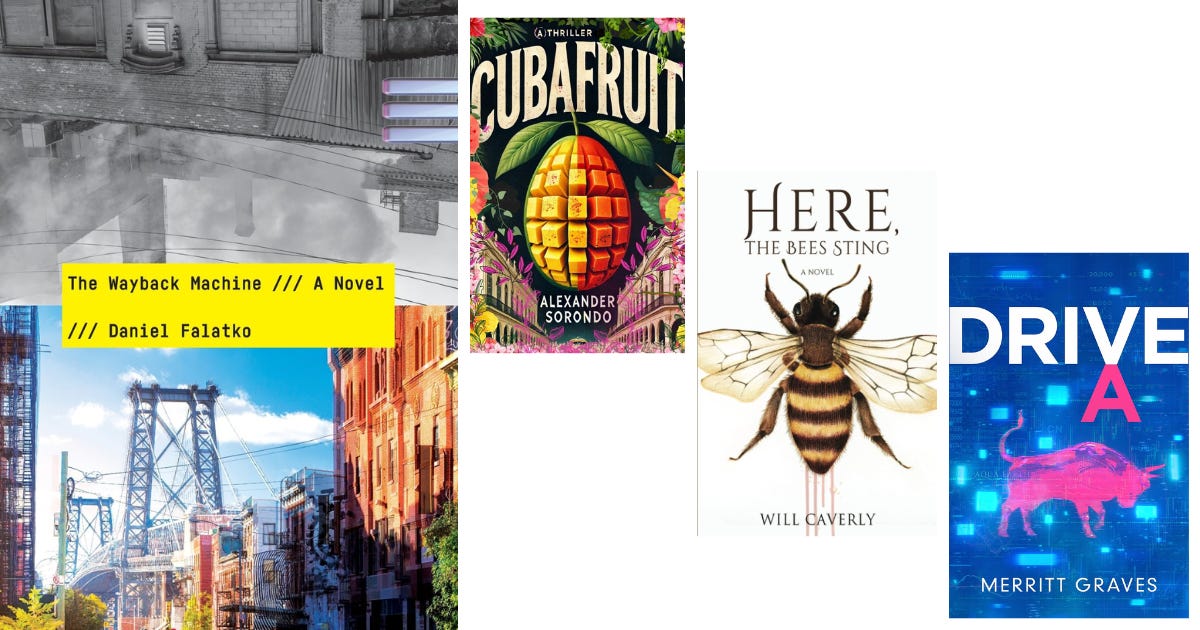
And that’s our winner! Dan Falatko’s The Wayback Machine, a novel about a former music journalist—the writer for thinly-veiled fictional analogues to Pitchfork and Vice—who gets out of prison and starts asking some serious questions about what happened to that early aughts world! Where did it all go!

I loved the book. It’s obviously the product of personal obsession and a deep love for the subject matter. It was self-published in February 2025, and now, a year later, it’s won an award and has received a fair amount of critical attention. Hopefully good things lie in wait for this book and this author.
Our three runner-up books were:
Alexander Sorondo’s Cubafruit
Merritt Graves’s Drive A
Will Caverly’s Here, The Bees Sting
I can recommend all of these books! Cubafruit has already gotten a lot of buzz on Substack—it’s a sprawling literary thriller about a biographer who is targeted by a dictator’s contract killer (it was reviewed by both X and Y). And Drive A was my original finalist pick--I wrote about it here, and so did Moo Cat.
And I really had a special place in my heart for Here, The Bees Sting, which I thought was a highly-accomplished novel. This book is amazing, it’s a mystery. There’s a bunch of people in a valley who are being terrorized by killer bees. And a bee inspector goes out to find what’s happening, what’s driving the bees insane. But then, the story is also told from the perspective of the queen of this bee hive, who is flailing and facing rebellion from her workers. The hive is suffering from some mysterious illness, and they’re blaming the queen for her poor leadership. The bee sections were top-notch, really well-done.

Final Thoughts
I started this contest because I have many online acquaintances who have self-published novels, and I wanted to be able to highlight work their work in a way that felt fair, and not just like I was praising whoever had the most online clout. To this end, I enlisted our wonderful judges and tried to create an impartial judging system for judging.
Hopefully, this decision feels somehow legit: I follow Dan Falatko online, but I would not say our relationship is particularly close, and I probably would not have read his book without this contest. There was another entrant, Peter Shull, who I felt much more positively about (so much so that I read his book on my own and wrote about it). Shull also entered this contest, but his judge didn’t select Why Teach? as a finalist so it was eliminated in the first round.
Personally, I am happy that I ran this contest. I am terrible at organizing things, so it was a bit stressful to be responsible for producing a result (I spent MUCH time wrangling with spreadsheets and Google Drives), but, as I’ve mentioned before, I found it to be a very emotional experience to look through these books. It was just clear to me that a lot of care had gone into the books, and that they were products of a profound passion.
I am in favor of self-publishing. It’s easy to be in favor of ‘gate-keeping’ in the abstract, but what happens when you’ve worked five years on a book and nobody wants to publish it? Yes, you can definitely take ‘no’ for an answer: I know many talented writers who’ve done that. In some cases, they’ve gone on to publish other books, but in most cases they’ve quit. Ultimately, I think each person needs to be their own gatekeeper. Yes, if the world is telling you that your work is no good, then it’s worth listening to that voice. But sometimes you go back to the book and re-read it, and you think, I just don’t agree.
Self-publishing is an author’s assertion that their work matters and that it deserves to be in the world. That’s not an easy statement to make.
With this contest, I hoped to honor these authors by taking their work seriously. Hopefully the authors got something out of it, but I would also completely understand if someone out there is shaking their fist saying Naomi has no taste! She is a horrible judge, a horrible reader! Luckily, I am not a gatekeeper. All the works that were entered into this contest—whether they were finalists or not—are free to purchase online, and I hope that they all manage to find the readers that they deserve.

Links and Acknowledgements
Thank you to all of our judges! They signed up for this very speculative venture, and I hope they got something out of it. They’re free to write about their judging experiences if they want. Our ten judges were: myself, Ani N, Lillian Wang Selonick, Kevin Dillon, Buku Sarkar, Adam Fleming Petty, Phil Christman, T. Benjamin White, Moo Cat, and Abra McAndrew.
I do think there’ll be a second round, but not right away—probably in 2027. In the meantime, please check out The Wayback Machine and our other finalists (links are to the Amazon page for each book):
Winner:
The Wayback Machine by Dan Falatko
Runners Up:
Cubafruit by Alexander Sorondo
Drive A by Merritt Graves
Here, The Bees Sting by Will Caverly
Other Finalists:
Glitterballs by Michele Howarth
Ms. Never by Colin Dodds
A Flight of Saints by Elizabeth Braithwaite
Zodiac Pets by Eric Giroux
In Judgement of Others by Eleanor Anstruther
Wide Walt and the Rock Creek Gang by Brian Jordan
Thanks for putting it together Naomi, I think you did great! Spreadsheet hell delivered a professional contest.
What a great thing you are doing--it's an act of service, really. Thank you for putting these titles on my radar.