
In 2010, I moved to Oakland, where I started spending every evening with a friend of mine named Brian—a former college roommate. Brian lived in the top half of a house in West Oakland, at 32nd and Hollis. His landlord owned several adjacent houses, around which they had constructed a tall corrugated-iron fence, creating a sort of compound.
Brian was a cello player, and he played in several folk-pop bands. Many of his closest friends were also folk-pop musicians, and because we were friends I went to a lot of house parties and warehouse shows where people played this casual, gentle music (this was before The Lumineers became popular, but the music was basically the same as The Lumineers). Many men in this scene wore tight pants, had beards and sported lots of tattoos. A few self-identified as hipsters, though most didn’t, because being a hipster was considered an insult. A hipster was somebody who just cared about style, didn’t have any real political or social project—they only wanted to be cool.
There was a kind of anti-establishment ethos. A lot of these people only worked part-time, kept their expenses low, didn’t see a place for themselves in mainstream society. But they were also young—most of them have kids and jobs now. Many of them have gone to graduate school (Brian is now a medical doctor).1
Anyway, while I was friends with these people, I heard a lot about various musical acts: Belle and Sebastian, Arcade Fire, Vampire Weekend, Neutral Milk Hotel, Bon Iver. Those are just the names I remember. I never thought even for a moment about listening to this music—I mostly listened to country music—but people seemed pretty excited about this kind of stuff.
At the time, there was definitely a feeling that this way of living was pretty cool. Oakland hipsters had a bit of a superiority complex when it came to San Francisco--we hardly ever went to SF, and we just thought, you know, SF was corporate, boring, expensive, full of rich people. If you wanted to be free and not be enslaved to the machine, you lived in Oakland.

The Hipster Novel
For a long time, I felt very nostalgic for this period in my life—it was great to have somewhere to be every evening. Great to walk into a party and already know half the people there. Eventually I went East for grad school, and the comparative sterility of campus life convinced me that I wasn’t cut out for academia.
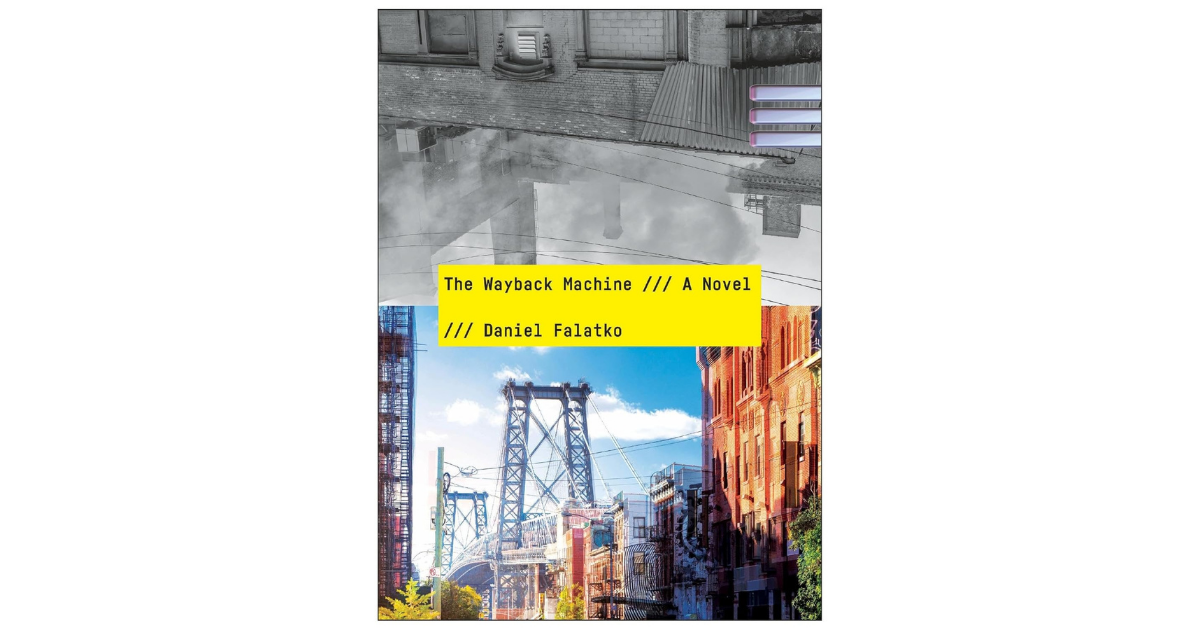
I recently read a novel by Daniel Falatko, The Wayback Machine, that is about feeling nostalgia for the hipster era.
This novel is about a man in his forties, Nathan, who participated in the early-2000s New York hipster era, writing for fictional versions of Pitchfork and Vice (which the novel calls Dagger and Bad Habits). At some point in the aughts, Nathan ran afoul of the law, for reasons that go unspecified until late in the novel, and he’s spent most of the intervening years rotting in prison.
But when the novel begins we’re sometime in the 2020s (I forget if the novel specifies an actual year)—Nathan’s been released from prison. It’s almost like he’s been in stasis for fifteen years. Early in the book, he reflects on his own appearance, and it becomes clear that he hasn’t moved on mentally from the early-2000’s, even though his body has aged:
It was a body that would have worked perfectly on a suburban father of two, but as a lone individual awaking in a paper condo on the Lower East Side, it was just sad.
And to think this was the same person who twice had sex with Cat Power, who had met and emailed with m.i.a. even though nothing ever came of it, someone whose girlfriends at one time were an unbroken string of part-time models for places like American Apparel, bad habits, and Mama Stone Vintage.
Nathan is mired in nostalgia for his own youth—a nostalgia that expresses itself in a nonstop stream of references to stuff that have no meaning to me (is Mama Stone Vintage real?) and presumably have no meaning to the reader either.
But Nathan is determined to steward the memory of his hipster youth, so he decides to appear on a podcast that’s dedicated to early aughts music trivia. Nathan goes on this podcast, which is hosted a pair of twentysomethings named Noah and Micah, and he starts spinning a lurid story about these magazines and about the record label, Industry Plant, for which he subsequently worked as an A&R Man.
His story is a somewhat Epstein-esque tale about the interlocking wheels of money, sex, and online clout. He claims that all these magazines, and their associated bands, were fundamentally dishonest, and that this whole music scene was manufactured, driven by money.
Through this podcast interview, we learn more about Nathan’s history. He came to the city as a kid. He made a name for himself as an pseudonymous commenter on this music magazine’s forums. His unique voice not only helped define the magazine, but also resulted in a kind of fame—suddenly he was a person to know in this city. He had girls, clout, a burgeoning career.
Nathan: You could earn 30k per year and live like a total rockstar. Get a space in a massive loft with like five other people. Go out every night. And people were fucking, man. Whenever I think back on some of the girls who gave my broke, malnourished ass attention at the time I tend to start weeping. All you needed was a look. Some dudes were pirates. Others sea captains. Some dressed like Keith Richards in 1972, others like Scary Monsters-era David Bowie or the front row of a Siouxie and the Banshees show at Cavern Club in 1982. Girls walked around with ukuleles and wore Indian headdresses.
Micah: Woah woah woah, girls were cultural appropriating right out in public?
Noah: That phrase didn’t yet exist, Mic.

The book could’ve used a villain
This novel maintained a strong hold upon my interest. It’s remarkable how much mileage you can get simply by withholding information. In this case, the book doesn’t reveal why Nathan went to jail until about the 2/3rds mark. It’s not a highly plot-driven book, but there is a kind of paranoid quality to it—Lillian Selonick pointed out its resemblance to a Philip K. Dick novel. Much of the tension comes from the insinuation that there is a vast shadowy conspiracy dedicated to suppressing these truths that Nathan insists on telling.
The book alternates between the transcript of this podcast interview and the story of Nathan’s present-day life, before and immediately after the air-date for the interview.. It’s a pretty unstructured book—the antagonists are loathe to appear onscreen, so we spent a lot of time just waiting for them to collect Nathan and (presumably) send him back to prison.
If I had any issue with the book, it’s that the antagonists could’ve been developed better. There was an excellent movie, released last year, called One Battle After Another, and this movie really built out its villains. It started with Colonel Lockjaw—a racist meathead with a fetish for black women. But behind Lockjaw there was a group of avuncular white guys called the Christmas Adventurer’s Club whose ridiculous mannerisms cloak their deadliness.
The Wayback Machine needed something like this. When, at the end of this novel, the actual villains step out from behind the curtain, they seemed like nothing special—I wanted an antagonist who had a bit of that Colonel Lockjaw charisma.
I think the problem is that the hero, Nathan, is so corrupt that it’s hard to imagine what a bad guy would really look like. Our hero participated, to some extent, in all the bad things he described (pimping out hipster girls to investors, selling good reviews, and dealing drugs with indie bands as a front). However, unlike his superiors (who are only out for the money), Nathan has some hard-to-articulate belief that this music scene is serving the higher good.
In this context, a true villain would be someone who was only involved in this scene for the clout, but…Nathan himself describes paying review outlets to give good notices to bands that he doesn’t think are good. So…how can he really criticize anyone else? If I was giving notes on this book, I’d say the author ought to have allowed Nathan to be good. Give him integrity. Give him a cause. Give him a line that he wouldn’t cross, and make that the reason he went to prison.
Probably I’m just projecting here, but when I think of my early novels, I really wish I’d been less cynical and had instead given my heroes the opportunity for their goodness to shine through. In Nathan’s case, there is a goodness that is clear to any reader, I think, but that goodness could be dramatized a little better. That’s what’s nice about a well-realized villain—they’re the shadow-self to the hero. For instance, in Moby-Dick, the first mate, Starbuck, seems so colorless and ineffectual, but when he’s up against Ahab monomania, we see that Starbuck is the closest thing on this boat to a sensible person. Similarly, if we put Nathan against someone who was truly, terrifyingly corrupt, maybe we’d have a better sense of what Nathan truly holds sacred.

Hipster music culture was shallow
I think what really sold the book for me was its ambivalence. For some reason, it’s vitally important for Nathan to tell people something about the hipster. But what precisely is he trying to tell them? Even Nathan is aware that this era had a problem.
And their problem is that this indie-music culture feels so shallow and image-obsessed that it’s quite hard to take its pretensions seriously. You see this in the novel, where there is so much talk about various musical acts, but nobody actually describes going to a show or experiencing some kind of strong feelings while listening to music.
Or, as Nathan puts it:
The instinct [in the aughts] was not to “stan” the things you loved, to gush about them and compose long treatises on why they were important….It was to tear them down. Because you were jealous.
This book evinces the same tendency, but writ large. Nathan loves this hipster era, and he shows that love by tearing it down, cheapening it, exposing all its compromises and lies. Which leaves both his interlocutors asking, “Was the hipster era actually good?”
Ultimately, the novel seems to say that when this era started, it was good. It was a way for ordinary kids from the suburbs to move to the city and quickly experience the kind of glamorous urban life they’d always dreamed about. But its goodness lay in its accessibility, and ultimately that accessibility is what destroyed it. The city became too accessible, too many people arrived, everything got too expensive, and all the signifiers of hipsterdom—the clothes, the concerts, the niche foods—got commodified, so now all you needed was money—you didn’t need any real cultural knowledge anymore.

Not sold on the narrative of cultural decline
If you’re over forty and have creative aspirations, then you likely believe there’s been some kind of cultural decline in America. But I am not actually certain this decline is real. 24-year-olds still write for blogs. They still get micro-famous on internet forums. They still move to the city and live in rented closets and go to house shows. We, as fortysomething Naomis and Nathans, don’t do those things anymore, but that’s just because we’re old—not because they aren’t happening.
However, that’s not a knock on the novel. It’s not a manifesto or s blog post, it’s a fictional story about a person, Nathan, who had a great time in his twenties and can’t forget about it. It’s about nostalgia and being mired in nostalgia, and trying to justify that nostalgia to an audience of kids who are at least somewhat interested in hearing your story, because these kids suspect (just as the early-aughts hipsters did in relation to their Gen-X older brothers) that their own lives possess an ersatz quality and that they themselves are only a hollow imitation of some truer culture that predates them.

The Samuel Richardson Award
For the past year I’ve been running a contest for best self-published literary novel. The contest had no entry fee, and it offers no prize money. The only reward is attention—reviews like this one. The Wayback Machine was a finalist for this contest, which is why I read it.
In the first round of judging, our judges selected ten finalists and wrote about their picks (two finalists are unfortunately missing their reviews, because the judges dropped out after selection).
Eleanor Anstruther’s In Judgement of Others
Brian Jordan’s Wild Walt and the Rock Creek Gang
Then, in this second round, each judge has picked their favorite from amongst the ten finalists. The Wayback Machine is my favorite from the Samuel Richardson Award finalists. It was a tough decision, but it held my interest the best. I really admired the energy of the writing—it’s not easy to write a book that’s seemingly so unstructured (it doesn’t really have chapters).
[The author] never tries to be too smart. Most of the characters are doped up with brain enhancers and fancy degrees from elite schools, but our protagonist is just like us: amazed, weary, and wary. The hyper-meritocracy of Graves’ world is never boring.
T. Benjamin White picked Cubafruit, saying
…for the time I had the book open in front of me, I was living in Cubafruit. It was one of the most immersive literary experiences I’ve had in a long time.
Lillian Wang Selonick picked The Wayback Machine, comparing it to a Philip K. Dick novel:
What is the essence of a PKD novel? Menacing darkness, deadpan humor, epistemological uncertainty, a malevolent and/or indifferent woman—the levels on the mixing board are set just so, and most attempts to replicate or remix the masters fail. My choice to win the contest has engineered a solution.
Adam Fleming Petty also picked The Wayback Machine, despite his suspicion that he was too much the target audience for this book:
Yet though I began The Wayback Machine a skeptic, I finished it a convert. Turns out, I love being a target market! Take it from this white man: being pandered to is the best! But that is not the only reason I selected this book as my personal vote for the Samuel Richardson Prize. Yes, this idiosyncratic and personal book made me respond to it in an equally idiosyncratic and personal way.
To be clear, The Wayback Machine might win this contest, but it has not won yet. I asked all the judges to turn in numerical scores for each book, and half of them have not yet turned in their scores (myself included).
Once we have everyone’s scores, I will take an average and the top-scorer will be the winner. Once the winner is announced, I’ll ask every judge to write about the winner—there’s a lot of diversity in the scoring, so whoever wins it is certain that one judge or the other will hate it, and hopefully that’ll lead to a lively debate about the book’s merits.
In one of my early tales I wrote about the class dynamics of the Oakland hipster scene:
In this world, it was genuinely quite hard to tell who’d come from money and who hadn’t. It’s not that there weren’t markers—if people had gone to college, but they didn’t have student loans, that meant something. But what precisely did it mean? Usually it meant that if they didn’t want to be here, they could find some way, often through further education, of escaping. But so what? Many people of the people in this world had no desire to escape. Even if they functionally had no alternatives, they’d convinced themselves they were here because they chose to be. Indeed, this was a place that many people desperately wanted to enter.
“We, as fortysomething Naomis and Nathans, don’t do those things anymore, but that’s just because we’re old—not because they aren’t happening.“
Fortysomething is “old?” All I can say is that you are in for one hell of a surprise.
I don't think we need to make up some story about why hipster culture declined ... it had a good solid 10 years. That's about how long these things last.
I was the right age in the right place at the right time (20s-30s, Brooklyn) and fully enjoyed hipster culture. Still do. The music was great, the art was fun, the fashion was accessible. It had a massive influence on culture.
I'm not sorry it's over, what followed was exciting too (though I feel too old to be part of it)
Anyway...I can't decide if I want to read this. That time and place is so sparkly in my memory, do I want to add someone else's memories?