
Why Teach?
During my twenties, my friends would circle constantly circle around the same topic. They would ask, “Should I go for a career that earns money? Or a career that helps people?”
I personally had chosen a career that neither earns money nor helps people (writing fiction), so I couldn’t empathize, but I still had many, many conversations with various friends on this subject. It was probably the defining drama for my slice of the Millennial generation.
But I’ve never seen an examination of this topic in literature. That’s why I was so drawn to Peter Shull’s Why Teach? when I first came across a review in Isaac Kolding’s blog.1 I immediately bought the book, as I often do after reading a review. Usually that’s where it ends—the book sits on my kindle, and I never actually read it. But recently I remembered this book and decided to actually open it.
I spent the next three hours reading the book from cover to cover, very transported and impressed.
The reason people don’t write books about this kind of conflict—what should I do with my life?—is that it’s very difficult to dramatize. There’s a risk that you’ll end up with a lot of rumination and not enough suspense. Because ultimately, how can this kind of conflict get resolved? When it comes to choosing a career path, you just have to pick something. And whatever you pick—that’s what ends up defining you.
But Peter Shull makes a number of smart decisions that are designed to ramp up the tension in the book. The novel is about a young man, in his mid-twenties, who is employed as an English teacher at a school in his hometown in Kansas. The protagonist, William, loves literature, but does not love teaching—something he makes clear at the beginning of the book:
The truth of the matter was that I never planned to teach, never wanted to be a teacher. Not that I hadn’t liked school, or been good at it. I had; I was. But the profession never held an allure for me as it does for some. Not once did I ever look at one of my own teachers and think Yes. That. I would like to do what he (or more likely she) does for a living. To the contrary, if someone had told me when I was a 17- or 18-year-old that I would grow up to head a classroom, I’d have likely read an implied insult in the statement.
William occasionally entertains some kind of Dead Poets Society fantasies of instilling a love of literature in his students, but every year he has to face up to the reality. He teaches at a poor school, and because he’s a male teacher who is popular with the boy students, he’s often given difficult kids and has to teach remedial classes.
Still, he derives some joy from picking his curriculum and attempting to introduce students to some favorite authors. But this year, there’s been a change in direction for the school. They are no longer allowed to use the ‘old curriculum’, which includes readings from actual works of literature. Instead, they need to spend the entire year teaching narrowly to the annual assessment test.
Early in the book, a school administrator, Mrs. Hirsche, observes his class. Afterwards she informs him:
“I have evidence of you teaching novels, plays, poems, literary movements and papers, but not once—not once—do I have evidence of you making use of district provided test prep materials.”
He gets a write-up for not using the approved curriculum. But...what’re they gonna do? They can’t fire William, because his test scores are actually pretty decent! His kids are doing fine in the annual assessment. This school is not a good place to work—they have difficulty finding and retaining teachers, and they really can’t afford to lose him. Nonetheless, they can make his life difficult, and they do.
But Peter Shull doesn’t lean too heavily into the Cool Hand Luke vibe. That’s part of the joy of this book. There are no fiery confrontations, no lawsuits, no termination hearings. Everything proceeds at a relatively cool, even pace. The tension comes from how the author has learned to turn the screws ever-so-slightly. Each time you think that you understand the situation—“Oh, he’s a rebel, standing up for literature in this school”—then there’s a scene in the classroom, where you realize these kids don’t necessarily care about any of the stuff he is teaching. And some of them are not doing well--some of them genuinely can’t read well, they need to learn something that William is unable to teach them. He is in charge of this classroom, and he is participating in the travesty of sending kids out into the world who don’t have the bare minimum in terms of reading and writing skills.
Of course that’s not true of all of his students, but it’s true for some.
Given that, why do it? He doesn’t love this job, and he’s being harassed by his bosses.
Then, on the other hand, there’s law school. His dad is a lawyer and makes a good living. William has applied to law school, and if he gets into a good program, he’s fairly certain he’ll attend.
So what will happen? What will he do?
I genuinely did not know. The book was told very unsentimentally. It seemed entirely possible that he could reach the end of the book and throw up everything, give up teaching. I have several friends who were teachers and did exactly that. One member of my (real-life) book club gave up teaching after ten years, learned to program computers, and is now much happier.
The book is so good. My only note is that the first chapter is superfluous and the second chapter makes a much better introduction to the text (my first quote above is from the beginning of the first chapter). After about thirty pages, I realized I was in the hands of a real storyteller and I relaxed—I felt trust that Peter Shull was going to bring this book home in a satisfying way.
I cannot describe to you how artful this book is. The alternating between his school life and his home life, and between the classroom and his confrontations with administrators—even the placement of his trips and school breaks—everything happens so perfectly. And it needs to happen perfectly, because otherwise this quiet, simple book would become boring.
I have never read anything else like this book. It’s not a problem novel. It’s not a polemic. It’s not meant to encourage people to teach. It’s a work of psychological realism that’s about one of life’s central dramas: the choice of profession.
I really highly recommend the book.

Why Teach? was self-published—it was actually entered by its author for the Samuel Richardson Award. I held off on writing about it, not wanting to pre-empt the assigned judge, but he’s informed me that he’s picked another book instead (which is fine). So Why Teach? is not a Samuel Richardson Award finalist, but it is one of the most interesting contemporary books I’ve read.
I don’t like how in reviews of self-published books, the work’s publication history becomes the real story. Everyone asks, “Why wasn’t this published by a big press?” And then people give the book a paranoid reading, where they try to justify, in their minds, the fact that a big press didn’t pick it up.
In this case, it’s quite obvious why no big press picked it up. There is nothing else like this book. It has no comp titles. There has never been a break-out book quite like this. My understanding is that agents weren’t interested in representing this book—I sympathize with that. I also wouldn’t want to be in the position of convincing a publisher to put it out, because publishers want to slot every book into some pre-existing market niche, and in this case the only possible niche is women’s fiction, but the book is about a twenty-five-year-old man, so that would be a very difficult sell. Putnam or Union Square or Park Row are not going to publish a book about a twentysomething guy.
The ‘literary fiction’ category offers one way for weird, offbeat books to get published. But to publish a literary novel, you really need some kind of credentials.2 If Peter Shull had an MFA, had a Stegner Fellowship, had gone to Yaddo, maybe agents would be more interested in this book. But even then, it’s sufficiently strange that I don’t know if they would be.
I often hear people say that the publishing industry has no room for avant-garde or experimental literature. In fact, many of the judges for the Samuel Richardson Award have expressed surprise that more of the entrants to the contest weren’t overtly experimental, that’s because there’s a stereotype that the literary world isn’t receptive to talented work. That stereotype is not true though. The literary world is extremely interested in talented work, but it has to be talent that comes in a form that they can understand and package.
In my opinion, it’s actually easier to sell an avant-garde, experimental novel than it is to sell an apparently artless book like Why Teach?. There are avant-garde presses, like SemioText(e) and New Directions. And there are avant-garde authors who’ve sold relatively well, like Rachel Cusk and Helen DeWitt. So with avant-garde books, there is actually some kind of ecosystem for supporting the work.
But there’s no obvious place on the market for a book like Why Teach?, which is simply a realist novel that doesn’t resemble any other realist novel. Nonetheless, Peter Shull persevered. He gave this book an attractive cover. He hired an editor to give him comments on the book. He made the best possible book, and he put it online to see what would happen.
I think that good things are in store for him. He has done what very few people have done: publish an accomplished debut novel on his own, while remaining completely true to his vision. In the future, he will publish more novels. Many of these books will also be very good. He will accumulate fans and followers and a body of work.
Peter has shown faith in his own abilities, and I believe that faith will be rewarded. Someday people will say, “How come in the early 21st century, every book was either about an envious loser in a creative profession or a twentysomething girl who’s screwing an older man?” And somebody else will say, “No, that’s not true. There was one guy who wrote about stuff that really mattered.”
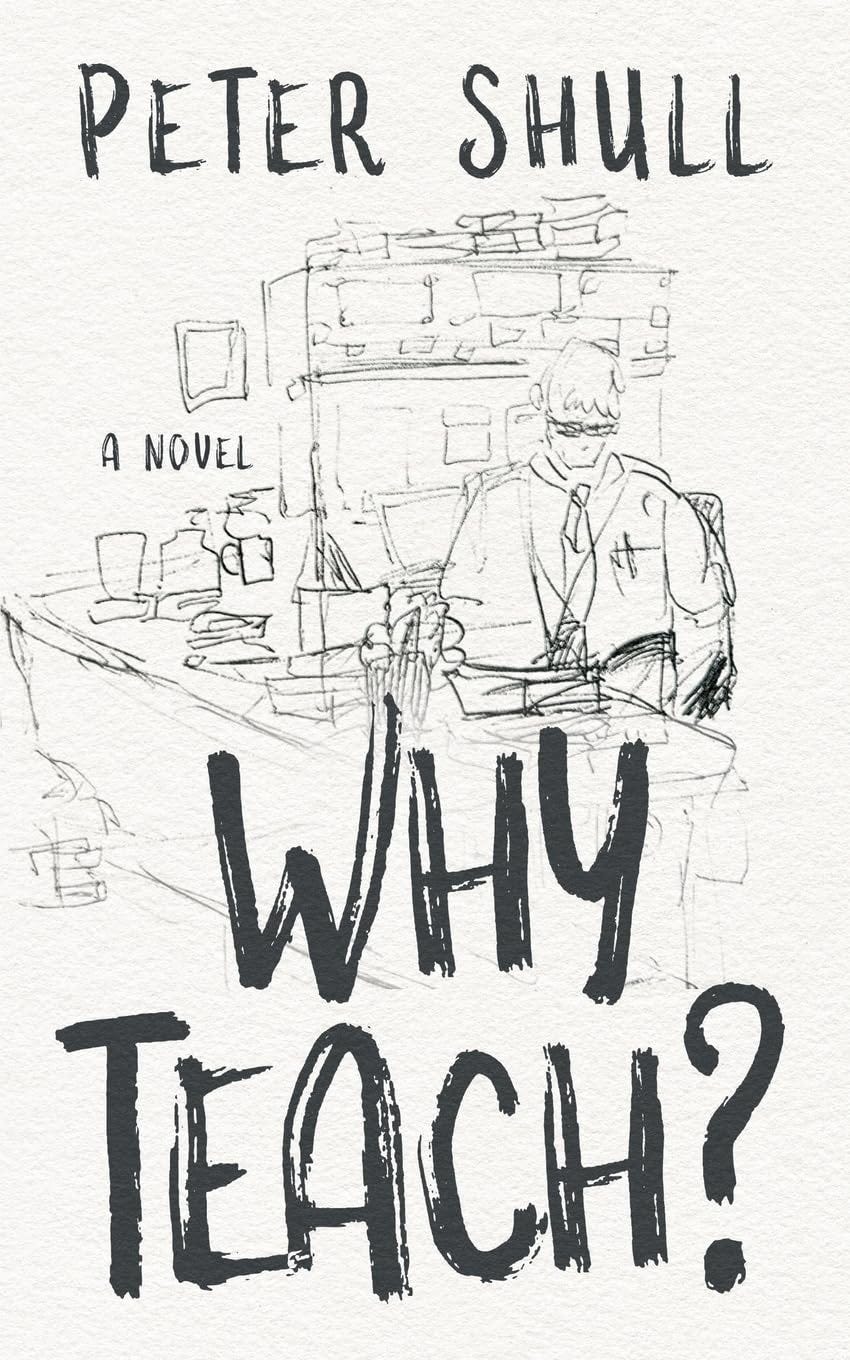
P.S. If you want to purchase Why Teach? here’s a link to the book on Amazon (paperback / ebook) and to Bookshop. Peter Shull also has an engaging newsletter you might consider checking out. His most recent post is about how educational testing has ruined our schools.
P.P.S. No story this week! My next post will be Tuesday, December 16th.

Seventh Samuel Richardson Award finalist announced!
Speaking of the Samuel Richardson Award, a seventh finalist has been announced! Adam Fleming Petty selected Elizabeth Braithwaite’s A Flight of Saints:
A Flight of Saints is the story of Sister Lucia, a young nun living in a convent in Northern Italy, in the year 1179. The convent was once a place of peace and purpose for Lucia, looked over by a benevolent abbess she adored. But a power struggle is taking place within the church at the time, and the abbess is forced out. The new abbess, Mother Clothidle, is cruel and harsh, so much so that Lucia forms a plan to escape the convent and travel to Bingen, where the beloved and saintly Hildegard ministers. A long and treacherous journey through the Alps.
Please check out the book! As a reminder, if anyone of you want to review any of the books that are a part of the contest (including Peter Shull’s Why Teach?), I’ll link to their reviews here. The other finalists are:
Here is a link to Isaac Kolding’s review. If you haven’t subscribed to Kolding’s newsletter, you should definitely consider it. He’s finishing a PhD in English Literature, and he’s great at making the intellectual currents of English academia seem somewhat-accessible.
For more on publishing a literary novel with a big publisher, see my post on why a creative writing degree can be quite useful.
I was fortunate to read this some months ago when Peter sent me a copy. Like you, I was impressed. And Peter is a great guy. You have done a good job capturing the premise and the shenanigans surrounding the publishing as well.
So I've just immediately subscribed to the reviewer and bought the book... These are vital questions to me: not just "Why Teach?" (I'm a teacher, and I ask myself every fuckin day), but also "Why Write?"; "Why Self-Publish, if no one wants your book?" (I did); "Why KEEP Writing?" .... Your thoughts here are very vital to me, and I thank you for putting me onto the work of those others involved.