
The 'weird girl' novel
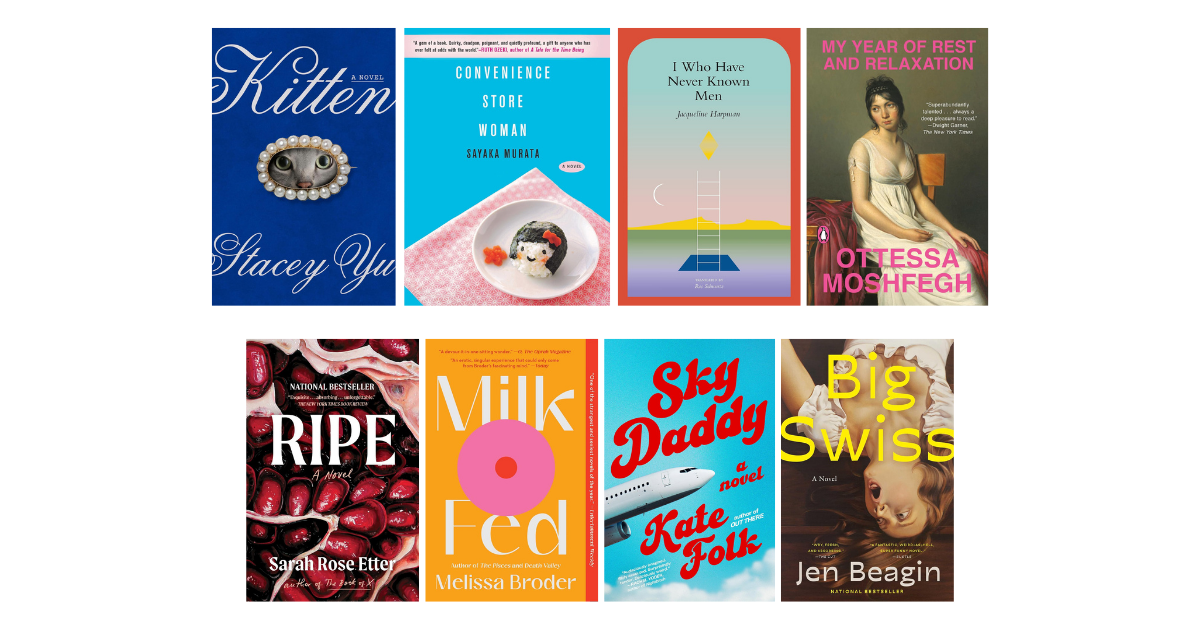
I recently read Kitten by Stacey Yu. I picked up the book because Petya Grady had raved about it, and I was intrigued by the premise: it’s about a young woman who becomes obsessed with her boyfriend’s cat.
Before reading this book, I was vaguely aware of the term ‘weird girl literature’, but as I read the novel, I just started to feel a sense of uncanniness. This novel is so strange: it’s about a very lost, passive girl. She has recently graduated from college, and she’s just lost her job. She’s dating a guy who is older (twenty-six to her twenty-two). He’s from a well-off family, and he also has a good job. But meanwhile this girl can’t really pay her rent, and her roommate is dunning her. Then her roommate tells her that they’re getting evicted, and the roommate has already found a new place to live.
She and her boyfriend go on vacation for two weeks to his family’s home…somewhere. It’s a made-up town named Holme. I think it’s supposed to be the Hamptons, but I wasn’t sure. Most of the novel takes place during the vacation. There is built-in tension because her life is falling apart, and she is so directionless. Her boyfriend is sweet, but he’s in over his head with this girl, who seems to have problems (something he vaguely comes to understand).
As I was reading the book, I kept wondering, “What do I expect to happen in this book?” I guess my expectation was that she would turn into a cat. But that’s not what happens.
The book held my interest, and I am happy for the time I spent with it. But I was left unsure how to write about it. The book felt like a visit to a strange country. I do not know the customs in this country, so I am unable to say whether this book is doing anything that is out of the ordinary by the standards of the people who inhabit this place.1
I had some free time, so I decided to educate myself about ‘weird girl literature’.

Assembling the list
My first stop was the r/weirdgirlliterature subreddit, which (rather amazingly) has eighty thousand followers! It seems like a highly active and dedicated community, given that this genre is surely less than five years old.
As far as I could tell, the term ‘weird girl literature’ appeared on BookTok sometime around 2020? Like all genres, there’s a lot of debate about the boundaries of weird-girl literature. But there seem to be a few reliable touchstones in the weird girl canon:
Ottessa Moshfegh’s My Year of Rest And Relaxation (2018)
Sayaka Murata’s Convenience Store Woman (2016)
Jacqueline Harpman’s I Who Have Never Known Men (1995).
I also did some scouting on the internet, looked at some articles, and solicited recommendations online, and I came up with a bunch of other weird girl recommendations
Jen Beagin’s Big Swiss (2023)
Melissa Broder’s Milk Fed (2021)
Sarah Rose Etter’s Ripe (2023)
Kate Folk’s Sky Daddy (2025)
So, with this list of books in hand, I began to read.

Convenience Store Woman
Oftentimes when I go investigating some kind of cultural phenomenon, I just think, “This isn’t for me.” Like a few months ago I invested a lot of time into progression fantasies and LitRPGs and at the end of the day, I just didn’t get it. The books were boring to me.
But with Convenience Store Woman, I immediately got it. This novel is very short—it’s about a Japanese woman who works at a convenience store. From childhood, it’s clear that something about her personality doesn’t really fit with human society. She doesn’t understand what’s expected of her. After she engages in some behaviors that land her in trouble at school, she finds herself distressed by the inability to meet expectations:
My parents were at a loss what to do about me, but they were as affectionate to me as ever. I’d never meant to make them sad or have to keep apologizing for things I did, so I decided to keep my mouth shut as best I could outside home. I would no longer do anything of my own accord, and would either just mimic what everyone else was doing, or simply follow instructions.
Then, as an adult, she gets a job at a convenience store, and, wonder of wonders, her job is fully routinized. There is an employee manual that explains exactly what to do. She takes instruction well from her various managers and models their behavior, and she functions happily at this store for eighteen years.
But, troublingly, some people expect more from her! They want her to get married or to have a better job.
After about fifty pages, she finds a boyfriend, and this changes how people view her, but she doesn’t like the change! She doesn’t like people seeing her as human! Now she has more friction with her family and coworkers, and this is very distressing to her.
The book is so bleak. I couldn’t believe it. I am basic, normally I wouldn’t read something that was so barren—I faulted Tony Tulathimutte’s Rejection last year for being too sad (I have softened a bit on that opinion). I feel like, I dunno…life is bleak enough. The truth of human existence is bleak. The point of fiction is to give people a shiny myth, so they can keep existing.
But I guess not! You learn something new every day. I learned with Convenience Store Woman that maybe you can just tell the (seeming) truth, that human existence is pointless, and people will enjoy it. I certainly did.

I Who Have Never Known Men
This book! Oh my god, what a book. Somehow, it is even more bleak than the last book. I had vaguely heard something about this book before. My understanding was that the book was about some women who were trapped in a cage together for no apparent reason.
I thought, “How could this possibly work? That doesn’t seem like a very interesting novel.”
But how wrong I was! There’s just enough incident in this short book to keep you reading. They get out of the cage eventually. They wander around outside. Everybody else on this whole entire planet is dead! The whole planet, whereever they go, is just full of dead people rotting in cages, folks who starved to death because they didn’t manage to escape. These women are the lucky ones, because they’re still alive.
These women are not on planet Earth (in my opinion), but it’s really unclear where they are, or how they got there. These women live for decades on this planet, until eventually they die, one by one. Then the narrator (who is the youngest) walks around some more until she dies too.
Just enough things happen so that you’re not bored. And it’s a fine line, right? If too many things started happening, then you’d be distracted from the underlying horror of this empty existence. This book walks that line perfectly.
It also helps that the situation is so unrealistic. If this story had felt like something that could actually happen to me or someone I loved, I would’ve stopped reading. It doesn’t resemble anything even from science fiction—it feels purely like a thought experiment. Because this situation could never actually happen, you’re insulated somewhat from the darkness. What a triumph. What a masterpiece.
This book was originally released (in France and Belgium) in 1995, and it was first translated into English and released in America in 1997. At that point, folks were like ehh, this is just another book, no big deal. The book was then reissued three more times over the next thirty years, without ever getting traction.
Until, in 2022, on its most recent re-release (by Transit Books) the novel got picked up by BookTok. But people talk about that fact—‘picked up by BookTok’—as if it’s somehow inscrutable. What happened is that some people—many of them young women who weren’t even alive when the book first came out—read the book and were like, This is awesome! And then they told other people about the book, and those people read the book, and they agreed, This is awesome.
The Point in their BookTok takedown really glossed over the remarkable fact that this book managed to get popular on social media. The author of this takedown went to such lengths to claim that the book’s success was tainted by way people talked about it. This seemed so unnecessary. My stance is that if a popular novel is bad, then you can blame the mass taste and say that readers are awful. But if a popular novel is good, then there’s no need for this performance at all! Instead, it’s your happy duty to say the opposite: “Wow, there is a community of people on the internet who is able to recognize excellence and can respond to it in a genuine way.”
Anyway, my journey into ‘weird girl literature’ continued apace.

My Year of Rest And Relaxation
Another book where, when I heard about the premise, I thought, “How could this possibly work? It seems implausible and boring.”
This book is about a young woman who’s got a reasonable amount of money because of the early death of her parents. And she elects, for whatever reason, to stay holed up in her apartment and take a lot of sleeping pills, so she will just sleep all the time.
Like the two previous books, this book had a difficult narrative task. It needed just enough incident that you’re not bored, but not so much incident that life starts to seem fun.
In this case, the book elected to fill its space with a fair amount of flashback and reminisce. I generally enjoyed the parts where we learn about her college days and her job and her childhood.
I also liked that this protagonist is attractive and revels in her good looks, something that is surprisingly rare in contemporary novels. In contemporary books, everyone wants to be pretty, but nobody ever feels pretty. Maybe that’s the reality of life today, but at least in our fantasy, as expressed through books, people ought to sometimes enjoy being hot.
But with this novel, there wasn’t quite enough incident. I got bored. A at some point I was just waiting for the book to end. A lot of the story is padded out by conversations with her best friend, Reva, who is needy and insecure. When the protagonist finally shows Reva the door, the pacing improves and the book gets much more interesting.
Then Reva dies in 9/11, and the story ends with the protagonist imagining Reva jumping from the towers. I think this was the best part of the book.
Still, this was a miss for me. I was bored. Also, not to be nitpicky, but I felt like the protagonist would’ve died. You can’t be taking this many sleeping pills and not eating—you’ll die. That’s what got Heath Ledger.

Milk Fed
Another book that didn’t quite work for me.
I still finished the book. The novel held my interest—it was much more interesting than the average book, so I am mostly rating it against the highs of the Harpman and Murata novels.
It is very unfair to Melissa Broder, I think, to group her novel artificially into a genre that she certainly hadn’t ever heard about when she wrote the book. Like, how, does it make sense to say that Milk Fed—a quirky sapphic book about a woman learning to accept fat bodies and fattening food—is somehow not as good as I Who Have Never Known Men, a book set in a horrible dystopian nightmare world about a plain, barren existence that’s only marginally better than death?
So, yes, it is unfair. But then…if it wasn’t for the fact that these books had been artificially grouped together in a certain genre, I wouldn’t be reading them at all. That is the double-edged sword of genre. If your book plausibly fits into a certain genre, it’ll get much more attention than if it’s floating free, without anchors to any community. I saw this with the Neo-Bernhardian books—there’ve been so many takedowns of these books, but if they weren’t part of such a very distinct genre, most of them would’ve received very little critical attention at all.
Milk Fed is about an assistant at a talent-management firm in Hollywood. Rachel is on a perpetual diet, and she leads a controlled, sterile, friendless existence. Then, in therapy, she crafts a fat girl out of clay. And this clay body (it is implied) is a golem, who is incarnated as Miriam, a girl who works at a local frozen yogurt place. Rachel and Miriam become good friends. Miriam is very fat, and she eats enormous quantities of food. While hanging out with her, Rachel also eats a lot of food. Rachel is sexually attracted to Miriam, and they eventually begin hooking up.
Miriam is from a very warm, big Orthodox family. And Rachel is attracted to her family as well. Miriam is a living Venus, who symbolizes life and abundance in all its forms. But their relationship is doomed, because Miriam’s family would never accept a gay daughter.
I wanted more. The book felt glib. It’s just too easy, somehow. I know plenty of women who are in love with other women who have a different body type, and it doesn’t necessarily lead to self-love. It’s easy to love in somebody else what you despise in yourself. So I didn’t necessarily buy that this love would be healing. But then if you’re going to be glib, then you should be glib, and love should conquer all. Being poised halfway between fantasy and reality didn’t really work.

Big Swiss
This worked slightly better. This book is also a sapphic love story. It’s about Greta, a woman in her mid-forties who takes a job as a transcriptionist for a sex therapist. The book is set in Hudson, a town in upstate, New York that was taken over by rich millennials during the pandemic and turned into an expensive hipster paradise. This is the second book I’ve read recently that was set in Hudson—The Ten Year Affair also took place here. I have to think that, given the demographics of the town and its proximity to New York, we are going to be seeing a lot of fiction set in this place over the next ten years.
While transcribing these sessions, Greta becomes fascinated by one of the clients: Flavia, a 28-year-old gynecologist who was the victim of a really horrible violent incident when she was twenty. When they later meet at the dog park, Greta pretends she doesn’t already know Flavia’s most intimate secrets. Instead, she befriends and seduces the younger woman.
Narratively, the book gains a lot of steam from this underlying deception: I wanted to know what would happen next, whether Flavia would accept Greta despite her lies and manipulations.
It’s also a fairly hot book. I liked the sex scenes. I liked the descriptions of Hudson’s colorful inhabitants. There is Om, the kindly sex-therapist, who wears denim shorts and mesh shirts, and who seems like a joke, but actually seems to have a lot of insight. There’s the run-down house from the 18th century, where Greta lives with her friend Sophia. The house has no heat and seems like both a sanctuary and a squat. There’s the various other sex therapy clients, who come in and out of Greta’s life—it’s a neat trick how we will meet some seemingly normal person and then Greta will tell us about their sex thing.
And there’s a darkness that runs underneath the book. Flavia’s past is horrific, but Greta’s past is also pretty bad—her mother committed suicide when Greta was thirteen, and Greta was raised by an assortment of aunts and uncles. Flavia is a compelling character, because she is so Swiss (her national origin is why the book is named Big Swiss). She is quite cold and matter-of-fact—she refuses to dwell upon what happened to her. She’s both adventurous and a little fragile. You can see why Greta is in love with her.
I enjoyed this book more than Milk Fed, but…it wasn’t depressing enough. Greta’s life in Hudson seemed good! It seemed a lot better than most peoples’ lives. It’s a warm community, full of colorful characters. Most people like Greta and want to help her. And although she’s behaved abominably by deceiving Flavia, I didn’t have the sense there would be long-term consequences. It honestly just felt like a romance, but (again) without the Happily-Ever-After.
However, reading these two books, I am realizing that’s just how some of these books are. They’re quirky. They’re about people who don’t quite fit into society, so they form off-beat friendships and relationships that don’t quite follow the typical script. And…that’s the book. They are comforting to read and certainly not bad, but I personally wish these books cut closer to the bone.

Ripe
A return to despair! Sarah Rose Etter’s novel is about a tech-worker who is followed everywhere by a miniature black hole. The black hole doesn’t do anything and doesn’t have any plot significance—it just symbolizes how empty and meaningless her life is.
It’s a workplace novel. The protagonist is alternately praised and bullied by her megalomaniacal bosses. This book is an accurate description of the post-rebellion mindset of the millennial office worker. Your job is meaningless, the company is evil, and the structure of society is corrupt, but there’s seemingly no escape, even on a personal level, so you just put your head down and hope to succeed at your work.
It’s like Fight Club, except there’s no fight club.
Once you get one job, then you get another job, and another job after that, and on and on. The years accumulate. Nothing about me had changed except the scale of my life: I got a new job or a promotion, I moved into a bigger apartment, I wore new clothes, I went to dinner at fancy places where the food was served on small plates. My emotions went blank, and I moved through each day as if in a meaningless dream.
Nothing really happens in this book. There’s some surface-level events that can hold your attention for the space of a few chapters—she’s dating a chef, she is involved with some intrigues at work, she has a troubled relationship with some of her friends—and these just keep you reading the book until her life finally crumbles.
I recommend it. Would’ve been my favorite of the contemporary ‘weird girl’ books except for...

Sky Daddy
What a book! Certainly my favorite of the American novels that I read for this post. I actually know Kate Folk—I see her once a year at a mutual friend’s birthday party—and she’s a relatively well-known author here in the Bay Area. So I had heard a fair amount about this book.2
This is another novel where I wondered how it could possibly work: it’s about a woman who is sexually attracted to airplanes. Once a month she takes a flight, in the hopes that the plane will demonstrate its love for her by choosing to crash.
I believed this was my destiny: for a plane to recognize me as his soulmate mid-flight and, overcome with passion, relinquish his grip on the sky, hurtling us to earth in a carnage that would meld our souls for eternity.
This idea seemed thin. I couldn’t imagine there was enough to hold my attention for three hundred pages.
But how wrong I was! What is so smart about this book is that Linda is odd, but she has social intelligence. She’s not like the protagonist of Convenience Store Woman, who is bewildered by human behavior. Linda gets it. She understands why people behave the way they do. And, moreover, Linda does have a desire for human companionship. She has two primary relationships. The first is with her coworker and best friend, Karina, with whom she spends a fairly large amount of time. And then later in the book she gets a boyfriend, with whom she also has a complicated and thoughtful relationship.
In Convenience Store Woman, there was an air of tragedy, because she lacked friend / family relationships and sexual connection—an essential part of life—but Sky Daddy isn’t quite like this, because Linda does have those things, but they’re just askew and unsustainable. For instance, when the book finally gets around to describing the way she pleasures herself (with a shard from a crashed 737) while flying, you fully understand why it’d be impossible for her to have a regular romantic relationship:
Each jolt issued a ribbon of pleasure through my body. I wedged my right hand under my thighs and pushed the chunk of 737 inside me. I didn’t require much additional stimulation while in flight. N108DQ brought me to the edge, and I pushed myself over. As we carved through rough air, I came silently, again and again.
Nobody would go on Hinge dates if they could have peak sexual experiences every time they fly.
The book is driven by Linda’s voice, which is so playful and fun, especially when she’s describing planes:
My date for Friday evening was N108DQ, a fellow I’d been with a few times before. I’d looked up his tail number only after booking the flight, a rule I adhered to with all my lovers, out of a superstition I harbored, something about how romance was dampened by overplanning. N108DQ was a fine twenty-year-old 737-800. I’d found him erratic and hot-tempered on our previous dates, qualities I ascribed to his lust for me.
But I was impressed by the book’s plotting and characterization too. Linda is not that invested in the personal lives of the people around her, but it’s clear that the author has thought a lot about this milieu, so as you get to know the side characters, you learn that they have a lot more depth than they initially appear to have (something that surprises Linda as well), and they’re all embedded in their own web of relationships that includes Linda, but doesn’t begin and end with her. It’s so fascinating that this book is about someone who’s quite isolated and self-absorbed, but she’s within a world that is very alive and much bigger than her concerns.
Overall, an incredible performance. Highly recommend.

A return to Kitten
This post was just supposed to be a review of one book, Kitten! Now I had read eight books, and it felt like enough to at least write my review. Returning to Kitten, I’ll note that this feels like the only weird girl novel (out of those I read) that was written with an awareness that it would be read as a weird-girl novel. Stacey Yu, the writer, is a popular BookTok creator and is quite young herself—she seems squarely within the weird-girl literature world.
And it felt, to me, like the novel was balancing some of the tropes of the weird-girl novel. Almost all of these weird-girl novels feature detached, anhedonic protagonists who are working low-level jobs without much hope for career progression or a better life. They all have troubled relationships with their mothers, who are often alcoholics or suicidal or have mental issues. They all have best friends who are slightly-happier and more-grounded. They (almost) all have these troubled boyfriend relationships, where there’s a man who’s interested in the woman, and the woman accedes to his interest, but you can tell something isn’t quite working. And they often have one element (the cat, the plane, the golem, the convenience store) that somehow awakens the protagonist and elicits a liveliness from them that nothing else can manage.
I think what separates Kitten the most from these other books is that the protagonist feels young. She’s not a weird-girl yet. She’s just someone who is sad and lost. She is obsessed with the cat, but the obsession hasn’t yet become world-dominating. So there’s a sense that maybe normalcy is an option for her.
If I was to critique the book, I’d say that the boyfriend felt underdeveloped. Something about him wasn’t quite working.
But, on the other hand, the relationship with the mother was much better-developed than in these other books. In the other books, the mothers were overbearing or somehow difficult, but in this book the relationship is quite different. Here, the protagonist was raised by a single mother, and for a long time, the daughter could be her mother’s best friend. But then, slowly, the daughter grew up, and she couldn’t be everything for her mother anymore. And she feels the sadness of that separation really keenly. I found it very affecting, because that’s just part of growing up, especially nowadays. You put so much into your children, and for a while they’re so close to you—in this case, the daughter had taken up painting purely because the mother loved it. But then that closeness ends, and although you’re in each other’s lives, it’s just not the same anymore:
My mother and I were very close when I was a girl, and then, against our best wishes, I grew older. It happened without my noticing, as if in some secret hour a crack in my brain widened and never again would I reach for her little finger. I started high school, learned I was good at it, and painted less. I made a few friends. Even so, I felt they knew something I didn’t, like the crickets that sang below my mother’s window.
If I was to rank this book against the others I read, I’d probably put it somewhere above Big Swiss—maybe around the level of Ripe. I liked that it cut closer to the bone than some of these books, and that you really feared for this protagonist and wondered if something terrible was going to happen to her.
In general, I enjoyed these books when they were sadder, when life seemed more meaningless. But there were exceptions: although I liked the starkness of My Year of Rest and Relaxation, it really didn’t hold my interest. And Sky Daddy was relatively less abject, but I found myself quite impressed by the way it embedded its depressing premise within a warmer worldview.

I know nothing about BookTok
Throughout this piece, my interaction with the weird girl community really occurred on the most basic level. These are books that are popular weird girl staples. All I wanted from this community was a list of what to read, and they gave it to me. I did not really look too deeply into the way this community tends to discuss these books, because I figured the books would speak for themselves.
Personally, I do not spend much time on TikTok. Awhile ago, I looked into BookTok, it just seemed like a lot of earnest young women monologuing on front-facing video about books they enjoyed. Similarly, when I looked at the r/weirdgirlliterature subreddit, it was just…an internet forum, where people discussed a genre of books they enjoyed. There was a lot of discussion of the relative merits of various books: I found plenty of people arguing that some of the books I discussed here were overrated, while others said no they were actually good.
To really understand BookTok or r/weirdgirlliterature, I’d need to spend a lot of time in these forums, and I have no wish to do that. But if you’re going to judge a literary community that you don’t belong to, then I think you have to judge it by the fruits. You need to judge it not by its trappings, but by the books themselves.
What I disliked most Selen Ozturk’s takedown of BookTok in The Point is that it is primarily a takedown of the discursive style of BookTok.
What’s new is that now the reader’s appraisal of the work, regardless of its ambition, caves into their emotional response to it. On BookTok, evaluation is testimony: the reader’s response to a book isn’t evidence in service of a judgment, it is the judgment.
Ozturk claims that even when BookTokers enjoy a book that is genuinely good, like (in her opinion) My Year of Rest and Relaxation and I Who Have Never Known Men, that they are not enjoying it for the right reason. They are not making a careful, considered aesthetic judgement of the book, they’re just operating on some purely base, thoughtless emotional level.
But that’s exactly what Ozturk is doing herself. She feels disgust for the discursive strategies employed by BookTok’ers, and she feels that they are uncouth and classless, and as a result they are bad readers (her piece is titled ‘Common Readers’). Moreover, this article, the BookTok takedown, was itself just an expression of pure emotion—anger and disgust—that was designed to go viral online (which it did). It was really no different, in essence, from the videos that it criticizes.
This article was so baffling to me. All I see in the literary world is a hunger to have an impact. All of these small presses, publishing little reissues like I Who Have Never Known Men, keep claiming their books are better than mainstream books from big presses. And journals like The Point, which love to review these reissued classics, claim to be at the vanguard of culture. But when one of those books actually does go viral and does have a big impact, then somehow that’s bad, because…people don’t talk about the book the way they’d talk about it if they were writers for The Point.
But don’t you see how insane this is? Imagine that you were in the business of promoting classical music. And you learned about this cool symphony orchestra that went into high schools and played forgotten classical hits, and that afterwards these high schoolers were often so enthused that they’d post videos saying, “It blew my mind! It was insane! I cried, and felt the deepest emotions I’ve ever felt. My life has been transformed by this classical piece.”
And then imagine this somehow made you unhappy. And you wrote an article entitled “Common Listeners”. And the upshot of your article was: Wow, they’re talking about this forgotten classical piece the same way that an eleven-year-old would describe Olivia Rodrigo’s new album. See, even classical music can’t touch these brutes!

Is it good to discuss books online?
Personally, I judge a tree by its fruits. A bad tree cannot bear good fruit. That’s in the Bible. Here, the fruits are good. These weird girl novels are really very strikingly good. On its own, that’s not surprising—every genre has some standouts that are very good. But with this genre, you don’t have to look hard to find the good stuff—even the most popular weird girl novels, like Convenience Store Woman and I Who Have Never Known Women, are very good.
And they’re good in quite a different way that I am used to. They really upset my expectations about what a novel could achieve. I didn’t believe it was possible for a contemporary novel to successfully portray life in such a bleak, uncompromising way. I figured that anything too sad would become boring. But I was wrong.
What a joy. What an incredible thing. And because the fruits are good, I have no trouble saying that r/weirdgirlliterature (and the associated strands of BookTok discourse) must be good as well.
I don’t think the lesson here is that “the internet is good” or that “BookTok is good”. I just think critics tend to draw too fine a line between ‘us’ and ‘them’. There are probably many people who read The Point who also post on Reddit. I have no doubt that a few BookTok’ers also read The Point (I know that I have a few BookTok creators amongst my own subscribers). There exist a lot of different literary communities, and those communities each have their own discursive style. But there’s also considerable overlap between these communities. And, moreover, while each of these communities has its collective taste, each individual within the community also has their own individual taste.
If you belong to one of these communities, and you want to describe a book, then you are best served by using the kind of rhetorical appeals that are likely to gain traction within that community.
Moreover, people also have different ideas about what kinds of rhetoric are good and what kinds are bad. Personally, I don’t like snobby, elitist rhetoric—I think it’s bad. I am perfectly capable of larding my reviews with references to Kant (The Point references Critique of Judgement so often that the editors really should ban it, as a cliche), but I don’t do it, because it’s a naked appeal to authority: when authors reference Kant it often feels like they’re saying, “I have read Kant, so my opinion is better than yours.”
But regardless of my personal feelings about the relative value of different forms of rhetoric, I do think there’s a way of judging literary communities impartially. I think each community needs to be measured not according to its rhetorical style, but according to its fruits: are they doing a good job of convincing people to read good books?
And here, on this corner of the internet, this weird-girl literature community seems to be doing a really good job of elevating books that have a lot of literary quality. Quality has won out, which is exactly the thing that people say is impossible on the algorithmic internet.

Why is this? How is this possible?
I am tempted to say that it’s all in the name. These are books that are about weird girls. There is some desire for novelty that is baked right into the genre. These are books that are not like the other books. They have to be different somehow. But to get traction with this audience, they also have to be accessible. And it takes a lot of skill to make something that’s both different and accessible. If your novel is powered by the usual engines of suspense (“will they or won’t they?” or “who killed her?”) then it’s a lot easier to make a mediocre book that is enjoyable. But many of these books are relatively plotless—their appeal is that they expose the banality and tedium of everyday life. And it is very difficult to make that kind of book interesting.
This genre has developed a few tricks. Many of the protagonists face financial constraints, so there’s the tension that comes from wondering if they’ll make ends meet. Then sometimes their lives are so miserable (as in Ripe or I Who Have Never Known Men) that you wonder if they’ll just kill themselves. Other times, they’re engaging in wild and unsustainable behavior (a la Kitten and My Year of Rest and Relaxation) so you know that at some point there’ll be a crash.
And they also usually have a friend character, who provides an injection of reality and gives them someone to talk to. They also pad out their length a little bit with flashbacks, so you can see the protagonist in different circumstances.
But still…if one of these books is going to be at all readable, then it needs to be really excellent on a page-by-page level. Every relationship and every scene has to do the work of engaging the reader.
Like with this incredible novel I Who Have Never Known Men, the progression is perfect: they spend the first fourth trapped in the dungeon, and then just as you’re getting bored, they manage to get out. Then they wander around, and just are you’re getting bored, they settle down. Then the women begin to die, and just as you’re bored, the last woman dies, and the protagonist is free to wander again. Even in this seemingly-plotless novel, the plot needs to be extremely taut, or it risks losing the reader.
Eventually, I can imagine weird-girl literature fossilizing into a set of stale gestures that you fit together mechanically. You take a depressed woman and give them a best friend, then you give them something to fixate upon for a few hundred pages, and at the end of the book they (metaphorically) kill themselves. Some would say this has already happened. But these particular books that I read didn’t feel stale. In part, this is because most of them weren’t written as weird girl novels. Instead, it felt like these novels were just books with similar aims—they wanted to demonstrate the experience of living without hope—and if they tended to use a similar set of tropes, it’s because these authors faced narrative problems that are very difficult to solve and can only be approached in a small number of ways.
This is the third ‘contemporary literature’ survey I’ve written this summer. For previous entries, see my posts on the ‘sad millennial’ novel and on the Neo-Bernhardian novel.

Elsewhere on the internet…
I have some deadlines coming up, so there’s a chance this’ll be my last post until September. As such, I’ve got a lot of linking to get out of the way!
My nonfiction book, What’s So Great About The Great Books? has received a review in Commentary. I haven’t read it closely (I am a wimp and tend to avoid my reviews), but it seems positive! If you haven’t ordered a copy yet, you can get my nonfiction book here (Amazon) or here (Bookshop) or from your local bookstore. It has surprisingly good bookstore placement, so there’s a good chance if you walk into an indie bookstore it’ll be there.
Adhithya K R interviewed me about my true passion, blogging. It was such a wonderful chat! I am surprised by how rarely people ask me about newsletter-writing, even though it’s definitely the thing I’m best known for. Adhithya is just a nerd for this stuff though, which really showed. Wonderful conversation.
When I was deep in the weeds, reading Thomas Bernhard, I tried my hand at some Neo-Bernhardian pastiches. I realized, as I was writing, that nobody was ever going to read the center of these very long paragraphs. Furthermore, it’s very hard to quote or screenshot the middle of these paragraphs, so they feel very safe. It was just quite freeing to write something that I was positive nobody would ever read. Marigold was kind enough to publish the best of these pastiches “Pulverizing The Careerist, Prize-Seeking Writer” in the latest issue of Magazine Non Grata.
T. Benjamin White offered his mixed take on our Samuel Richardson Prize winner, The Wayback Machine. This is excellent! Would love if more judges followed suit.
The problem is that this transcript takes up too much of the book, pulling us away from more interesting matters. Chronologically, the podcast is the novel’s inciting incident. After the interview concludes, Nathan tries to spin the publicity into more lucrative media opportunities, but some shadowy forces – sent by his old boss, perhaps? – are following him. It becomes a cat-and-mouse-thriller.
Meanwhile, the “thriller” component (ie everything that’s not a podcast transcript) feels a bit underbaked. Supposedly, Nathan is being pursued by shadowy forces, some powerful syndicate that’s displeased with the information he exposed on that podcast. They’re trying to ruin his life, or possibly end it. These sections didn’t quite work for me. A thriller, even a literary thriller, needs forward propulsion, and too often it appears that Nathan is simply paranoid, until suddenly his fears are realized near the end. This is partly due to the structure; had the podcast been truncated and frontloaded, the thriller section may have felt more cohesive.
Full disclosure: Kitten is published by Random House, which is also my publisher. But I purchased this book at full price and was not solicited to write about it.
Kate Folk’s novel is also published by Random House. Same deal as above, I bought book at full price. However, in this case I probably wouldn’t have panned the book if I hadn’t liked it (I do not like to pan books if I am likely to run into the author socially)—I just would’ve avoided mentioning it.
I did not find Convenience Store Woman bleak at all! On the contrary, I found it a refreshing take on how to live authentically in a world that regards you as a misfit. Keiko found her freedom in a job that everyone else looked down on and in a singlehood that everyone around her believed should make her miserable and unfulfilled, but it did not. It seems like you missed how subversive the book is.
Here is a quote from the post I wrote about this book:
"[I would contrast] Keiko’s attitude toward her job with a famous passage from Jean-Paul Sartre’s Being and Nothingness, in which he criticizes a waiter for identifying too closely with his occupation:
“Let us consider the waiter in the café. His movement is quick and forward, a little too precise, a little too rapid. He comes towards the customers with a step a little too quick. He bends forward a little too eagerly; his voice, his eyes express an interest a little too solicitous for the order of the client… All his behavior seems to us a game… He is playing at being a waiter in a café.”
To Sartre, this exemplifies “bad faith,” an inauthentic attempt to evade the condition of actually always being more than a waiter, of being an individual who has agency and responsibility. Yet in Convenience Store Woman, Keiko exercises her inherent freedom by choosing to return to a role that others disparage. For her, embracing the role she enjoys is the authentic choice. It’s hard to imagine a more robust and persuasively ironic rejection of Sartre’s existentialist doctrine."
The whole post is at https://www.introvertupthink.com/p/convenience-store-woman but it is paywalled, so I quoted from it extensively.
I'm going to go back and finish reading this article but I have to argue with you about My Year of Rest and Relaxation first! The story of her friendship with Reva is core to that book, and I find it among the most memorable and moving depictions of female friendship I've ever read. The protagonist doesn't want to care about Reva, especially when Reva's mom dies and that forces her to revisit her own grief. But something inside her, some part of her subconscious, makes her wake up on the LIRR with the appropriate clothes for the funeral (the long sequence of continuous action that follows blew me away). And Reva has no reason to care about this bitchy girl who always puts her down. But she's the only one who even tries to intervene in the protagonist's self destruction. The fact that these women barely understand how they feel about each other is tragic... but their expressions of that feeling are seared on my heart forever.