
The 'Sad Millennial' Novel
Erin Somers — Claire Lombardo — Andrew Martin — Christine Smallwood — Halle Butler — a coda about 'literary careerism'
Upon turning forty, I gained a new appreciation for the classic mid-century affair novel (e.g. John Williams’s Stoner). You know the kind of novel I’m talking about. You’re married. Everything is…okay. Then, suddenly, you’re sleeping with someone else! How did this happen! It feels pretty good. But…surely it’s not good. Surely it’s actually bad.
Back when I was young and unmarried, I’d read affair novels and think that I understood them, but I really had no idea. Now that I am happily married, I knowthat even a happy marriage is a trap. You don’t want to leave, but you also can’t. The affair novel is a peculiar form of entertainment, designed for married people, that calls attention to our predicament whilst subtly satirizing and downplaying it.
Anyway, for the last week I have been on vacation with my family, so I decided to investigate what’s going on with the 21st-century affair novel.
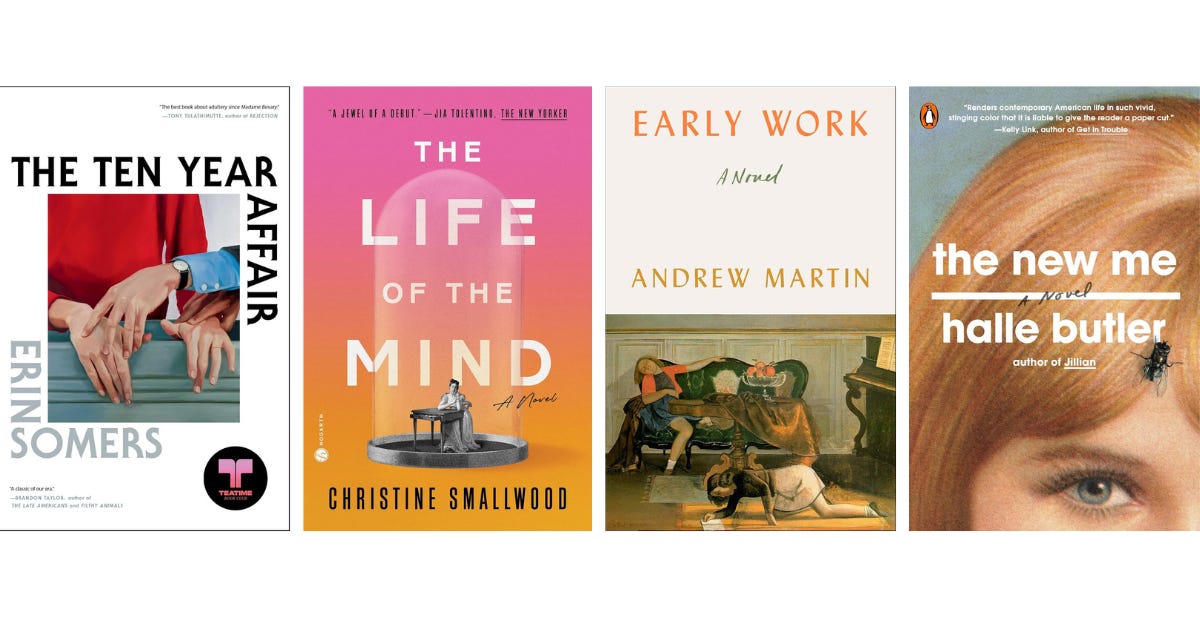
I was recommended The Ten-Year Affair (2025), by Erin Somers. This is more of a device than a novel, but it’s such a good device. The book opens with a pair of refugees from New York who buy a house in Hudson. He’s an editor at a big publishing company; she writes a newsletter for a marketing firm (or something like that—I was very vague on her job). She’s on maternity leave after the birth of her second child—she meets a local dad who’s also on paternity leave, and she has a flirtation with him. They exchange a kiss, but the dad pulls back when she propositions him. Rude!
Then, for the next seven years—two thirds of the book—these two people DO NOT SLEEP WITH EACH OTHER.
The book is called The Ten-Year Affair. This is a lie. She imagines an affair with him, but even the imaginary affair is quite sketchy—it’s just there to convince you, the reader, that at any point she would be happy to sleep with this other dad, if he was willing.
This woman’s life is so bland and so boring. None of the characters in this town are remotely sketched out. It is truly a triumph to create a life just good enough that the characters don’t take action to end things, either by divorcing, having an affair, or just killing themselves. And then it’s an even bigger triumph to convince the reader to sit through year after year after year of this horrible life, just on the off chance that these two characters—neither of whom have any personality—might sleep together.
The book gave me a renewed appreciation for Vincenzo Latronico’s Perfection (2022), which was also about a bland millennial couple, because at least Tom and Anna (the characters in Perfection) always hoped that their life would get better. They always had some scheme on the horizon, whether it was going to sex clubs or scoring a big new design contract, to transform their lives. They didn’t see the emptiness of their own existence, but that was also their triumph. They successfully avoided staring into the abyss, and if they could tolerate themselves then good for them.
The characters in The Ten-Year Affair can see the abyss. They can see their lives are empty, but because these characters are not acutely miserable (they are distracted by child-rearing, if nothing else), they somehow muddle along. I guess there is a charm to that as well.
In my own life, I am much more Perfection than The Ten-Year Affair. I always feel like the next project will somehow change everything. And then I pursue the next project, but it doesn’t really change everything, and I just grow older. It is really the passing of time that changes things, and my life would change regardless of what I did. But I enjoy the illusion of control—the illusion of being self-created.
It might sound like I am saying The Ten-Year Affair is bad. I am not saying that! It’s a very good book. I liked the book quite a bit, because it allowed me to feel very superior to the lifeless couple at its center. I kept thinking, “wow, I also lead a bourgeois millennial existence, but I’m much happier than these miserable people!”

Lombardo
And I really do think the lifelessness was a selling point, because later I tried to read an affair novel that was much more life-like, and I didn’t enjoy it.
This second book was Claire Lombardo’s Same As It Ever Was (2024). Lombardo is apparently very popular, her first book came out in 2019 when she was only thirty. That book was a Reese’s pick and a bestseller. The author herself has an MFA from the Iowa Writer’s Workshop and is represented by Ellen Levine (Marilynne Robinson’s agent) and the book was acquired by Lee Boudreaux (Percival Everett’s editor), so it’s not that the book wasn’t ‘literary’ or ‘sophisticated’ enough, I think it’s just that this book tried too hard to make me sympathize for the unhappy woman and…I really didn’t want to do that.
The Lombardo novel is about a young mother who leads a bland suburban existence. She is depressed, and she starts an affair with a friend’s son. This book does a lot of work that Erin Somers didn’t do—it portrays a good relationship between the wife and her husband. It gives a lot of texture to their life and to their various friendships. And yet…somehow the result was more bland than Erin Somers’ novel. In the Somers’ novel, the characters felt like types, but in the Lombardo novel, the characters also felt like types, but with a lot more details added.
I think, for me, I just want something more than likeable characters placed in a difficult circumstance—I want a story that cuts closer to the bone. It’s not about being more realistic—there’s actually something very unrealistic about the emptiness of the characters in The Ten-Year Affair. Like, in The Ten-Year Affair, the protagonist has these two children, but the kids really seem like placeholders and are barely discussed—they don’t have the real, living presence of the children in the Lombardo novel. But still…I think the bleakness of The Ten-Year Affair carries a deeper sense of reality, and it gets closer to depicting the sense of tedium that actually drives people to blow up their lives.

Martin
I abandoned the Lombardo and moved on to Andrew Martin’s Early Work (2019) and Down Time (2024). Early Work was the best of these two: it was about an aspiring novelist, Peter, who lives with his long-time girlfriend, a med student, in Richmond, VA. In the first scenes, Pete meets Leslie, an exciting and high-strung fellow writer, and they begin an affair. Both Pete and Leslie are a mess. Pete is obviously an alcoholic; Leslie (she has her own viewpoint sections) has gotten into several intense, substance-fueled relationships that culminated in drama and broken hearts. Basically, it’s just a very classic affair novel. Pete is bored by the thought of a lifetime spent walking the dog and watching TV with his doctor girlfriend. So…he just doesn’t do that, and instead he embarks upon this ill-advised affair.
This novel had much more distinct characters than the Somers or Lombardo books. Martin said that he was very inspired by Raymond Carver and John Cheever, and Pete is a character who, in a mid-century novel, would’ve had a more lower-middle-class background. But the book is set in the 2010s, so he’s a Columbia grad and has left early from a PhD program in English. The characters have some amount of privilege—they’re educated and possess social capital and Pete doesn’t worry about money, because he leads a charmed life, but he’s still a loser. It’s a very interesting portrait, because he is obviously bad news, but if you met Pete in real life, you’d probably still like him and be attracted to him, because he is simultaneously empathetic and self-absorbed. He mostly cares about himself, but he’s willing to include you, at least for a while, within his circle of care. Because of this type of maneuver, egotistical guys like Pete tend to do really well with women, at least for a while—something that this book accurately reflects.
Martin’s second novel, Down Time, is more sprawling, has more characters, but is less confident. It has two writers—Aaron and Malcolm—and two boring relationships that are stifling them. In this case, only one of them has an affair and breaks up his relationship, while Malcolm stays (mostly) faithful and gets married to his boring doctor girlfriend (Andrew Martin is married to a doctor himself—make of this what you will!) My interest in Down Time faded after a while, and I needed to force myself to finish.

Smallwood
In one of his interviews, Martin recommended Christine Smallwood, so next I read Smallwood’s Life of The Mind (2021). Not an affair novel, but it still felt like one, because the main character was so pathetic.
Dorothy has an English PhD and is an adjunct professor at (I assume) Columbia University. The scene opens with her miscarrying a pregnancy, and over the next few months she expels blood and clots and other fetal material. The novel is told in six chapters. Each chapter is self-contained and takes place over the course of one day, so it feels like a series of short stories. Some are stronger than others. My favorite chapter is the one where she goes to a conference in Vegas and has conversations with an academic rival and with her former advisor. The conversations take on a very stylized, surreal quality—her rival tells her a long story about sleeping with the twin brother of the boyfriend of another academic that they know.
She also has a long conversation in Vegas with her former academic advisor, who is such a beautiful monster. Judith is from that first generation of woman professors who were unleashed, by Betty Friedan, and allowed to truly be awful. These women released books, wrote essays, and terrorized English departments for decades. If you’re a grad student, you tend to idolize these women, but they hold you in contempt, because they know you are weak:
Judith, Dorothy knew, was one of those unusual people whose charisma and power to terrify are rooted in their unpredictability. Her majesty had a multiplying effect. Whereas some people govern by force of personality, she ruled by a kaleidoscope of personalities. And yet knowing this did not make Dorothy any more prepared to respond. Because even if Judith might do anything or be anyone, Dorothy was still just Dorothy.
The gist of the book is that Dorothy feels stuck in adjunct hell. She’s having no luck on the job market. She has no passion for her work. She feels very mediocre, and she’s wasted her life, essentially. Her youth—the period when she could’ve been doing something—she spent in graduate school, where everyone (including her advisor) realized she wasn’t really going to make it as an academic, but somehow Dorothy didn’t get the memo and now she’s only just finding out, and she’s bitter and hates herself.

The Best Butler
My final foray into this mini-genre (millennials who realize their lives are empty and meaningless) was another Andrew Martin recommendation: Halle Butler’s The New Me (2019). What a fantastic book! I could not believe how excellent this novel was. It was so effortless. This book reminded me of what it’s like to read a book when you’re not a literary critic. You just sit down, read the book, really enjoy it, and then at the end you think, “Wow that book was so good!” and you’re thankful that such good books exist.
The novel is about a woman, Millie, who is placed by a temp agency in a new office. And she would really like to be hired on permanently by this office, even though she hates everyone who works there and can’t stop mentally judging them. Millie has a terrible personality—She radiates judgement and has an edgy, off-putting energy, as demonstrated by my favorite paragraph of the book.
There always seems to be this unspoken idea that if I start talking, something bad is going to happen. Like I’m going to take something too far or say something mean or weird. But the things I say are completely normal for the most part, and I think everyone is blowing everything out of proportion, like when my parents, on silent drives home from family functions, would critique my innocuous nine-year-old barbs, or when my dorm roommate took me aside and told me I needed to apologize for embarrassing our friend with some blithe comment, or when people’s faces go cold when I talk when I’m in a good mood, or when James said “Wow, you really go for the jugular” just because I maybe got a little fed up with his friend Emily, the grad student, who always treated me like I was stupid, and one night, yes, a few drinks in, I laughed when she said “utilize” and she said “what?” and I said “just utilize, it’s a meaningless word” and then she tried to tell me that it “communicated” something different from the word “use” and the way she looked at me, chuckling, glancing over at James like “oh, how sweet, it tried to talk,” made me so mad that I might have said, maybe, something along the lines of “yeah, it communicates something, it’s a real first-gen-college-grad kind of word, like your parents are small-town conservative Christians who didn’t have any books in the house, and you’re self-conscious about your upbringing so you want to stand out by using elitist intellectual language, but you don’t actually know any long words, so you just truss up the word ‘use’ for no fucking reason other than to try to make people feel like you’re the one with the big mental dick, even though ‘utilize’ is basically just administrative jargon and completely déclassé to them that knows.”
Anyway, you know from the beginning that she’s not going to get this job, because her supervisor, Karen, has some viewpoint sections that narrate her attempts to fire Millie. Eventually you realize Karen is not that different from Millie—she’s a low-level employee who feels insecure and is on a power trip. So you’re reading the book, waiting for the hammer to fall.
But Millie is also not going to be left destitute! Her parents already pay her rent, which allows her to live alone in her own apartment, and she has no student loans. Late in the novel, she visits her home-town and stays with her parents for a bit—they’re a little frustrated by their daughter, but it’s clear they’re nowhere near the end of their rope when it comes to supporting her financially.
So then why did I read this whole novel? Nothing happens, and you know nothing is going to happen. I don’t know…it is inexplicable. That’s where the art is. The point of view is just very fun, and it has a very cunning way of shifting viewpoints, so you can see, from the outside, that Millie is actually exactly as awful as she originally seems (but so is everyone else—there are no good people here). Millie is a classic anti-hero. She is bad, but not weak. She has an unrepentant quality that I really adored. And the book has, by far, the most perfect ending of any of the books I’ve discussed here—something you don’t see coming, but which seems obvious once it happens.

Other Butlers
This was Butler’s second novel. I also read Halle Butler’s third novel, Banal Nightmare (2024), about an aspiring artist who moves back to her hometown after a breakup. This book was intermittently interesting but ultimately less good, because it’s about five characters, Moddie, Nina, Bethany, Kimberly, and Pam, who know each other in this small town—Nina and Moddie and Pam are all childhood friends, and all five of these people are somehow involved with the local university. And it’s just very hard to keep them straight. Nina, Bethany, Kimberly, and Pam all seem to have boyfriends who are bad in different-but-similar ways. Many of these women have artistic aspirations. It’s a confusing and messy novel, on a page-by-page level.
However, Butler’s first novel, Jillian (2015)—I read this book last—was much better. It’s about two people, Megan and Jillian, who work together at a doctor’s office. Jillian is thirty-five and has a child. She’s simple-minded and full of absurd schemes that’ll never bear fruit. Megan is twenty-four absolutely cannot stand Jillian and complains about him constantly to her boyfriend. It differs from The New Me in that the characters in Jillian are just so abject—you genuinely worry about them. Jillian, in particular, feels like she’s headed for a jail cell at some point, because she loses her drivers’ license, gets into debt, and becomes addicted painkillers. And this woman has a child!
Jillian’s sections made me increasingly anxious, in a way that eventually stopped being enjoyable. I appreciated that in her future novels, Butler stopped portraying people who were quite so down-and-out. If your worldview doesn’t allow for catharsis or redemption or political action, you shouldn’t portray people with genuinely hopeless lives—you should stick to privileged self-absorbed losers.
I was so enthused by Halle Butler that I started looking into her! I couldn’t believe I had never heard of such an accomplished writer before. She is definitely not unknown. She grew up in Bloomington, Illinois, and did her undergrad at an art school in Chicago. Her first novel came out from a small press, Curbside Splendor (that later collapsed, as many small presses do, after it got lax about paying royalties to its authors). This novel, which came out when the author was thirty, became an unexpected success and led to her being selected by Granta as a Best Young Novelist in 2017. She got a fancy agent, Claudia Ballard at WME, and her second book came out from Viking. The New Me was a breakout success, selling hundreds of thousands of copies, and led to her third book selling for much more money to Random House (odd to switch imprints like this—there’s probably some story involving editorial disputes with the Viking editor).
Until the success of The New Me, Butler worked a series of odd jobs, often in placements by temp agencies—a background that informs the setting of her first two novels. She has a very edgy affect in her interviews, and is outspokenly against literary careerism, as she demonstrates in this profile by The Cut:
“Careerism and consumerism are not necessarily great bedfellows with art,” she tells me, understating a point that she later makes more starkly: “I would never write for money. Because that’s gross. Because I hate money!”…
Over tea in her snug Alphabet City apartment, she brings up the phrase “you sold your book,” which she finds repulsive, a naked embrace of commerce.
Normally I find this kind of rhetoric to be a bit stale. So many writers will say they’re ‘against careerism’, but then I look into their careers and realize they have top agents and work with big corporate publishers. So what, in practice, does it mean to not be careerist? However, when a writer is truly good, everything they say becomes a charming quirk, so in this case I was happy to interpret Butler’s words as an uncompromising statement of principle. Obviously, the path to making real art is to truly believe, with all your heart, that you’re not a careerist.
(But it helps if you then also get a high-profile agent and sell your book to Viking, who can give it good marketing and an attractive cover, which allows people like me to eventually hear about it.)
for woman in academia going through breakup millennial I liked Weike Wang Chemistry
This was a wonderful piece — thank you! Your work is so much fun to read!