
The most-disliked people in the publishing industry

One way of studying literature is through direct experience. You read a book, you observe that it is excellent, and you try to describe the experience of reading it.
But there also exist other ways. And one of the most promising new approaches to come out of the academy is the “sociology of literature”—the study of how ‘literature’ is created, experienced and defined by the world at large.
Right now, in 2026, one of the main ways literature is constructed is through a set of interlocking institutions—creative-writing departments, book review pages, prestige publishers, grants and fellowships and residencies and awards—that all have the explicit aim of encouraging literary excellence.
The study of these institutions has resulted in a number of interesting books. The two most well-known are Mark McGurl’s The Program Era, which examines MFA programs, and Dan Sinykin’s Big Fiction, which looks at the publishing industry. But these books are far from alone, there was also Inside The Critic’s Circle (a study of book reviewing), The Economy of Prestige (on book prizes), and I’m sure many others.
The sociology of literature can be controversial. In his review of Big Fiction, Christian Lorentzen took aim at the whole field, saying that Sinykin “reduces aesthetics and their pleasures to market strategies and susceptibilities”.
But I think this criticism doesn’t really hold up. And here’s why:
Imagine that we had a ‘sociology of literature’ study that was about the dynamics of a medieval scriptorium. Imagine that you could embed yourself as a fly on the wall in the meeting where various monks advocate for the copying of different medieval manuscripts. This is also a marketplace. Every manuscript takes six months of work and takes hide of fifty sheep. Now imagine you hear some monk advocating that they make a copy of this poem, Beowulf. The existence of this poem is one of the great mysteries of English literature. Why did some monastery in the 11th-century spend so much time and energy copying a centuries old poem that likely has a pre-Christian origin?
We can surmise many different possibilities. It’s preserved as part of the Nowell Codex, which includes information on many monsters and marvels. Maybe it was preserved because Beowulf is about a set of monsters: Grendel and his mom and the dragon. Perhaps they didn’t care about the poem as a literary object at all.
But maybe that’s putting the cart before the horse. Maybe they actually assembled the rest of the codex around Beowulf, to create an ostensible reason for preserving this unique text. Was the desire to preserve Beowulf the whole reason for the existence of the manuscript? Or was its preservation only incidental, because it happened to fit with the overall theme of the project?
This would be a highly fascinating thing to know, and it would influence the way we read Beowulf. If we understand Beowulf to have been preserved because of its literary quality, then we might understand its poetic features as being typical of a certain genre of poetry that’s largely lost. Whereas if we understand Beowulf to have been preserved only incidentally, then we cannot guess with nearly so much confidence about its origins.
Similarly, in contemporary times, it is interesting to know how the publishing industry handles the idea of literary quality. Is quality merely incidental to their aim (which is to sell books and make a profit)? Or is quality at the core of their mission?

Publishing is not just a business
While they were both excellent books, I felt that The Program Era and Big Fiction suffered from a similar issue. They both treated their respective subjects (MFA programs and corporate publishing) as homogenizing institutions, which force writers into certain molds.
I think there’s an element of truth to this analysis, but it leaves out a critical part of the picture, which is that the people who work in these institutions tend not to conceptualize their activity in this way. If you talk to any MFA professor, they’ll say their main priority is to preserve the student’s voice—whatever makes their work unique. Similarly, if you talk to any editor at Little Random (the corporate publisher profiled by Big Fiction), they’ll say their aim is to publish books that are unique and move the culture forward.
That’s the thing about publishing. The industry only functions because the people in it are willing to work for not much money. Bertelsmann (the owner of Random House) is a for-profit corporation just like Palantir (a defense contractor), but the employees of Random House don’t need to be paid as much as the employees at Palantir, because Random House is perceived (by its employees) as fundamentally good, something that serves humanity, while Palantir designs software that the government uses to find targets for drone strikes. Jobs at Random House are much harder to get than jobs at Palantir, even though jobs at Random House are paid much more poorly. No college-grad would work for Palantir for $55k (the starting salary for an editorial employee at Random House).
This is also true when it comes to the suppliers, the writers. It took me a lifetime of work to write a book that Random House was willing to sell, but I’m not being paid for those years of labor. I am giving a huge corporation a product to sell, but I am doing it for a fraction of what it cost me to produce that product.
That dynamic is baked into the economics of the business. As such, the business itself requires that perception that it’s somehow serving the cause of literature as a whole.
In my opinion, the sociology of literature has, up to now, not really taken into account these dynamics. Yes, literature is structured by institutions that serve their own self-interest, but that self-interest requires a lot of other people to give them their labor at a very low cost. And that can only happen if the business does enough to maintain this glow of prestige.
Middlemen
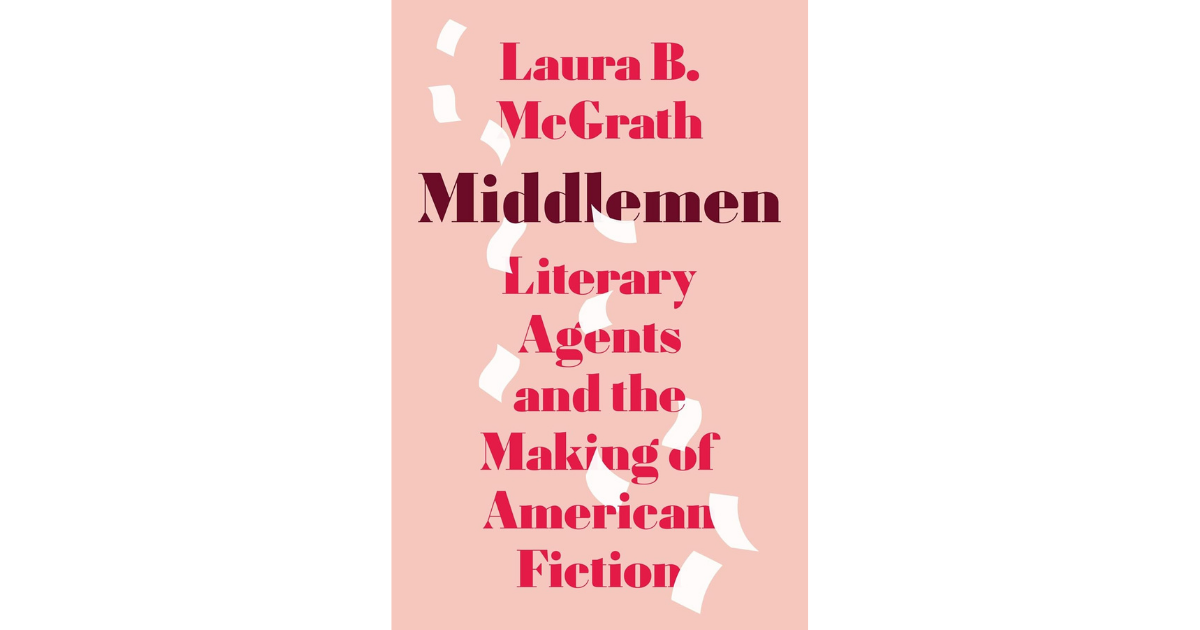
That’s why it was so exciting to read Laura McGrath’s forthcoming book, Middlemen: Literary Agents and the Making of American Fiction. This is the first time I’ve read an academic book (McGrath is a professor at Temple) that really seems to take into account the wispy hard-to-define reputational dynamics that’re at the core of how the publishing industry functions.
And McGrath’s book is about probably the most mysterious and most-disliked actors within the industry: literary agents.
Literary agents are the main gatekeepers in contemporary publishing. If an author wants to sell a book to a major publisher, then the author needs to find a literary agent who can successfully market their manuscript to editors.
Although editors exercise some selectivity—rejecting fifty manuscripts for every one they publish—literary agents exercise a much prior and more extreme selectivity, oftentimes rejecting hundreds of queries just to find a single client.
But how do they decide which projects they want to represent?
Some agents probably only care about money: they pick high-value projects and sell them aggressively, maximizing their own returns. Agents get paid 15% of what their author makes, which means agenting is the part of the industry that most closely resembles an actual business. There’s only two ways to get rich in publishing: become a commercial breakout author, or become the kind of literary agent who represents those authors.
But agents who are entirely profit-oriented are not the subject of McGrath’s book.
Instead, she is writing about the agents who specialize in representing prestige fiction. As she notes, this is only a small subset of America’s overall population of 1,500 literary agents. Most agents, according to McGrath, specialize in nonfiction. Even out of agents who primarily sell fiction, more than 70 percent of the deals are for expressly commercial genres (romance, thrillers, science fiction, etc).
Within that remainder, the novels that have the potential for mainstream literary acclaim, there is a huge amount of stratification: according to McGrath, “only twenty-five agents are responsible for representing half of the authors short listed for major American literary prizes in the twenty-first century.”
McGrath’s aim is to tell some kind of story about how these agents (the twenty-five, and those aspire to be like them) pick and market their projects.
(Full disclosure: McGrath and I share an agent. I considered whether this debarred me from writing about the book, but my interest in this book predates the start of my current agent relationship. I have been excited about it ever since I started following McGrath’s substack, textCrunch, in February of last year. Hopefully nobody feels like I’ve crossed any ethical lines here. I read a pre-pub copy: the book won’t be released until April 28.)

How to become a famous agent
One of the more interesting things about the book is the idea that there is a reputational economy amongst agents. Over the last 100 years, there are a few agents who’ve managed to achieve independent reputations of their own: Sterling Lord, Candida Donadio, Lynn Nesbit, Andrew Wylie. And, without exception, these are agents who represented marquee literary writers like Jack Keroauc (Lord), Joseph Heller (Donadio), Joan Didion (Nesbit), and Philip Roth (Wylie).
In telling the story of these agents, a certain pattern tends to recur. Quite often, you have a young agent, in their twenties, who comes across a manuscript that nobody else is interested in. They take interest in this manuscript, championing it aggressively, convincing editors there is a market for the book. And when that manuscript breaks out, the agent’s reputation is established, and they start to develop a niche as a representative for these high-brow literary books (this same story was re-told, with slightly different features, for Lord, Donadio, and Nesbit).
For me, the most interesting part of the book was the third chapter (entitled The Collection) about what motivated agents to sell short story collections.
In this high-brow, prestige end of the business, one major way that agents find authors is by reading literary journals and cold-contacting the authors of stories they like. So they recruit lots of short story writers. But…selling a story collection is extremely difficult.
McGrath explains the appeal of using literary journals as a recruiting ground:
…short stories help agents identify the writers with literary aspirations...[and] the imprimatur of reputable literary journals such as Ploughshares, or an anthology such as Best American Short Stories, functions as a type of peer review: experts agree that this writer is talented and there is an audience (however limited) for their work.
But since it’s very hard to sell a short story collection, many agents expect these clients to produce a novel. McGrath quotes Chad Harbach as saying, “A writer’s short stories...lead to a novel, or they lead nowhere at all.” An anonymous agent reports, “I very rarely take on a [writer] these days, unless there’s the seed of an idea of a novel at least.”
Only a very few agents are willing to try and sell a writer’s story collection. Mcgrath writes:
The short story collection is widely regarded as the most difficult sale an agent can make. One agent explained to me, ‘I liken it a little bit to Olympic diving. That is, if you’re being graded on level of difficulty, then short story collections are definitely more difficult to sell than novels. But if you want to be an Olympic diver, you have to do the hardest thing. And that’s the short story collection.
This is a persistent theme in McGrath’s book. Agents need to earn money, but they don’t just prioritize earning money. Many agents, particularly at this prestige end of the business, have some kind of literary aim. They see their role as championing the best projects. And if they succeed in selling these high-prestige projects, then they gain outsized reputational rewards.
For instance, Andrew Wylie and Lynn Nesbit are legends in this business, but they probably don’t make more money than Jodi Reamer or Shane Salerno, who are two of the top agents for commercial fiction. Nonetheless, Wylie and Nesbit have enduring reputations that will likely outlast those of Reamer or Salerno, simply because the former are doing the harder thing, they’ve succeeded in the harder realm.

Crafting the debut narrative
The juiciest part of this book is the second chapter (the debut), which is about the importance of the first novel.
This is true in all commercial sub-fields. In the YA world, your debut deal is also likely to be the biggest, and if your debut underperforms, it’s much harder to sell subsequent books. However, I’ve been surprised by the degree to which it’s true in the literary world. I have an older friend who was querying agents recently, and every agent who offered on the book wanted to know whether she’d published any books before. It seemed clear to here that if this wasn’t her debut, many of these agents wouldn’t have been interested.
As McGrath makes clear, there is a pathway to launching a debut author as a promising new voice:
The backbone of every debut is the debut narrative, the story of the book and its author, and how both came to be. Crafted behind the scenes by author and agent, the debut narrative first becomes public with the agent’s pitch, the major points of which are highlighted in the deal announcement, only to be repurposed into interview questions and profile fodder…
It’s been fascinating, in this book, to see the ways that the author’s background really plays heavily into selling a title. In earlier chapter, McGrath sits in on a session where agents are evaluating queries, and she notes that often an agent will consider an author’s background (their backstory or credentials) when deciding whether to offer representation. That’s in part because the agent is looking forward to the way the author will be pitched to editors. There are certain awards, certain credentials, and certain biographical markers (in particular, the author’s youth) that can be used to pitch the author as a wunderkind, an exciting new talent. If the author has the whole package, it’s a lot easier to sell their book.

Sometimes there’s no winning
I did appreciate the parts of the book where McGrath offers a less rosy and idealistic account of the industry. For instance, in the fifth chapter, The Advocate, she interviews several Black agents, who tended to have a much more cynical take on many of the dynamics we’ve seen in previous parts of the book,
The most interesting dynamic, for these Black literary agents, is the famine-or-famine scenario. Most the time, the publishing industry is not particularly interested in Black authors. But it goes through these periodic surges of interest, when suddenly the gates open, and Black authors can start commanding higher advances. But, as a Black agent, Marie Brown, explained to Laura McGrath, it’s mostly White agents who benefit from these boom times:
White agents began extending offers of representation, in some cases luring Black writers away from Black agents like Brown, by promising astronomical advances. ‘Those agents have certain opportunities and connections that I don’t,’ Brown explained—existing relationships with the most powerful editors, and a list of big-name clients.
I liked this chapter. It was nice to see a little conflict, something to suggest that the industry imposes structural consequences on less-connected people.
This book’s methodology mostly involved interviews with agents and research in agency archives. As a result, it tends to tell the agents’ side of the story. That’s not a flaw, since the book is primarily about how agents conceptualize their own role, but...authors and editors would likely have a very different story to tell about the role of literary agents.

The most-complex relationship in an author’s life
Speaking as an author, I can attest that when writers get together, we often gossip about our agents. Generally our relationship with our publisher is much more straightforward. We have contracted with them to sell a book, and publishers are usually fairly upfront about their expectations for that book. It’s not that we don’t have gripes with publishers and editors, but the relationship isn’t nearly as emotionally fraught as the one with our agent.
That’s because the agent relationship doesn’t feel like a business relationship. Your agent is your representative. They work for you. But agents don’t make that much money on the average client. Clients also go through up-and-down periods, so at any given time you might be fallow or not producing much. Agents don’t necessarily do a strict cost/benefit on whether you are worth the amount of time you’re taking up. Most of the time, your career is costing your agent more (in labor) than it’s bringing them (in money), so there’s a feeling that you’re bound by something more than money.
Moreover, agents have a sentimental attachment to their clients and vice versa. You started off together when neither of you had anything concrete. You just had a manuscript and some hopes. Then the manuscript sells, and it’s still not clear what’ll happen. Maybe the book will break out and be a huge hit! Or if that doesn’t happen, maybe the next one will be a hit.
Usually your agent is, to some degree, a fan and an admirer. And, unlike with an editor (who requires the backing of their employers if they’re going to keep publishing with you), there is nothing stopping an agent from continuing to be committed to your work.
In practice, it’s complicated. An agent’s stock in trade is their judgement. Ideally, when an agent puts a manuscript on submission to editors, they want to be able to say, “This is going to a hit.” For literary authors, the meaning of ‘hit’ can get a bit fuzzy: a book can be considered a ‘hit’ if it gets a lot of buzz, even if sales aren’t that high. But agents want to be confident that the editor will be happy to have acquired this book.
And, oftentimes, an agent loses that faith in an author. You can still be a fan of their work, but you might stop believing that they have the ability to succeed in the critical and commercial marketplace at the level that an editor would want. When you lose this faith, it becomes hard to sell their work.
It’s a hard thing to navigate, because there is something unpredictable at its center: the book. Periodically, an author emerges with a manuscript. Sometimes they’ve talked about this manuscript to their agent and sometimes they haven’t. And sometimes this manuscript is a pleasant surprise. Sometimes, the manuscript feels like the kind of thing that could make an editor excited.
But it’s hard to say. Most authors know how to pitch a book so that it sounds good. But usually when they present the book to the agent, there’s an open question: is this something new that will break the pattern of past failures? Or is it just more of the same?
Agents have to read every book with an eye to whether they can convince an editor that this book is going to be the next big thing. It’s a particular type of reading, a particular way of relating to books. It can definitely seem cold and commercial. I know, having been dropped by several agents, that it’s quite a blow when someone who’d professed interest in your work suddenly says it’s no good and they can’t sell it anymore.
It’s even more complicated in this high-end part of the business, when what you’re selling is difference, uniqueness—you’re selling the idea that no other author is doing what this author is doing.
Literary versus commercial
Although I loved McGrath’s book, I did think it was unclear on one major point. There is nothing more complex in the publishing industry than the distinction between ‘literary’ and ‘commercial’. McGrath does touch on this distinction a few times, as when she tells the story of two agents who competed for the same project. One agent wanted to pitch the project as a literary novel, the other saw it as more of an upmarket women’s fiction book.
But I don’t think the book is clear enough that she’s talking about a very specific part of the business: the kind of prestige fiction that’s published by big, corporate publishers. This type of fiction is quite different from both upmarket fiction and nonprofit fiction. ‘Upmarket fiction’ is a form of commercial fiction that shares many stylistic similarities to prestige fiction, but it’s marketed in a way that tends to bar it from being reviewed in major periodicals or being in contention for awards. ‘Nonprofit fiction’ is published by small presses (oftentimes nonprofits) and is marketed for a small, niche readership.
Prestige fiction operates quite differently from commercial fiction or nonprofit fiction. The main difference is that the gatekeeping for prestige fiction is much more intense. When it comes to commercial fiction, if you have a good concept and decent execution, it’s a lot easier to find an agent—your credentials usually aren’t a big consideration. Similarly, when it comes to nonprofit fiction, you can email the editors and make direct contact in various ways with the publisher—there’s more of an indie, DIY vibe.
It’s really with prestige fiction that the industry’s gatekeeping becomes most intense. For instance, in commercial fiction if you have a few failures, you can publish under a pseudonym and ‘debut’ all over again. But in literary fiction this phenomenon doesn’t exist—if your book fails, then you carry the weight of that failure forever.
Similarly, in commercial fiction, the focus is usually on a manuscript: you almost always write a marketable manuscript and then get an agent—there’s no commercial equivalent to the “don’t call us, we’ll call you” culture of literary fiction, where promising writers get snapped up by agents on the basis of short story publications.
I wish the book had done more to work out these differences—perhaps by including a chapter that focused on upmarket fiction—and I do think the failure to clearly make that distinction is going to lead to confusion down the line, especially when it’s read by aspiring writers or by academics who’re unfamiliar with the publishing industry.
This is an area where Dan Sinykin made a very good choice, by profiling a worker-owned publisher (Norton) and a nonprofit publisher (Coffee House) that operate according to slightly different incentives from the big corporate publishers that were the main focus of his book.

Neither good nor bad
The natural question for any reader of McGrath’s book is, “Do we approve of this system?”
Previous sociology of literature books that I’ve read have tried to skirt this question, tried to have it both ways. It’s been a while since I read The Program Era, but my sense is that Mark McGurl felt the MFA system was restrictive, but within those parameters it produced good fiction. Dan Sinykin, in Big Fiction, tried to say that big corporate publishers were producing a new form of fiction, ‘conglomerate fiction’, that had its own characteristics and needed to be evaluated differently. But, as I wrote in my review of the book, it seemed pretty clear to me that he thought big corporate publishers were bad for literature.
Middlemen is similar to The Program Era and Big Fiction in that it’s about a change in the publishing landscape. Until the late 20th century, literary agents weren’t particularly important: John Cheever went without an agent for thirty years, Philip Roth also didn’t have an agent for a few decades, Tim O’Brien has never had an agent (to my knowledge), and Louis L’Amour also didn’t employ a literary agent. Many authors had direct relationships with publishers. And even when they did employ agents, the agents didn’t have a strong gate-keeping function, they were around to negotiate contracts and keep track of rights issues.
As McGrath details, agents initially weren’t very shark-like. It wasn’t until sometime in the 1950s that agents started routinely submitting manuscripts to multiple editors at once, to get multiple bids and play them off against each other. Before then, agents would submit manuscripts sequentially, to one publisher and then another, giving each one an exclusive.
The system, as of 2026, where agents are the only people who can submit to the major publishers, is a system that’s arisen relatively recently. It’s unclear why things have changed so much, but probably it’s downstream of corporate consolidation. You have a business dominated by fewer companies, making bigger bets on fewer books. As Sinykin wrote about in Big Fiction, you also need more sign-off even within companies to get approval to buy a book. You no longer have a heroic editor model, where one editor can purchase a book with minimal pushback from his bosses and from sales & marketing.
In an environment where more is riding on each acquisition, it makes sense that the additional social proof represented by the agent would become more important. If you’re wondering whether a manuscript truly has legs, then it’s helpful to know that it’s represented by Bill Clegg or Nicole Aragi—these are hugely high-profile agents, and if they’re staking their reputation on the book, then it must have something special that other books don’t have.
Because of this, if you’re doing something truly weird or truly different, there’s only two major ways of getting a big book deal. You can start off at a smaller press and have a breakout book (a la Ben Lerner). Or you can somehow catch the attention of a high-profile agent who can make the case that you’re the next big thing (a la Ottessa Moshfegh). The path to some purely serendipitous encounter—the idea that an editor could just stumble across your manuscript and take a chance on it—is much narrower. It’s not zero, but...it’s much smaller than anyone would like.
To a large extent, agents are determining what kinds of authors have access to prestige publishers.
The good stuff has to come from somewhere
What’s nice about McGrath’s book is that she’s not interested in judging this system. Instead, she’s more interested in describing how good stuff comes to get published. Because the fact is, your favorite author—whoever they are—probably succeeded under this system. How did that happen? How did your favorite author pass through the filter and manage to interest a big corporate publisher in their work?
Middlemen does a good job of explaining that there are two situations where agents face a structural incentive to take a chance on more-innovative work:
Young agents will sometimes push hard on difficult, literary books because these can be career-making sales; and
Agents who’ve made a reputation selling more-commercial books will sometimes take a risk on a more-literary book, because this is the way to level-up as an agent and win a bigger reputation in the field.
And in both cases, when agents take these kinds of risks, they’re likely to pick material that’s off-the-beaten track because...they likely don’t have their first choice of manuscripts. Anything that was an easy or obvious sell would probably go to a more-established agent (one of those twenty-five agents who dominates the awards lists).
This isn’t the only way that new styles enter the publishing world, but it is one major way. And Laura McGrath has done a great job of teasing out and explaining those dynamics. Which I think is important, because without a book like this, the natural assumption would be that agents don’t really care about quality, they only care about what’ll sell. And this assumption would lead in turn to the idea that when something good does get published, it only happens by accident, or because there is some mechanical process that presents people with a book deal the moment they graduate from the Iowa Writer’s Workshop.
I don’t know that this information is particularly useful for authors, but I think it’s worthwhile for critics, academics, and cultural commentators to understand the incentives here. Academics should understand that agents want to represent high-prestige books. They do it for the same reason that authors want to write high-prestige books. And that (not incidentally) is the same reason editors want to acquire high-prestige books. And it’s because...people love prestige.
And the way prestige is conceptualized, by authors, agents, and editors, then gets encoded into literature itself. In our era, that’s happened primarily through this institution of the young debut author, who’s launched onto the scene by her first book as a major talent.
This ‘debut author’ phenomenon explains many features of the current literary landscape. For instance, there’s been much talk about why authors seem to publish fewer books today than they once did. And that’s because so much is riding on your first book. Authors can’t debut with just anything. It has to be a book that seem somehow ‘big’ (ie capable of making a splash and becoming a breakout). The longer time to debut also gives you more time to accumulate credentials (publications, fellowships, degrees) that can get one of these big agents interested in you.
This incentivizes authors to spend a lot of time working on short stories (to gain early publication and prizes), and then, once they acquire an agent, to rapidly switch horses and produce a novel in a high-pressure environment. Moreover, it’s an environment where time is of the essence, because their youth is itself a commodity. This (at least to my eyes) leads to a lot of overpraised debuts that’re structurally shaky.
Now that academics have been told about these debut-author pressures, I am sure it’ll affect how they read the early work of many authors who’ve debuted in the last thirty years.
What’s nice about McGrath’s book is that it’s clearly not just written for today. It’s also written for ten, twenty or fifty years in the future. It is a book that’s accessible to the general public (thankfully it has a minimum of theory and scholarly apparatus), but its primary aim is to inform English professors and humanities scholars about the way the publishing industry works. It’s not meant to be the final word on literary agents or prestige publishing—it’s the starting point from which many people will write articles in the years to come.
I read a pre-publication copy, the book is coming out on April 28th.

Elsewhere on the internet…
I sold a story (“The Friend”) to Lightspeed, one of the top sci-fi journals. It’ll be my seventh piece for them. This story uses two characters I have originally featured on this Substack: Valac, the demon who grants wishes that don’t have any catch or hidden downside; and Rajiv, the Indian-American middle-class guy. This was originally going to be this week’s tale, but I decided to submit it to a journal instead, and now you’ll have to wait a year to read it.
My post on Conan the Barbarian was nominated for the Robert E. Howard award in the best essay category. Thanks to whomever nominated me!
I was featured on The Honest Broker’s podcast. Thanks so much to Jared Henderson for inviting me and interviewing me. As I recall, we talked a lot about my fiction, which was my first time talking about it at length with anyone—such a wonderful and refreshing experience.
Ross Barkan wrote about ‘the New Cultural Criticism’—a school that includes pieces by me, Henry Begler, Daniel Falatko, Alexander Sorondo, Chris Jesu Lee and others. Much discussion online about whether this hype is merited. The options seem to be, “Yes, this is new and unique, or it’s merely continuing the tradition of the best writers and bloggers of the past twenty years”. Either way, I’ll take it.
Henry Begler wrote about my forthcoming nonfiction book, What’s So Great About The Great Books:
What makes What’s So Great… work is that it is not, in the end, a plea for everyone to read the canon—Naomi openly acknowledges that many people simply aren’t interested in doing so and have chosen different and equally fulfilling ways to spend their life. Rather, it is a larger case for using one’s limited leisure time ambitiously, for setting a lofty goal and trying to reach it, rather than being satisfied with passive day-to-day existence.
You can pre-order What’s So Great About The Great Books? on Amazon or on Bookshop or from your local bookstore. The book comes out May 19th.
Really enjoyed this post, Naomi. As always, I appreciate the blend of personal narrative and critical analysis. I agree with a lot of what you say here about the strengths and limitations of recent works on the publishing industry and literary institutions more broadly. I haven't yet read McGrath's book, but I'm looking forward to doing so as soon as it's released.
The one qualification I'd make about your assessment of the sociology of literature is that the works you cite are almost all from academics associated with one scholarly group: Post45. Those authors have a very specific methodology, which tends to prioritize the study of single institutions (publishing, creative writing, etc.) over the complex of "interlocking institutions" that, as you rightly note, combine to produce literature as we know it today. I agree with you that McGurl's The Program Era and Sinykin's Big Fiction are important contemporary works that are well worth reading. But I also worry that focusing on such a small group of recent academic works that share key methodological premises risks giving us a very narrow portrait of what the sociology of literature looks like across the academy. This is as true of the critics (i.e. Lorentzen) as the proponents of the new sociology. In my eyes, it's like taking what one conglomerate publisher like Penguin has done over the past two decades and assuming it's representative of publishing as a whole.
I don't mean this to take away from your really insightful reading of those recent works. But I do see an increasing trend on lit stack of limiting discussions of the sociology of literature to a handful of folks in the Post45 group, and I hope these discussions will eventually broaden to include others working in the field these days. My own canon would include the three major sociologists of the book in the post-Bourdieuian tradition (Gisèle Sapiro, John Thompson, and Pascale Casanova) as well as literary scholars such as Simone Murray, Claire Spires, Lee Konstantinou, Sarah Brouillette, Günter Leypoldt, and my colleague Andrew Goldstone. To my mind, Sapiro, Konstantinou, and Brouillette are particularly good on the issues of prestige you raise in the post.
Finally, fwiw, I respect that you divulged that you and McGrath share an agent. In a relatively small cultural world, these kinds of connections are inevitable, and I think the best approach is to be transparent, as you are.
Publishing a book can be really hard. That is why Amazon has direct Kindle publishing as an alternative. Now that is just like a drip of water into an ocean. I always wanted to work in publishing on the inside. I reviewed books for a long time and never got noticed.
Good writing can only be read if you know where to find it. I was an English major and know the basics of writing , good writing in science is harder. Fiction is judged narrowly. I am optimistic with a large splash of pessimistic. I have not sold anything except for $5 and medium has yet to pay me.
Marketing is hard for some people and comes naturally to others.
There is good writing and there is luck. Luck comes to those who never give up like so many authors. They know people, if you write something good, you are expected to write something else good. Deadlines and pressures can lead to drinking. There are walss of rejection letters.
Octavia Butler was like this. I am writing to survive my layoff and I have some money. Life can hard for an author.
I feel insignficant but I still write. Someday...