
This year's trendy new thinker
Apparently, reading scores are down not just in America but throughout the world. This means that, on average, contemporary young people have lower literacy than young people did even ten or twenty years ago.
I recently read an article by Sam Kriss on this topic, where he used the ideas of an English professor (and Jesuit priest) named Walter Ong to try and imagine what a ‘post-literate’ future might look like:
....the post-literate age will have more in common with primitive society than it does with the industrial modernity that produced it. After writing, we will once again live in a world defined entirely by our direct sensory experience. But now, our direct sensory experience won’t be of the things that physically surround us, but the images streaming through our phones.
Over the next several weeks, I came across a few more mentions of Walter Ong while browsing the internet, and I realized something. This was the guy! Ong is this year’s guy! You know, just like the guy three years ago was Christopher Lasch, and two years ago it was Rene Girard, now it’s Walter Ong’s turn to be the literary theorist who gets resurrected to explain something about our contemporary condition.1
When a new guy gets anointed, you better get on it, because he usually disappears after a year or two (to be replaced by a new guy). If you wait too long, then there’s no point: I’m not gonna be the fool who’s wading through Rene Girard in 2026.

Where there’s a guy, there’s a book.
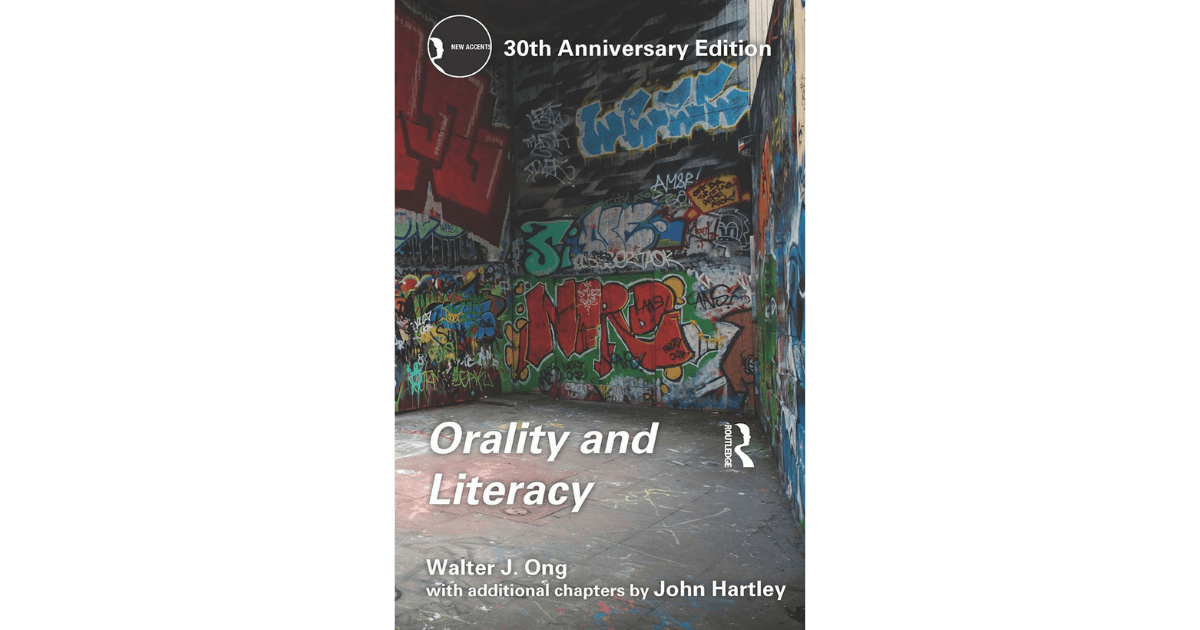
Each guy has a main book. Nobody’s got time to be reading seven or eight books by the guy. In Walter Ong’s case, the book is Orality and Literacy, which came out in 1982. And this book is about three things:
The difference between oral and written literature.
The difference between oral and literate individuals.
The difference between oral and literate cultures.
Right from the start, there’s some need for an awkward terminological explanation, because what is orality? I have never heard of this term before! I am used to this other term, illiteracy, which seems to resemble orality. However, I gather that it’s not PC to talk about ‘illiteracy’ if you’re someone who studies orality, because it implies that literacy is the superior state, and that illiteracy is lacking.
So Ong uses the term ‘oral’ or ‘orality’ to describe a state of existing without writing. He further subdivides this into ‘primary orality’, which is when there’s no writing at all in the person’s culture, and ‘secondary orality’, which is when your culture has writing, but there’s something within your culture that has oral characteristics.
Ong begins with oral literature. He talks about the discovery in the 1930s, by his thesis advisor, Milman Parry, that The Iliad and The Odyssey had begun as oral literature. This is a debate that is too complicated for me to summarize here, but I guess a lot of people thought that these works, although they’d drawn on oral storytelling traditions, had been composed for the pages, and they treated them as singular works, composed by an author, just like Herman Melville composed Moby-Dick. But Milman Parry said no, that he could tell from the structure of the texts, with their repeated epithets, and something about the organization, that they must’ve been composed on the fly by oral storytellers. And that each time these storytellers tell the story, it’s different. Oral storytellers don’t memorize a tale exactly, instead they learn certain formula for constructing a narrative, which means each time they tell it, there’s a different organization and different episodes. They also have a tendency to wander down certain tracks, extemporize for a bit, and then dig their way out. It’s a wholly different way of telling stories, Parry said.
And he claimed the written versions we have of The Iliad and The Odyssey are basically one particular instance of this style of storytelling. And then he did a bunch of work to try to demonstrate that this was true.
Ong makes a great case that The Iliad and The Odyssey are basically as close to oral literature as we can get—that they were translated directly to the page from some oral storytelling tradition, and thus they give us a very clear view of what orality looks like.
Downstream of Parry’s work, there was a big effort to define what culture in an oral tradition might look like. The big thing about an oral tradition is that it’s all remembered, nothing is written down. It’s not just that it’s recited aloud, it’s also that there’s no ur-text to consult, besides peoples’ memory.
There was a list of (I think) eight characteristics that were shared by oral literature. Parry said it tended to speak in aggregates (lots of simple declarative statements, often joined by ‘and’), to use lots of adjectives, to have a lot of redundancy and repetition, to be conservative (i.e. not introduce any ideas or concepts), to remain very close to direct human experience, to be ‘agonistically’ toned (i.e. concerned with conflict), to be empathetic or participatory, and to be homeostatic.

Orality isn’t worse than literacy (except it clearly is)
But if this was just a book about oral literature or culture amongst oral peoples, nobody would care about this book.
The meat of the book is that Ong makes a lot of statements about how literacy unlocks new modes of thought and new potentiality for a culture.
As he puts it:
Oral cultures indeed produce powerful and beautiful verbal performances of high artistic and human worth, which are no longer even possible once writing has taken possession of the psyche. Nevertheless, without writing, human consciousness cannot achieve its fuller potentials, cannot produce other beautiful and powerful creations.
It’s such an interesting rhetorical performance on Ong’s part, because he’s so insistent that literacy is not superior to orality—he harps relentlessly on this point. But he also keeps insisting, often in the very next paragraph, that civilization (and all the good things we derive from it) really depend on literacy.
There is hardly an oral culture or a predominantly oral culture left in the world today that is not somehow aware of the vast complex of powers forever inaccessible without literacy. This awareness is agony for persons rooted in primary orality, who want literacy passionately but who also know very well that moving into the exciting world of literacy means leaving behind much that is exciting and deeply loved in the earlier oral world. We have to die to continue living.
Basically, once you have literacy you get no more Iliads! Those are gone, they’re impossible. You just can’t do an Iliad anymore (Ong claims), unless your entire culture is oral. But...you do get science and philosophy.

Some illiterate people in Uzbekistan couldn’t do abstract thoughts (maybe)
There’s a lot of talk about how abstract thought is impossible without literacy. And Ong isn’t just saying that without literacy there is no way to advance a certain kind of scientific or philosophical knowledge, he is saying that it’s literally impossible for oral people to even do the kinds of thinking that would lead to scientific or philosophical knowledge.
The major evidence here comes from a study in the Soviet Union by A.R. Luria. This man went to what is now Uzbekistan in 1931 and studied illiterate people. He would ask them a lot of questions to assess their cognitive abilities, and he discovered that the cognitive abilities of people with even marginal literacy were very different from the cognitive abilities of illiterate people.
In Luria’s field work, requests for definitions of even the most concrete objects met with resistance. ‘Try to explain to me what a tree is.’ ‘Why should I? Everyone knows what a tree is, they don’t need me telling them’, replied one illiterate peasant, aged 22. Why define, when a real-life setting is infinitely more satisfactory than a definition? Basically, the peasant was right. There is no way to refute the world of primary orality. All you can do is walk away from it into literacy.
In Luria’s study there are a lot of answers like this, from illiterate people who argue with the premises of his questions and claim not to understand them. Ong claims these answers are redolent of orality.
‘Say you go to a place where there are no cars. What will you tell people [a car is]?’ ‘If I go, I’ll tell them that buses have four legs, chairs in front for people to sit on, a roof for shade and an engine. But when you get right down to it, I’d say: “If you get in a car and go for a drive, you’ll find out.”’ The respondent enumerates some features but turns back ultimately to personal, situational experience.
Whereas if one of Luria’s subjects had even a little bit of education, Ong often found their answers to be much more satisfactory:
By contrast, a literate collective-farm worker, aged 30: ‘It’s made in a factory. In one trip it can cover the distance it would take a horse ten days to make – it moves that fast. It uses fire and steam. We first have to set the fire going so the water gets steaming hot – the steam gives the machine its power. . . . I don’t know whether there is water in a car, must be. But water isn’t enough, it also needs fire’. Although he was not well informed, he did make an attempt to define a car. His definition, however, is not a sharp-focused description of visual appearance – this kind of description is beyond the capacity of the oral mind – but a definition in terms of its operations.
Many people find this section to be one of the most convincing parts of Orality and Literacy, but I am less convinced. To my eyes, the ‘bad’ definition of the car seemed fine! It wasn’t technical and didn’t talk about machines and how the car works, but that’s probably because the illiterate person just didn’t know how a car operated. It’s not that they were incapable of abstraction, it’s just that they were ignorant of details that Ong feels are somehow necessary for explaining what a car is.
On a broader level, it felt to me like a lot of things were described as cognitive differences when they could just as easily be cultural differences.
I mean, you’re talking about the Soviet Union in 1931. The central government had come to this remote area and were trying to undertake some sort of wholescale civilizational replacement. They were trying to alter the way of life of these people.
In that scenario, I think you’re going to find that there are lots of differences between literate and illiterate people. If someone is literate, it means they’ve become assimilated to this new culture, which contains things like researchers who barge into your home and ask you silly questions. You’ve learned that it’s best to humor them.
Whereas if you’re less acculturated—if you don’t work for wages in a factory, but are instead a pastoralist or subsistence farmer—then you don’t necessarily see the point of answering questions like this.
Like...is this measuring the difference between orality and literacy? Or is it measuring the difference between the native culture and the imported Russian culture?

Whence came modernity
You could say that there is no difference between those two things. That Russian culture is literate culture, and that this native culture is oral culture. But it seems to me like that’s the major question at the heart of this book.
There is a thing called modernity—this mysterious thing that happened around two hundred and fifty years ago, starting in England, where suddenly every aspect of society started to change. And modernity offered England these wild comparative advantages over other cultures, which enabled it to project a level of force much larger than its population would suggest. And as a result of that pressure, other cultures sought to emulate England. Through that process of emulation, modernity spread across the globe.
But...is modernity really the same as literacy? Does that ring true? I, personally, remain unconvinced. Literacy arose...what...five thousand years ago. Modernity arose two hundred and fifty years ago. There’s a pretty big gap in between that needs to be explained away.
Walter Ong tries to split the baby by using a bunch of caveats and just-so stories. For instance, he at one point claims that Egyptian hieroglyphics, Babylonian cuneiform, and Chinese ideograms are lesser forms of literacy. He goes through all kinds of other writing systems and explains why these systems are inferior to the Greek alphabet. As he puts it:
...the Greeks did something of major psychological importance when they developed the first alphabet complete with vowels. Havelock (1976) believes that this crucial, more nearly total transformation of the word from sound to sight gave ancient Greek culture its intellectual ascendancy over other ancient cultures.
That’s the first step. First you dismiss every kind of writing that’s not an alphabet. Anything that’s got pictographs is out—those guys are basically just oral, forget about them.
But then...he says that even once you’ve got literacy, you don’t have a truly literate culture until you’ve got printing. You don’t just need words. You also need mass distribution of words.
And then...even beyond that...there’s some additional stuff that needs to happen before you’ve got a truly literate culture. As he puts it:
Oral habits of thought and expression, including massive use of formulaic elements, sustained in use largely by the teaching of the old classical rhetoric, still marked prose style of almost every sort in Tudor England some two thousand years after Plato’s campaign against oral poets. They were effectively obliterated in English, for the most part, only with the Romantic Movement two centuries later. Many modern cultures that have known writing for centuries but have never fully interiorized it, such as Arabic culture and certain other Mediterranean cultures rely heavily on formulaic thought and expression still.
Basically, if you feel a culture somehow isn’t advanced enough, then you can just say they haven’t “fully interiorized” literacy yet.
This is convenient as a rhetorical tactic, because it means the assertions in this book are impossible to falsify.
(This circularity is something that occurs whenever you resort to essentialism. For instance, you might say that men are essentially aggressive. And if someone says ‘I am a man and I am not aggressive’, then the response might be that you’ve just insufficiently ‘interiorized’ the true nature of manliness.)

The essence of orality
But this is where the real meat of the book is. We are not necessarily interested in the cognitive abilities of people in Uzbekistan who can’t read. Maybe those Uzbek people had the ability to describe a car and maybe they didn’t. It doesn’t matter.
What we’re more concerned about are the kids right now, in contemporary America, who apparently can’t read very well. These kids may or may not be able to describe a car. They may or may not be able to engage in abstract thought. We don’t know.
Furthermore, these kids, whether or not they can read books and engage in abstract thought, have access now to forms of communication that allow them to broadcast their voices to millions of other people. They can make videos. They can record podcasts. They can do tweets (I read one article that said tweets are an essentially oral form of literature).
It’s true that it’s been decades since we’ve lived in a society where the printed word was the most important form of mass media, but even when most people were getting their info from TV and radio, these forms of communication were still governed by the printed word. They were owned and operated by highly literate people, who had very literate habits of mind.
Now, with the tiktoks and youtubes, it’s not like that. You potentially have people who are very influential, but who have an essentially oral frame of mind. There is nothing stopping someone from gaining millions of followers and influencing public affairs even though they can’t read good.
This is what it means to say our society might be becoming an oral or post-literate society. Not that reading scores are down, but that literate people themselves might no longer be in the driver’s seat.
I do think this ‘orality’ idea is somewhat useful, because otherwise people like me (people who are highly attuned to the written word) look at a lot of online discourse and think, “This is really stupid. We live in idiocracy. Dumb people are taking over.” But if you think, “Oh, some of these people are not stupid, they’re just behaving the way an intelligent oral person behaves” then somehow it’s easier to think about why people might be speaking the way they do.

Orality and ‘the discourse’
Reading this book has given me a lot to think about. You know, when you spend a lot of time online, you encounter something called ‘the discourse’. And this is basically just ‘whatever people are talking about today’. But if you try to describe ‘the discourse’ to people, it’s often quite difficult. You have to hunt up tweets and TikToks and other really ephemeral things.
And the discourse feels like it has some qualities that are reminiscent of oral culture, in that it’s quite repetitive, just the same thoughts and feelings, repeated consistently, and that whenever something happens, you can basically predict the form that the discourse will take, but somehow it doesn’t matter, because moving through the stations of the discourse fulfills some social function in our society.
However, I do feel like the discourse always existed! You know, I noticed this back when I was writing my piece on the New Yorker story. I’d encounter all these articles where critics referenced an ongoing chatter, on the cocktail party circuit, about whether the New Yorker was any good. This chatter was ephemeral—we only know it existed because it was written up in these article—and it was quite repetitive. You see the same complaints about The New Yorker’s fiction section (that it was simultaneously insubstantial and overly-sentimental), repeated again and again, across more than five decades.
Now, a lot of that cocktail party chatter happens online.
Similarly, people don’t have friends anymore. They don’t go to parties anymore. They don’t join organizations anymore. A lot of in-person conversations that were happening ten years ago—they don’t happen in-person anymore. Instead, they occur online, in a way that allows other people to overhear and eavesdrop.
I think it’s a stretch to say that the existence of this online conversation somehow means society has become more oral. Doesn’t it mean the opposite? That we have become less oral? Even our orality has become much more literate than it was in the past. Like, instead of doing phone calls, we do text messages—it’s a form of communication that leaves a trace, leaves a record. Even if text messages don’t look like literary texts, they are still texts of a sort.
It’s worthwhile to think about how there’s a lot of text now that partakes of orality, but I hesitate to make the next logical leap—the idea that somehow, because people do tweets and TikToks, that our ability as a society to engage in abstract reasoning has somehow decreased. I don’t necessarily feel convinced by that idea.

But I still highly recommend this book
None of that is a knock on this book. Orality and Literacy is a great introduction to the concept of orality. It’s only two hundred pages long. It’s written in what feels (to me) like a pretty straightforward style. Walter Ong obviously feels a kinship to Marshall McLuhan and references him in the text, but McLuhan has always felt like a bit of a charlatan to me. He would write in these gnomic utterances, and it was hard to tell what he really meant. Yes, you could read meaning into his work, but I never knew if that meaning was actually what McLuhan intended.
Walter Ong is different. His ideas seem pretty clear, and he communicates them effectively. I would say the ROI for picking up this book is pretty high, but you better act fast! I am pretty uncool, so once I’ve heard about something, then that’s the beginning of the end. We only have maybe another six months of Ong before he’s done, and we move on to the next guy.
What’s So Great About The Great Books?
It was nice to be Isaac Kolding’s first podcast guest! It was a free-ranging discussion but my favorite part was when we discussed The Closing of the American Mind.
ISAAC: There’s something interesting about reading somebody who regards you with the utmost contempt…But that’s a turnoff, right? That’s obviously different from what you’re trying to do. I’m surprised to hear you sound so enthusiastic.
Naomi: Well, it was not a turnoff when I read the book. I was twenty-six; I had already read Proust and all this other stuff. So I was like, this book was so great. Yes, I am better than everybody else. The Closing the American Mind is really written for people who want to feel superior to other people, which is all people. In that way [The Closing of the American Mind] is a lot better than my book.
Although my book is sadly inferior to Allan Bloom’s, it’s still pretty good!
What’s So Great About The Great Books is about why people should read classic literature (and read it in this one very highly structured way that was invented in the 1930s by some professors at the University of Chicago) will be out on May 26th! Preorder a copy from Amazon or from Bookshop.
I also have two launch events. One is in NYC (May 27), where I’ll be in conversation with Clare Frances. To RSVP click on the button.
And the other is in SF (May 30). Here I’ll be in conversation with Ross Barkan (who also has a novel that came out recently, Colossus). This is at an undisclosed location, so you definitely have to RSVP if you want to attend.
When Lasch was all the rage, I wrote about him as well.
It's funny to me that Ong is this year's guy, because he's part of a line of academic research that has moved considerably beyond him. (But then, that was also true of Girard.) In my opinion, the bit of his work that remains interesting today is actually his excellent study of Peter Ramus. Still, I agree with you that he is this year's guy: he keeps popping up in my reading too.
I think, however, that the reason he's this year's guy makes it inappropriate for him to be this year's guy. (This is not a criticism of your essay but of the fact that Ong is this year's guy.) Here's my reasoning. The really empirically obvious difference between literate and illiterate societies is memory. Without writing, illiterate societies tended to develop other ways to retain information. (Lynne Kelly is the synthesist to read on this: basically there has been an explosion of cool new research on the amazing and intricate ways illiterate societies have preserved information. In terms of mnemonics, literacy was a downgrade.) The somewhat wishywashy stuff about abstract thought vs immediacy, etc that Ong speculates about is all downstream of this one hard difference: do you have to keep info in your head or can you write it down? Because of that--this is my idea now--literacy is a kind of one way street thanks to modern technology. We might be moving away from literacy, but we are not moving back toward a world where information is stored in personal memory. Imagine a kid who can't read at all but can somehow use tiktok and youtube. They do not live in a world where they have to store all the important info in their head. Video and audio recording are themselves ways of preserving info outside your head. I imagine your average tiktok dancing teen studies the dance of the hour with the same scholastic intensity as Aquinas studying Aristotle. So the kind of "orality" this hypothetical kid exhibits lacks the absolutely key feature of pre-literate orality (memorizing everything). This kids "orality" is a new kind of thing. And that's why (imo) the work of someone who studied the transition from orality to literacy is basically useless for us trying to understand this hypothetical transition from literacy to... post-literacy? or whatever fancy word we want to use for it.
not to out-hipster myself but i was already doing ongiana back in january 2024 https://samkriss.substack.com/p/before-i-reach-my-enemy-bring-me