
Yesteryear
I loved Gone Girl. I read the book in 2013, shortly after it came out, and just felt a pure and uncomplicated passion for it—I enjoyed seeing the doltish husband squirm, and I really admired the psychopathic wife, and the propulsive plotting made such a strong impression on me that I subsequently wrote about the novel a number of times.
Over the next ten years I read maybe fifty other domestic thrillers. I liked almost all of them, including the mega-hits like Woman in the Window and The Girl on the Train. So it wasn’t just Gone Girl that worked for me, but this entire genre of novels it inspired—books about a woman with mental issues (usually alcoholism or a personality disorder) who was trapped by her husband and needed to outwit him.
The reason I read Gone Girl was that in my twenties I prided myself on my ability to enjoy bestsellers. I not only liked Gone Girl, I also read all the Twilight books, all the Hunger Games books, and The Fault In Our Stars and Eleanor & Park and a number of other YA bestsellers. What’s great about reading bestsellers is that you’re not only reading a good book, you’re also communing with the popular will—it’s nice to enjoy something at the same time as millions of other people.
However, if you read a bestseller and you don’t like it, then that’s a sad, alienating experience, where you’re left wondering why ordinary people have such terrible taste.
In my thirties, I frequently experienced that alienation. I did not enjoy On Earth We Are Briefly Gorgeous, I did not enjoy Fifty Shades of Grey, I got only marginal enjoyment from Tomorrow and Tomorrow and Tomorrow and Normal People—I liked them, but they didn’t enthuse me the way Gone Girl (or even The Hunger Games) had. I don’t know—maybe my own ambitions as a writer got in the way and prevented me from enjoying these books, but (aside from the domestic thrillers that I mentioned earlier) I basically fell out of the habit of reading of reading bestsellers—I never even attempted Where The Crawdads Sing or Lessons In Chemistry or The Correspondent.
For this reason, I was initially going to give Caro Claire Burke’s Yesteryear a pass, but then it started accumulating a lot of upset reactions on Substack from Rafael Frumkin, Leigh Stein, Jerusalem Demsas, and others. The gist of their criticism was that the book didn’t take seriously the inner lives of Christian women, and, somehow, from the way they talked about this book...I became convinced that I would probably enjoy it a lot.

Yesteryear
This novel just came out from Knopf, where it was acquired by Jennifer Jackson, the same editor who acquired Tomorrow and Tomorrow and Tomorrow and Station Eleven and Peter Heller’s The River—she has a genius for publishing propulsive books that’re somewhere between literary and commercial. And the book is already a bestseller, already going to be adapted into a movie with Anne Hathaway.
It’s about a woman named Natalie who lives in a farm in Idaho with her husband and five children. The husband is the scion of a US Senator and is kind of a failson and dimwit. The wife is an influencer who’s very popular online. Apparently she is based on a real-life influencer, Hannah Neeleman, who operates a farm called Ballerina Farm and has nine children and ten million Instagram followers.
One day this woman Natalie wakes up, and she’s on a farm with a man who looks like her husband, but isn’t her husband. There are some children on the farm. Everything looks vaguely old. The date etched into the wall says it’s 1855, and she’s trapped now on this farm doing boring farm chores, without any nanny or personal assistant. She has to do the same old stuff she used to do for the camera, but now it’s her actual life, and it’s really dull.
This premise, where she is transported back to 1855, is the weakest part of the book. It is thin, I agree with the criticism. It is very clear right from the beginning that she’s not actually in 1855. She believes she’s been taken somewhere else and is being captured, but she honestly doesn’t think that hard about what’s happening on this farm where she’s being held captive.
Instead, for most of the book, she just flashes back to her life, and how she ended up with her influencer career. This is really where the meat of the book lies.
And who was I?
A flawless Christian woman. The manic pixie American dream girl of this nation’s deepest, darkest fantasies. The mother every woman wanted to be, and the wife every man wanted to come home to. Like a nun in a porno, it didn’t make sense, but also, by God: it worked.
My name is Natalie Heller Mills, and I was perfect at being alive.
Not at all about real life
There’s essentially three main characters in the book, besides Natalie herself. There’s Caleb, her husband, who is one of the most dimwitted guys I have ever seen in a domestic thriller.
The thing to understand about the book is that there’s an uncanniness to all the characters. This is a book that is basically a response to images that the author, Caro Burke, consumed through her phone—images of some woman’s perfect life on a remote farm. And in this book, the author wanted to play, not with reality, but with those same images. So her aim is to give us a distorted, fun-house mirror version of that influencer life.
And I think Caleb is basically the author’s fantasy about these big, tall, bland perfect husbands that influencer women have (husbands who inevitably get caught up in sex scandals or abuse them or do something weird). These guys always seem really dumb, and if you decided to exaggerate that dumbness, then you’d get this guy.
Then there’s his dad, the patriarch, the Senator, who basically just wants his idiot son settled somehow. He views Natalie—a poor girl his son met at college—with some distaste initially, though eventually there’s a kind of budding respect.
But the strongest relationship is Natalie’s mental relationship with “the Angry Women”, who are the embittered upper-middle-class professional women that she imagines hate-watching her. Sometimes Natalie thinks directly about these women. Other times she interacts with them online. And often she imagines one specific woman, her college roommate, Reena, and how Reena must be eating out her heart with envy, thinking about Natalie, leading to the novel’s most bravura passage (reminiscent of Amy’s “Cool Girl” speech in Gone Girl)—a long paragraph where she imagines Reena’s future life after college:
She would have to work hard to get the job, and hard to keep it, and even harder to get promoted, and any promotion she received would lead only to more work, more responsibilities, more hours in the office, and in the meantime she would have to squeeze out a few free hours a week to do everything else: date, stay fit, buy groceries, see friends. If she was one of the lucky ones, she would keep receiving small little bumps to her salary—smaller, of course, than the bumps her male colleagues received, but no matter…
Overall, Natalie’s voice is an incredible rhetorical performance, because the audience for this book is basically the angry women. This is our fantasy. We are the ones who hate Natalie and want her to suffer. But she constantly gets back at us, thinking about us, and how she’s better than us. And yet even that is our fantasy—what if the woman we were parasocially fixated upon was reciprocally obsessed with us?
Natalie comes from a religious family somewhere in the West, but she went to Harvard, which is where she met her husband. Natalie opted out of the traditional career and instead put all her ambitions into this image she wanted to project, using her husband’s father’s money. And by being the perfect mother on Instagram, she also gets money, power, respect, far in excess of what her college classmates get.
Like, it’s impossible to say that Natalie is not a success. The worst you can say is that she’s not authentic, that she’s not really home-oriented, doesn’t care about motherhood—she’s only doing it to get ahead. But then, if that’s true, and being an Instagram mom is just her version of having a career, then that makes her even more of a success by the standards of the professional-class women who’d ordinarily look down on her for being so domestically oriented! There’s no way to win, either she’s a better mother than us or she’s a better career woman.
However, because she’s so unambiguously perfect, we get the privilege of torturing her with this ludicrous made-up scenario where she’s trapped in 1855. Because that’s our fantasy, right? This woman can only achieve career and domestic success because of women’s liberation. Women’s liberation is the only reason she has the power and freedom to prance around on the phone screen, performing motherhood. But if somehow that gate was to snap shut, then everything would go away. She’d have nothing. She’d be sunk, and she’d be destroyed by the inherent contradiction involved in making a professional career out of motherhood.
The book hates Natalie
I think the many people who have called out this book for its malice are correct. It revels in hatred towards its protagonist. But that is what makes the book good. There is an unabashed obsession with Natalie and with her performance of perfection. The book admires her, but it is ashamed of that admiration, so it punishes her. As the Cato Burke put it herself in an interview:
I think at this point I feel more critical of my own behavior online than I do of random tradwife influencer accounts, because it almost feels like I’m in a maze holding the map that will lead me out and for whatever reason I just…don’t…leave? I know on a fundamental level that social media is a mass form of performative rot, and yet I stick around anyways.
This is why, I think, the book doesn’t make a strong effort to build out Natalie’s religious background (she is Christian, but we never learn what denomination, or even whether she goes to church or has a spiritual advisor). It’s because this kind of influencer is generally careful to keep the specifics of their religion off of their feed, so it’s not really a part of the parasocial relationship that is the true subject of this novel.
When I was a YA author, I knew many Mormon authors, and one year I was even a judge for the YA category for the Whitneys (an award for LDS authors). During this time I read dozens of novels by Mormon writers, and they almost never had Mormon protagonists, because these writers (accurately) believed that they needed to obscure the details of their faith if they wanted to reach a mass audience. As a result, secular Americans tend to consume a lot of narratives that are by very-religious people, but those narratives often have this uncanny quality, where they seem to implicitly endorse traditional values (a lot of Mormon YA writers write very clean, chaste romances, for instance), but the characters never mention God and don’t go to Church.
And this content succeeds because it is very appealing! Both secular and religious Americans have many of the same values. We want domesticity, clean living, good food, close contact with nature, and strong relationships with family members.
Everyone loves domestic perfection. It doesn’t matter if you’re queer, PoC or feminist—you’ll always be fascinated by a thin, pretty woman with five kids who spends her days baking bread and homeschooling the kids. But these images also inspire envy and rage and a (wholly unfair) desire to punish this woman.
And what makes Yesteryear good is that it indulges in that desire to punish the woman from Instagram. It doesn’t punish some perfectly-nice Mormon woman who’s good at making videos. Instead, it invents a cynical, calculating woman who is creating videos purely for the purpose of making us, the liberal viewer, feels bad. And then the book systematically tortures this woman.
Yesteryear isn’t perfect
It is definitely worth asking whether it is good that there is a popular novel that’s built around the reader’s desire to hurt some poor woman who (at least in her real life incarnation) has done nothing wrong.
I think you could easily argue that this novel is harmful, because it indulges very negative feelings that should not be indulged.
But I don’t think you can argue that the book is somehow unsuccessful or poorly-constructed. The book wants to torture the woman from Instagram, and that’s exactly what it does.
If I have any critique of the book, I’d say that it needs a villain. Gone Girl was powered by multiple conflicts, between the husband and the detectives, then between the husband and wife, and then between the wife and the crazy guy keeping her captive.
Here, in this book, there’s no real cat-and-mouse game. There’s a woman, Shannon, who is trying to take down Natalie, but her plot takes a long time to develop and isn’t really revealed until the final pages of the book. And other conflicts, between Natalie and her husband, between Natalie and her father-in-law, and between Natalie and the people in the 1855 version of her life, aren’t as well-developed as they could be.
But Gone Girl is sui generis. That was Gillian Flynn’s third novel, and she’d honed her plotting skills to a sharp point. I mean…that was a novel that launched an entire genre that, fourteen years later, is still going strong. It was an unparalleled achievement. In contrast, Yesteryear, is just a pretty entertaining book.
The ending of Yesteryear also wasn’t quite right. It felt like too much—by the end of the book I’d attained a kind of respect for Natalie, and I felt like she deserved a triumph like the sort Amy got in Gone Girl. The big twist in Yesteryear also felt quite sweaty and unrealistic. Gone Girl had this problem as well—several times it introduced twists that didn’t really hold up, but the book moved so fast that you didn’t have time to think about whether stuff like Amy’s fake diary really made sense.
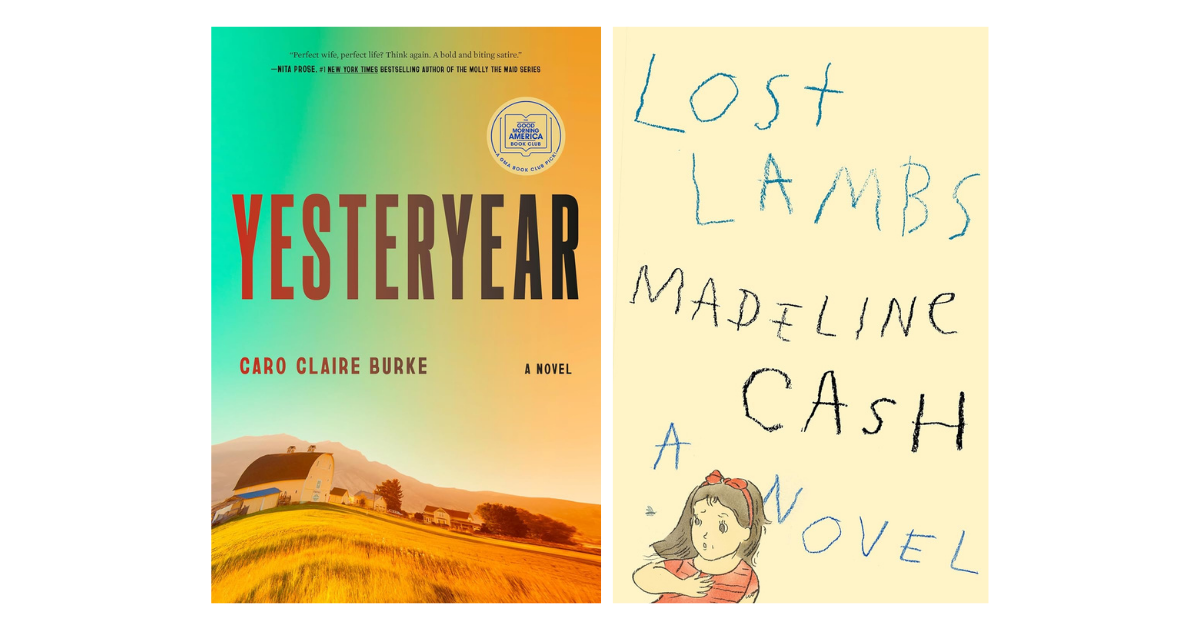

Lost Lambs
My real-life book club recently read Lost Lambs at my suggestion. This is a novel by a 29-year-old author, and my pitch to my book club of fortysomethings was “Let’s learn what the young are thinking about these days!”
I would say that opinion was somewhat mixed. One person was very enthusiastic, most others didn’t really care for the book. I was somewhere in between.
It would be extremely difficult for me to explain the difference in market-positioning between Lost Lambs and Yesteryear. They’re both basically intended for the book club market, but Lost Lambs is slightly more hip. It’s from an editor at FSG, Jackson Howard, who is known for publishing trendy authors with a lot of indie cred. The author, Madeline Cash, started a magazine called Forever that was hot for a while, and she had well-received short story collection that came out a few years ago from Clash Books. I would say the market-positioning of her book is more literary than Yesteryear, but only in some vague, hard-to-define way.
Anyway, I love Jonathan Franzen, and Lost Lambs was essentially Cash’s attempt to write a Franzen-style family novel. It’s about a suburban couple who’ve recently opened their relationship, which has resulted in negative effects on their three daughters. Everyone is very quirky, and they live in a Franzen-esque heightened reality. For instance, one daughter has an online relationship with a jihadist. Another daughter is dating an Iraq War vet who’s also the bodyguard to a shadowy tech billionaire. The husband is sleeping with a nun, who runs the local chapter of a religious outfit called the Lost Lambs. And there’s a lot of other zany antics.
I enjoyed reading it. But…it did feel like the book was trying too hard. You know, it felt like Yesteryear really came from somewhere deep inside the author. Caro Claire Burke had some feelings of envy and hatred towards this Ballerina Farms woman, and those feelings congealed into this hateful and intoxicating novel. In contrast, it felt like Madeline Cash just wanted to write an important literary novel that would be compared favorably to Jonathan Franzen.
Both books achieved their aims, but I respect the aims of Yesteryear much more. It’s a book that feels urgent in a way that Lost Lambs doesn’t.

Elsewhere on the internet…
Abra McAndrew reviewed my forthcoming nonfiction book, What’s So Great About The Great Books:
I really respect that she cops to having only read about two-thirds of the Lifetime list she recommends in What’s So Great, while reading almost 2,000 other books during the same period, including texts from a wide range of world traditions excluded from these lists, as well as 20th century and contemporary American books. She’s in no way arguing that these particular classics are the only books worth reading, only that these are the best, most “universal and timeless” reads if you want to really understand what is good in literature and how specific people thought and lived in societies very different from the contemporary world.
Danielle Shi also reviewed the book for ZYZZYVA:
Kanakia’s comprehensive survey of books draws on several traditions, borrowing from Clifton Fadiman and John S. Major’s The New Lifetime Reading Plan, their list a byproduct of a Great Books educational movement in 1930s-’40s America. That movement, “though it cloaked itself in tradition,” derives its stature not from its perceived social cachet, or any real influence within the mainstream literary world. Actually, Kanakia suggests, the “Greatest Hits compilation of 2,500 years of Western literature […] was a rather new way of educating kids and was a target of ridicule by most cultured people.”
My nonfiction book, What’s So Great About The Great Books? is out in exactly one week, on May 26th! Preorder a copy from Amazon or from Bookshop or buy a copy at my events in NYC (May 27) or in SF (May 30).
I generally like the framing here (Gone Girl vs. Yesteryear), and the basically pragmatic truth that Flynn's novel is probably better because she just "honed her plotting skills to a sharp point." I love Gone Girl (and Fincher's movie) because it encapsulates a kind of early 10's feeling so well. But to bring up another 2013 novel, The Love Affairs of Nathaniel P. was Adelle Waldman's debut, and I like it as much as Gone Girl! So maybe you're giving Caro Claire Burke too much sympathy. She could have written something that was somewhat ambivalent (Waldman) or actively critical (Flynn) of women in her own social milieu and instead she's giving people in that milieu (left-leaning professional women in urban areas) this fantasy about how other women are going to be punished for their choices. You don't have to write what you know, but if you write what you hate, your writing's going to be kind of flat, right?
When did they send out the memo that writers can’t hate what they’re writing about? This is honestly distressing to me, some of my favorite books are full of spite.