
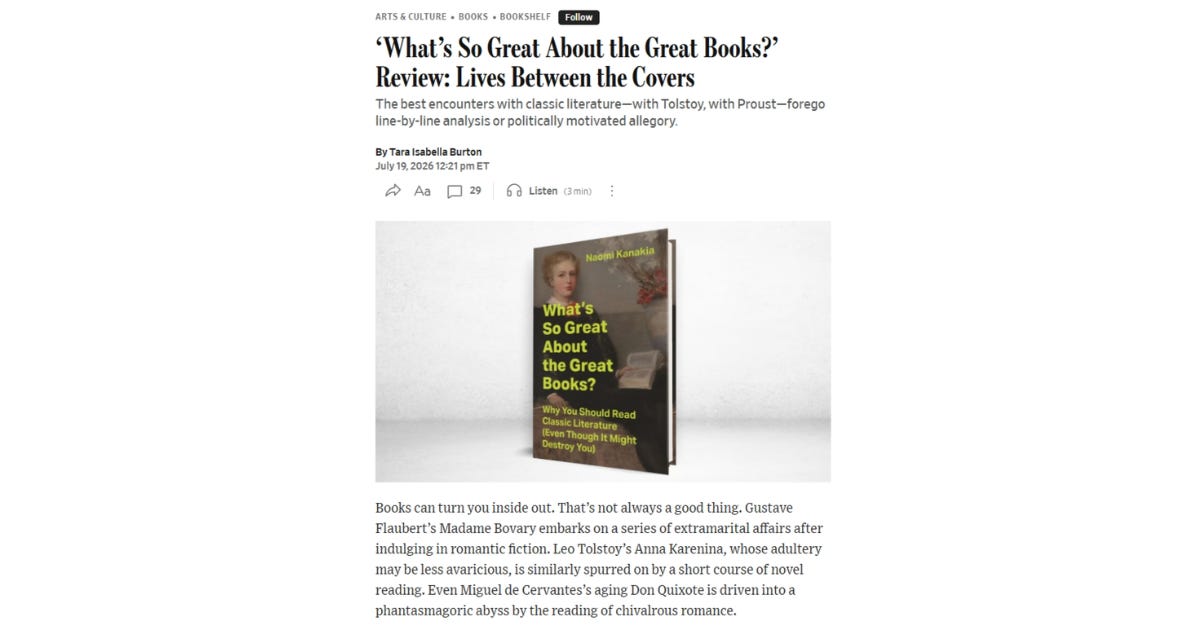
The Wall Street Journal reviewed WHAT'S SO GREAT ABOUT THE GREAT BOOKS
plus some interesting links
My nonfiction book, What’s So Great About The Great Books? released this week in the UK. Do you have the Great Books in the UK? It feels like a very American concept to me. If you’re British, please read my book and tell me whether anything like the Great Books movement exists in your milieu.
Perhaps because of this release, The Wall Street Journal reviewed the book. Tara Isabella Burton had good things to say:
It is precisely in that moral vision—the integrity of which Ms. Kanakia so movingly writes—that we find a defense of the Great Books far more provocative, and far more original, than much of the right’s habit of treating them as antiwoke bulwark for the culture wars.
Pleased to see this coverage! Perhaps as a result, the book has shot up in the Amazon sales rank--so reviews do sometimes move copies.

Other coverage
Rich Horton writes:
I’ll mention a key element of the “Great Books” as Naomi would have it -- they deal with important moral issues, and they do so with respect for views on both sides of the issue -- and with a sense of, not perhaps ambiguity, but openness to the possibility that competing views to those of the author might be valid. And yet not nihilism -- a conviction that there is a moral center that we must seek. And this book is valuable on multiple terms -- the arguments for reading Great Books, the discussion of what makes Great Books great, and simply the pleasure of accompanying a reader on her journey.
Robert Minto writes:
From my fannish perspective, I think this book matters in Kanakia’s oeuvre because it fully exploits her strongest literary asset for the first time in print: I mean the seductive voice that was previously restricted to her internet writing. It’s a voice casual yet precise, unselfconsciously nerdy, simultaneously idealistic and cynical—and utterly singular.1 As for the book’s subject matter, apologetics for reading the classics, I have to admit I’m dubious about its persuasive power. Not because of any deficiencies in Kanakia’s reasoning or writing, but because I’m dubious about apologetics of any kind, in the service of any faith, art, or ideology.
I had no idea that Minto had read so much of my work! I agree that this book is the first time I’ve used my internet voice in print--my hope is that my forthcoming collection utilizes it more, but who knows.
My nonfiction book, What’s So Great About The Great Books? is out today, May 26th! Order a copy from Amazon or from Bookshop. There’s also a pretty good chance it’s at Barnes and Nobles or your local bookstore. The distribution seems pretty good, though I’m not promising anything.

Many such Bernhard takes…
For The Point’s substack, Jon Baskin wrote what he called ‘an addendum’ to my post on Thomas Bernhard. He too is a fan of Jordan Castro—Baskin writes:
The genius of Castro’s inheritance of Bernhard lies in its recognition of two differences between Bernhard’s era (and even the era in which I began reading Bernhard), and our own. The first is that “social life” now takes place predominantly online, rather than in person. The second, which flows from the first, is that this online experience has familiarized us all with the perennially resentful and castigating voice of Bernhard’s seemingly eccentric narrators, as well as with their (once seemingly extreme) habit of judging everything their contemporaries say, even when it purports to be an analysis of a work of art or a meditation on their lives, as an act of competitive posturing.
Baskin goes on to say that maybe even this experience of the internet, as an arena of online ranting and posturing, perhaps belongs primarily to the past, and that novels like Castro’s are really a time-capsule, a record of a text-based internet that has since given way to the internet of vertical video.
In the comment section for my original Bernhard piece, Clement Killeaton left a comment saying that he thought Bernhard’s voice was too easy to imitate, so much so that it formed a kind of dead-end, locking aspiring writers into a position from which it was difficult to innovate.
He expanded upon this comment:
…writing like Thomas Bernhard specifically is easier than writing like other writers, easier than choosing another narrative voice from amid literature’s panoply of narrative voices, not merely due to the distinct qualities of Thomas Bernhard’s narrative voice, the flowing sentences and italicized repetitions that lend his prose, which is now your prose, the unmistakable rhythm that leads every last commentator on Thomas Bernhard, every last one without fail, to note the musical quality of Thomas Bernhard’s narrative voice, and to reference Thomas Bernhard’s musical training in his youth, but also due to the patina of serious literature that this narrative voice endows upon your work, a seriousness stemming in turn from the demands that such a structure ipso facto places upon a reader, the lack of paragraph breaks that cause the text to assume upon the page an imposing heft, transforming before the reader’s watering eyes into a sustained scream, a mountain rearing vertiginously toward the heavens, a great oozing magma of words signaling to the reader that you, the Neo-Bernhardian writer, are a serious writer of serious literature, all because you can do a pretty credible job of writing like a writer whom a lot of other writers are currently trying to write like.
The whole post (which is thankfully not written in this same imitative voice) is very interesting and well-worth reading.

A Chekhov effort-post
Recently, I also really enjoyed (and was impressed by) Adhithya’s attempt to get to the root of an eternal question: What makes Chekhov’s stories so good? As Adhithya notes, this is a question that surprisingly few people attempt to answer, perhaps because the stories are so seemingly artless:
It’s that resistance to analysis that baffled me. Every great writer is great at multiple things, but they’re recognized for something. Tolstoy had this incredible talent for creating moral masterpieces that asked big questions, filled with nuanced characters and vivid set pieces. Turgenev mastered the character of the Russian peasant: he evoked admiration for their simple lives and a horror for the system that crushed them. Dostoevsky’s frenzied rants cut deep into the darkness of the psyche, and Gogol’s deranged idiosyncratic voice conjured a bizarre world. But Chekhov…
Chekov’s writing is like sea water that slips through clenched fingers. But it leaves the taste of salt on your palm. It’s the sound of a faint melody from a different room, a soft fragrance in the evening breeze. The after-effect of reading a Chekhov story lingers for ages, but it’s hard to verbalize or to communicate.
I think Adhithya does a pretty good job of getting to the heart of Chekhov. Well worth reading, and it’s a lesson to me that even when you’re writing about great authors, who’ve been analyzed to death, there’s value in an earnest and straightforward approach.

Take the little magazines survey!
Finally, I am trying to write a summary article about the ‘little magazine’ intellectual scene, and I’d love to get some reactions from the subscribers to these journals. I am particularly interested if you’re a subscriber to one of the following:
N+1
The Drift
The Baffler
The Point
Liberties
The Yale Review
The Hedgehog Review
The Believer
Initial results have been fascinating—I won’t say more, to avoid biasing the responses, but I think people will enjoy hearing why readers subscribe to these journals and what they believe about the role of these journals in our society.
To respond, just fill out this Google Form. Thanks so much for your time! The survey will close on August 15th.