
More important than my book's release
Many years ago, I read a book called The Lonely Crowd by sociologist David Riesman. He posited that once upon a time, in America, we lived in a tradition-oriented society, where people just did whatever society told them to. Then we became an inner-directed society, where what happens is that during your childhood you are presented with certain ideals, and you’re told that these ideals are desirable. And when a person in an inner-directed society reaches adulthood, they freely pursue these childhood ideals even though nobody is forcing them to.1
This inner-directed concept seemed to accurately represent how I was raised. As a young person, I was told that it was really important to read the classics, so when I became an adult, that’s exactly what I did.
I have often been told (including by Riesman in this self-same book that was written thirty-five years before my birth) that we don’t live in an inner-directed society anymore and nowadays peoples’ desires are very malleable and determined entirely by the consensus of the herd.
Personally, I have my doubts. I feel like every writer, thinker, and professor still basically advocates immersing yourself in the greatest work of the past.
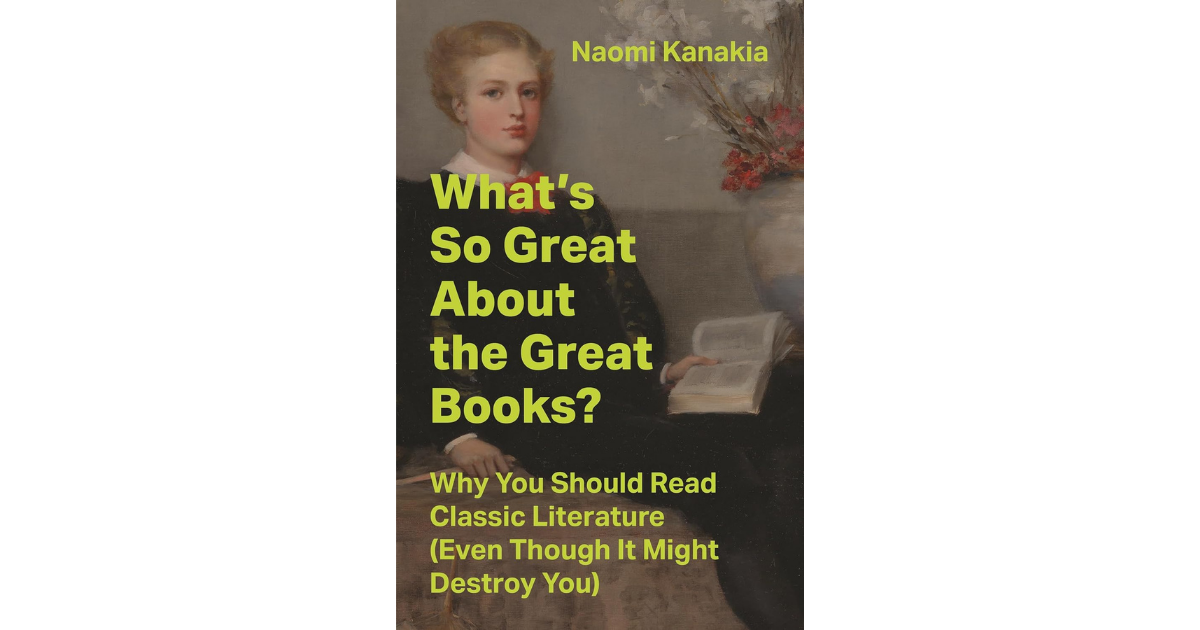
However, if these values that I live by are indeed under threat, then it’s my duty to somehow defend them, which I have done by writing a book entitled What’s So Great About The Great Books?
I have been working on this book for four years, and now today it is finally out. Yes, today, May 26th, is my book’s release date. Hopefully it’s in at least a few bookstores.
The vast majority of you will not read or purchase this book, and that’s fine. It is not important for you to give me money or your attention. What’s much more important is that you understand how deeply I believe in the value of reading the Great Books.
Sometimes I worry that I don’t insist strongly enough on the value of reading the classics (and especially classics from the very distant past)—I know that everyone has their own TBR list, and they don’t necessarily want me to moralize about what they should be reading.
But I do think on this one day, the release of my book, I would like to be more categorical than I usually am. And I would like to say that I believe there are millions of people in America who would both enjoy and really benefit from a self-directed program of reading the Great Books.

The importance of reading old books
Looking back, I don’t recall ever being explicitly told that people were supposed to read Plato and Tolstoy and Euripides and John Donne. It just seemed obvious to me that this was a really good thing to do, and that many of my favorite authors had pursued some form of this education. Now that I am thinking about it, probably the early example that made the strongest impact on me was Samuel Delany, who was one of my instructors at the Clarion Writer’s Workshop in 2006, when I was twenty years old. At the time, it felt like he’d read every book in existence, and I absolutely idolized Samuel Delany (although he personally was not very encouraging about my own writing—an experience that inspired one of my most popular tales).
Before taking this class with him, I read Delany’s About Writing, where he very explicitly said that writers ought to read the greatest authors and then aim to follow their example, and that if you’re not capable of doing this, then you’re not really a writer:
In terms of writing, we’ve seen the last twenty-five years’ explosion of writers’ workshops and MFA programs. But there’s a possible built-in failure in this program: while many—or even most—people can internalize a range of literary models strongly enough to recognize and enjoy them when they see them in (some) new works that they read, very few people internalize them to the extent that they can apply them to new material and use them to create.
Lots of people want to.
But not many people can.
Most of you who read these notes—the vast majority—will discover, sometime fairly soon (that is, in the next three, four, or six years), that you are not really writers.
Later in the book, he gives a long list of authors you ought to read—needed to read—if you’re going to become any good.
You need to read Balzac, Stendhal, Flaubert, and Zola; you need to read Austen, Thackeray, the Brontës, Dickens, George Eliot, and Hardy; you need to read Hawthorne, Melville, James, Woolf, Joyce, and Faulkner; you need to read Tolstoy, Dostoyevsky, Turgenev, Goncharov, Gogol, Bely, and Khlebnikov; you need to read… [about fifty or a hundred more names that I cut —NK]
I found this so inspiring, and although my own reading is much broader than Delany’s (he never seemed particularly concerned with the ancients or even with the Renaissance), when I attempted to educate myself, I think that I followed the spirit of his advice.

The Great Books ideal is more important than my book
Maybe if I hadn’t encountered Samuel Delany’s dismissive and contemptuous attitude towards the typical aspiring fiction writer, I never would’ve set forth to read all the Great Books. Who knows.
Anyway, now it is Tuesday, May 26th, and my version of About Writing is coming out! This is my book, What’s So Great About The Great Books? And, like About Writing, it is a very idiosyncratic book. It’s my defense of a specific reading program, the Great Books, which involves reading all the greatest classics of world literature—including some that are famously indigestible—in translation, with relatively little in the way of classroom instruction or outside training.
This book is my attempt to transmit my own values to the next generation.
As I said, I really strongly believe that there are a large number of people in America who would benefit from reading the Great Books. The main thing I know about these people—the folks who ought to read the Great Books—is that deep down inside, they really want to do it. But for some reason, they haven’t given themselves permission. Because they don’t think they’re the kind of person who reads classic literature.
In other words, they’re just like me at age twenty-three. Back then, I read the Great Books not because I thought that I’d enjoy them, but because I was afraid that if I didn’t read them then I could never be a great writer.
The Great Books have given me plenty of enjoyment, but the truth is that if reading the Great Books was as pleasant and absorbing as reading Gone Girl, then there would be no issues—everyone would be reading them. Obviously, there is a barrier to entry. People bridge that barrier in various ways, but I think mostly it involves some amount of trying. Nowadays I find that if I want to appreciate something, then I usually can. But I didn’t know that when I was twenty-three. Back then I just rushed headlong into the classics, because I thought that if I didn’t like them, then that meant I was a bad person.
Today, I have a whole suite of techniques for trying to appreciate something. Mostly it’s a process of testing: I have dozens of books that I periodically go back to, testing whether it’s time for me to read them. Then, when the moment is right, I dive in. Sometimes I bounce out—I read several hundred pages of Gravity’s Rainbow last year, for instance, before deciding the moment wasn’t propitious (i.e. I was very bored). But oftentimes, when the moment is right, I get really enthused by an author and will read more and more of their work. Then I’ll look into their influences, and I’ll start reading about their culture and their language and their national literature.
These are relatively simple patterns of behavior that I’ve developed simply because I am anxious to enjoy the things I’m supposed to enjoy. If there is widespread consensus than something is a work of genius—and particularly if that work is an older book—then I really make a strong effort to enjoy it. Sometimes that effort doesn’t work, but I think it’s a worthwhile practice to withhold judgement on an older work (say…older than fifty years) that’s widely-regarded as being good and important. And that’s really the essence of the Great Books movement—it’s just an organized way of respecting the judgement of our forebears. Many people, throughout history, have felt these books were valuable, so we attempt to see their value as well.

Maybe I should be more emphatic
Samuel Delany was so harsh! He was so dismissive of most people and their efforts. This guy read War and Peace when he was thirteen, and he basically believed that unless you had that kind of all-consuming drive to be a great writer, then it could never happen for you.
That’s not really my style. I really feel no desire to make other people feel inadequate.
However, I do believe, just as Samuel Delany believed, that if you want to be a great writer or thinker, you should attempt to read the world’s greatest works of literature. Obviously, it doesn’t work for everyone. Lots of people have either consciously or unconsciously rejected this Great Books ideal, and they have gone on to produce good work. I just heard the other day about a writer who I respect who doesn’t read fiction at all! Regards it as a waste of time, because it doesn’t access truth.
That’s fine for them. Many people have brilliant and forceful and idiosyncratic personalities that’ve given them a strong sense of what they personally need to succeed.
But many more people are like myself at age 23—anxious to achieve something worthwhile, but with no sense of how that might happen. Reading the Great Books offered a path. At the time, I thought it was the only path. I know now that’s not necessarily true, but I still think it’s one of the most accessible paths to becoming a better writer and thinker—it’ll certainly do much more for you than doing an MFA program (this latter point is not controversial, virtually all MFA professors would agree that workshop is no substitute for reading the classics).
If I’ve failed to argue this point as forcefully as Samuel Delany did, that’s just because I have a different personality than he does. Sometimes I worry that I’ve undersold the Great Books, and that I don’t convey how transformative and useful they are. But hopefully the depth of my conviction comes through even though my tone isn’t particularly polemical.

For more info, see my book
The other day I was explaining about the Great Books to a friend, and she had many questions, “Which classics do you mean? Just the English classics? What about the Chinese classics?”
I told her all these questions are answered in my book.
Yes, everything I have to say about the Great Books is indeed contained within a book that is coming out today. As I’ve mentioned a time or two before, this book has ZERO overlap with my blog. Nothing from this book has ever been published on my blog, and nothing from my blog is in this book. That’s because I wrote the first draft of the book three years ago, before I had ever started this blog. I turned in the book, and then I started the Woman of Letters Substack as a way of promoting it.2
Now, three years later, the body has outgrown the head, and the blog is read by many more people than are likely to read the book. But still, I think the book contains much that’ll be new and interesting to readers of Woman of Letters.
This book is essentially about why you should read the Great Books. There’s nothing else quite like it—most other books on this topic take a much more polemical approach (somehow Western Civilization always seems to be hanging in the balance when people discuss this topic), and they also tend to get very mixed up with the question of what kids should be taught in college. I avoid all that stuff.
Instead my book is about whether you, a person who enjoys reading books, ought to make a concerted effort to read Tolstoy, Dostoevsky, Milton, Chaucer, Euripides, Plato, Aristotle, Nietzsche, and a bunch of other authors. I get down into the weeds and talk about exactly what I mean by the Great Books, and I even provide a list of books to read (the same list I’ve used for the past seventeen years).

The time for gratitude
With my past books, I’ve often been too caught up in my anxiety to properly thank all the people who helped me publish the books. In order to make a book, you come together intensely with a certain group of people. And after the book comes out, those relationships eventually fade or go sour. Your editor gets laid off or turns down your next book. Or the imprint decides not to give your book a paperback. Or your agent fires you, or you leave them. Or you leave the imprint to chase more money somewhere else. The point is, in the years after the book comes out, something usually happens to tarnish your memory of the book’s release.
So the time to praise everyone is when the book comes out, before all that stuff happens! A book’s release is really a time for the team to come forward.
In the case of Princeton University Press, I feel extremely positive feelings. I can recommend this press in the highest terms. They are truly exemplary.
This book began when Matt Rohal, an editor at PUP, read several of my pieces in The Los Angeles Review of Books and asked me to develop a proposal where I said something about the Great Books. We went back and forth a few times on the proposal for What’s So Great About The Great Books? (I think the title, which is excellent, is his). I’ve never had an editor who was better at managing me than Matt is. He is so good at delivering edits—there is so much praise, even when he wants major changes. I’ve always been confident that Matt trusted me and that I was fully in control, but then somehow I end up doing what he wants me to do! It is really magical.
I am truly amazed this book exists at all. Four years ago, I was a not-particularly successful YA novelist with few nonfiction publications and very little online platform. Matt and Princeton University Press not only took a chance on me, but they did so very enthusiastically.
Princeton University Press is a very big academic press. They have both a scholarly list (I think Matt acquires in philosophy) and a trade nonfiction list—the latter are the general nonfiction books like mine. Because it’s an academic press, everything has to go through peer review. My proposal got peer reviewed and then my complete draft got peer reviewed as well. In both cases I made substantial changes as a result of peer review. One of the peer review comments caused me to restructure the book to deemphasize a lot of the political stuff that used to be right at the beginning, and this change really substantially improved the manuscript.
Peer review was a difficult experience. I did have a classic Reviewer #2 experience, where I got some pretty negative peer review comments, but…that’s fair enough, and the comments ultimately made the book stronger. The peer review also corrected a few inaccuracies. It is nice to have scholars double-checking your work.
I am thankful to my former agent, Christopher Schelling, who negotiated my contract with Princeton University Press. Academic presses have this very exploitative baseline contract where they take all your copyrights. It’s possible to push back on this and get something that more resembles a regular book deal, but it’s a lot of effort, and I’m thankful that Christopher did the heavy lifting on this.
Princeton University Press also has an excellent production staff. Production was handled by Ali Parrington, who is extremely organized. Princeton University Press is so efficient. It’s like a machine. Copy edits were handled very well, by Plaegian Alexander—I normally hate copy-edits, but hers were at just the right level of detail, correcting genuine errors without being too intrusive. First- and second-pass pages also happened in a really orderly manner. It was just nice to not feel rushed and to have a strong sense of what the book would look like.
And then my publicist, Jodi Price, has been incredible! She is so on top of things. She’s really been emailing people and getting results. I have been so impressed. There is no job in publishing that’s harder than being a publicist, because…there are so many books, and outlets aren’t in business to do favors to publishing companies. They want to cover stuff that their readers will actually interested in. Authors are also very difficult, and we have a lot of expectations that we load onto publicists. They’re not miracle-workers, their job is to understand what kinds of pitches might be attractive to the people who cover books. I feel confident that Jodi is doing this job about as well as it can be done. Princeton University Press is lucky to have her!
My new agent, Alia Hanna Habib, has also very generously involved herself in some of the conversations about marketing the book.
Oh yes, and I really should thank Dog-Eared Books in SF, who agreed to sell the books for my SF event, even though it’s offsite. They have been great supporters of me over the years, which I really appreciate. And I should thank both P&T Knitwear and McNally Jackson Seaport, who both wanted to do events with me in New York. It is very hard to schedule a New York event, because bookstores tend to be selective about which author they’ll work with. I have very good feelings about P&T because they did a nice event for me for The Default World. In this case, McNally Jackson reached out first and I had already committed to them by the time I heard from P&T, but I still appreciate both bookstores a lot. Thank you so much.
And then, of course, there are all the people who requested copies of my book through my galley copy form! I sent out many copies of this book to various people in the Substack community, and there’s been a lot of advance press from my newsletter friends. There’ve been writeups or interviews by Robert Boyd Skipper, Isaac Kolding, Henry Begler, John Pistelli, Abra McAndrew, Alexander Sorondo, Petya Grady, Jared Henderson, and Henry Oliver. Thank you so much for engaging with my book.
(If you got a book and haven’t gotten to it, don’t feel bad—I also get many galley copies that I don’t end up reading).
This book was very difficult to write, probably one of my hardest writing experiences. It’s an immense undertaking to produce an entire nonfiction book—much more work (at least for me) than writing a novel. But it’s been a good experience. I owe everything good in my career to this book. In order to promote this book, I started this newsletter, which has grown and become such a life-sustaining endeavor. Because of this book, I also developed a lot as a writer—I am a nonfiction writer now! (In fact, some would say that I am much better as a nonfiction writer than as a fiction writer.)
I am really proud of this book. I do think that it’s the right book for someone. And that in twenty years someone will look back on this book and credit it with altering the trajectory of their life, just as Samuel Delany’s About Writing (may have) altered mine.
Whether the book will do more than that, and blow up, become widely-praised, and get assigned in schools…I dunno. Probably not. But it’s still a good book that someone needed to write, and I’m happy that I did.
My nonfiction book, What’s So Great About The Great Books? is out today, May 26th! Order a copy from Amazon or from Bookshop or buy a copy at my events in NYC (May 27) or in SF (May 30).
According to Riesman, that inner-directed stuff has now broken down, and we’ve transitioned to something else, an other-directed society, but...that part of the argument was never fully convincing to me.
Admittedly I had blogged on Wordpress for the twelve previous years, but my format on that site was quite different.
Congratulations. I think your timing (and I know this is mostly a matter of luck) is perfect. And I hope people are attracted to the book first and foremost because of your attitude: "I really feel no desire to make other people feel inadequate."
Substack seems to be full of people who push some form of a great books program because "Taking your medicine is good for you: Ignore the taste!" I'm 68: I don't need my mom hectoring me. I prefer just being reminded that The Faerie Queen really isn't impossible to understand and listening to an audiobook version is OK if that's what works. The doors have always been open. Sometimes we just need a little encouragement to step through them.
I always assign a bit of Delany to students in my intro creative writing classes and they get SO MAD at that passage. I try to find an encouraging and welcoming way to say “he’s right tho”