
Just give this woman some money
Once upon a time there was a woman who hated doing unpleasant things. I’m talking about stuff like school assignments, applying for jobs, responding to emails—She just really didn’t like to do unpleasant things!
This woman preferred to do pleasant things instead. For this woman, those pleasant things included learning about math and solving complex math problems. The woman didn’t have a degree in math and hadn’t studied math formally, but she wrote a blog that contained talented, witty proofs of various math problems, which she claimed to have worked out herself.
Many people were quite interested in this blog. Some thought she was a faker, cribbing other peoples’ solutions. Others thought she was a genius. But the woman believed that this ability was simple and not a result of genius at all. Her secret was that she’d never accustomed herself to the idea of doing unpleasant things. The way kids were taught in school was unpleasant, so they didn’t want to do it, and they didn’t learn. If they just followed their curiosity without interruption, then they would learn lots of wonderful things.
This woman wrote a novel in which she dramatized this idea. It was about a poor boy, convicted of stupidity and sentenced to the remedial education classes at his school, who relentlessly tried to gain exemption from his schooling by explaining the solutions to complex mathematical problems.
When this novel, The Ordinary Kid, was completed, the woman went about the task of finding a literary agent to represent it. The woman hated doing unpleasant things, so this process was a trial, but with each step, she had hope that it’d be the last unpleasant thing. Just do a query letter. Just sign a contract. Just do some revisions, and then it’d be over, and the book would get published.
Unfortunately, the process of revising this book with a publisher involved a lot of unpleasant tasks. The book contained pages of complex equations, written in mathematical notation, which the publisher didn’t want to render. The woman fought and fought and fought with the publisher to make them publish the book the way she wanted—each time she re-read the galleys, she found newer and more maddening errors. And even when she wasn’t fighting, the woman was worrying and stressing. She didn’t understand how this terrible situation had arisen! This was so unpleasant! This was worse than working, because you could just quit your job. This was worse than school, because you could just drop out of school.
Here it was quite different! It was something she cared about very much, and she wanted it to enter the world in a perfect form, and that required a lot of unpleasant labor.
Nonetheless, she prevailed, and the book was published.

Over the next few decades, her first book gained a lot of fans. And these fans wanted to know if she was working on more books.
And her answer was always, “I am terribly harried by life concerns, and I have very little mental energy to do basic tasks, so I need a safe, comfortable place where I will be separated from the world and completely free from any unpleasant life tasks.”
As a result, her fans kept trying to find ways to give her money so she could afford this situation.
Some gave her money directly, but even this was complicated, because receiving the money involved unpleasantness. There was a newsletter platform that allowed people to give you money, but she couldn’t figure out how to connect it to her bank! Too unpleasant! This was unpleasantness, exactly what she most hated—exactly the thing she’d devoted her entire life to avoiding!
Then some of her fans thought, “Okay, so it’s hard to give her lots of little checks. Why don’t we give her one big check.” One of these fans was a part of a grant-giving organization, and they got this organization to award her a twenty-thousand-dollar grant.
But when this organization tried to get her headshot and bio to announce the award, they ran into problems. She didn’t have time to dig up all that stuff, because dealing with these trivial issues was extremely unpleasant! She sent many emails to the administrator of this grant, saying, “Listen to me, if the point of this money is to help me work, then just listen to what I am saying—I can only work if I never need to do anything unpleasant. And this seems very unpleasant! So if you want the grant to fit its intended purpose (helping me work), then don’t you see that I need it to be much less unpleasant for me?”
And the grant administrator kept emailing her back saying, “Okay, so what can we do to make this more pleasant?” But the woman had a problem. To attempt to communicate effectively with this grants administrator—that would be unpleasant. She could’ve sent an email saying, “Just announce my name, with no picture or bio.” Then this administrator would’ve needed to run it past their board. Maybe they would’ve said no! But it would’ve been an actual proposal.
The woman didn’t do this, because offering a proposal and waiting to hear back—this would’ve been unpleasant. Exerting self-control and attempting to put herself in the other person’s shoes—attempting to figure out what might actually work for them—this would’ve been unpleasant. So she didn’t do it. Instead she abruptly withdrew herself from contention for this award.

This was a recurring pattern with most of the people who attempted to help her. Many times in the last twenty years, some supporter had thought, “Aha! All she needs is someone who will give her exactly what she wants, with no questions asked.”
But the problem was that “What do you want?” was a question. And it was a question that she found it unpleasant to answer. As a result, her answer was inevitably somewhat confused, which meant that her erstwhile supporter needed to ask some follow-up questions to clarify her meaning. And these follow-up questions were just another round of unpleasantness (from her perspective). And eventually the dialogue would be cut short! Too many questions! And she would issue a proclamation about all these terrible people who seemed to want something from her, and then her many fans would think, “What a shame that nobody can just give her whatever she needs, with no questions asked.”

What this woman truly wanted, more than anything. was to be returned mentally to the state she’d possessed before the publication of her first book, back when writing books had been a pleasant activity that she had enjoyed doing.
The problem was that now she had experienced what happens when you write something. What happens is that you might perhaps want to publish that thing. And she’d learned that the publication process would involve a lot of unavoidable unpleasantness.
As a result, the very act of writing had become unpleasant. Whenever she sat down to write, she just thought, “Even in the best possible case—I produce something great—this will be an unpleasant experience.”
And this not only created a disinclination to write, it also harmed the writing itself. Because when she’d initially written her book, she hadn’t been forcing herself. She had actually enjoyed writing the book, and she had written the book by following her own enjoyment, by writing down thoughts and situations that seemed pleasant to her. This never-ending pleasantness was precisely what’d given the book its readable quality.
Back when she was writing that very-pleasant first book, she had also faced a lot of unpleasant worries about bills and life tasks, and the way she’d escaped those worries was through her writing. Now, writing was itself an unpleasant thing that she needed to escape (which she usually did by going online and complaining that she couldn’t write).
In truth, she wasn’t really the same person anymore. She wasn’t the person who’d written that one great book. Back when she’d actually been a genius, she had always denied that she was one—she’d insisted she was just an ordinary person (and had believed it too!). Now that she was widely considered a genius, she played into the role—comparing herself to Pynchon, McCarthy, David Foster Wallace, asking if male geniuses would be treated like she has been—all to obscure the fact that she is not really a genius anymore. The thing that once meant nothing to her—the title of genius—has become vitally important, because it feels that title is a promise that...that...that...somehow there are still pleasant things in store for her. That someday, somehow, she will once again be the person she once was, back when she was doing the genius-level work that she can no longer produce anymore.
Once upon a time, she very much wanted to be understood. She wanted people to understand what was happening inside her head—things that she insisted were no different than were happening in everyone else’s head—which is why she produced her genius book.
Now she no longer has that desire to be understood, because she’s afraid that the real answer to the question “What do you need in order to write a great book?” is, “Nothing, because I am no longer capable of doing so.”

So instead of writing something that people might want to read—a novel or an essay—she spent a lot of time faffing around online. At some point, she got into the habit of just listing all the various books she’d like to write if she was actually capable of writing books. She invented whole universes of authors, and she started going further, creating book reviews and biographies and wikipedia pages for these made-up authors.
Yes there were procedures online to prevent the spread of misinformation, but getting around these procedures was fairly simple. And it was very easy to create an author that people would believe was real, even if they didn’t exist. Her fake authors were usually someone published by the NYRB or someone who wrote essays for tiny journals. Or, oh, even better, a poet! You could invent poets all day long without anyone noticing they were fake.
Eventually, for a few of these writers, she even began publishing actual books. After all, these were fake books, not her real work, and she didn’t care whether they won the ‘Folio Prize’ (something that was apparently real). Some of these fake authors attracted literary agents too, and she even had to do revisions for the benefit of these agents, but because the work wasn’t serious—it was just a joke—she had no issues altering it if her various agents wanted her to.
Eventually, some of her fake authors even had backstories. One of them transitioned! Yep, went from Frank to Francine, just like that, and even got a memoir deal out of the whole thing.
(You might ask how this woman could possibly write twenty highly-touted books per year. Well....how could she learn how to solve complex math problems without any education? When this woman enjoyed doing something, she just did it, with no issues.)

But there was a problem. She was really proud of some of this pseudonymous work, but nobody was reading it! Her work under her own name was famous, but some of these fake authors seemed (to her) equally good, and nobody was paying attention to them. So she decided to snatch a little attention for these authors of hers.
It only took a few days to create the fake award, with the most absurd name she could conjure, to tie everybody together. Then with AI she created a number of videos of people announcing their gratitude for the award. Now, instead of publicizing a dozen authors, she just needed to publicize a single fake award.
But how to do it?
Well, she thought back to her past life, when she used to complain so vociferously about the publishing industry online.
She hadn’t really thought about those old grievances in a long time—they didn’t seem important anymore—but she remembered now that one time when she, silly thing, hadn’t been willing to give a headshot to that foundation. Oh she used to do crazy stuff like that all the time (now of course she had the income from ten or fifteen fake authors coming in, so she didn’t need to worry much). But she channeled that old self, and she wrote a tweet, linking the announcement for this very fake award.
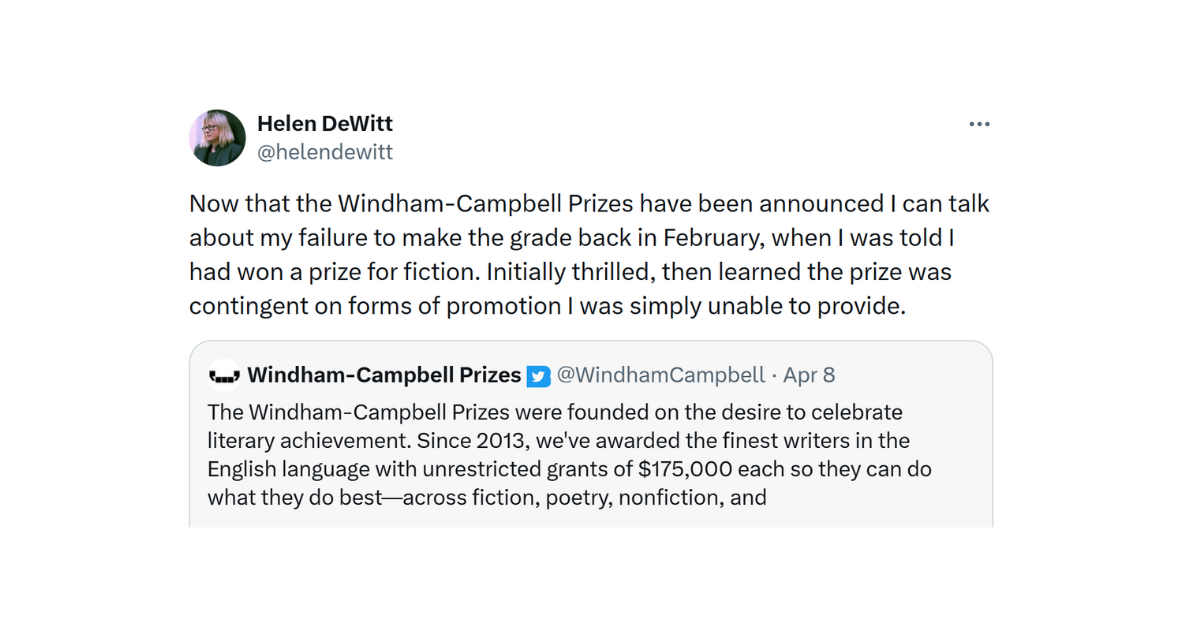
So she wrote a tweet: “Now that the Twatworth-Farnham Prizes have been announced, I can talk about how their unconscionable demands led me to turn down...”
And then she thought. Hmm...the number of the real foundation award she’d turned down, that’d been just $20,000. That was too small. Too believable. It wouldn’t get people riled up. So she thought and thought, trying to come up with a number that would really set the internet talking.
Finally, with a grin, she wrote, “Here’s how I turned down $175,000, even though I’m broke, because of my artistic integrity.”
There, she thought. That number was big enough. Within an hour of her pressing send, she was sure that everyone would realize this comically-large award (that nobody had ever heard of before) was an utter fake. And then they’d go one step further and think, maybe all these other awardees are fake too! Like, their books were obviously real, but maybe the people themselves were fake.
Finally, this woman was ready for all her hard work to be exposed. Looking at the full roster of books she’d written (fifty or sixty by this point), she reflected that it really wasn’t very hard to do this work. Answering an email was an unpleasant imposition. Writing books? Not so much. Writing books was a very pleasant game.
God, I hope people are going to be normal about this. Get behind me, oomf. You have my sword, Ms Kanakia.
Also delighted at the puckish mythology-inventing troll. Get this lady onto 4Chan, she'd love it.
Discourse posts bore me to death, but this approach redeems the genre. Fewer righteous manifestos built on quicksand, more Borgesian whimsy—that's what we need. This is good stuff.