
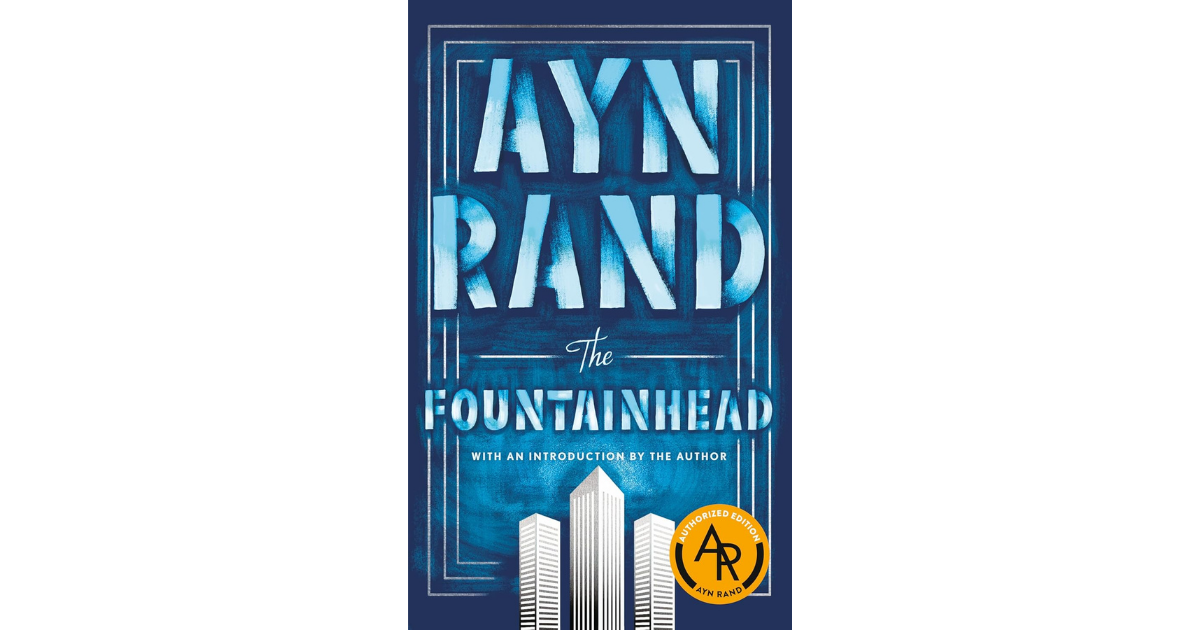
The Fountainhead
Back in the year 1998, there was a thirteen-year-old boy who loved to read. This boy lived in Washington, DC, and every week he would get armfuls of books from the library. He mostly read science fiction books, but he also read some other stuff too.
And his favorite novel was called The Fountainhead. It was about an architect who had some ideas about architecture that really weren’t fashionable, but he believed in them very strongly. And the architecture profession was like, “Okay...you can have those ideas, but that means we aren’t going to pay you to do architecture!”
Nevertheless, the architect persisted. He convinced a number of clients that these ideas were the right ones. And he built a successful career for himself.
It was such a stirring, fantastic novel. The thirteen-year-old boy loved this book so much. The author of the book was named Ayn Rand, and she was a famous libertarian. Even at age thirteen, this boy didn’t really buy into the author’s anti-government message. The boy was basically a Democrat. He believed in whatever Democrats believed (the boy read The Washington Post every day, and he was pretty well-informed about politics—he thought the Clinton impeachment was bananas).
But the boy sure did enjoy this novel, The Fountainhead.

Later in life, the boy aspired to be a writer. And he tried to market his writing to various publications. There were a number of magazines that published writing, and often these magazines did not want to publish the boy’s writing.
In some ways, the boy was faced with a conundrum similar to that of Howard Roark, the hero of The Fountainhead. The architecture profession, as described by this novel, is set up to accommodate the desires of clients who want buildings that resemble the great buildings of the past. And Howard Roark doesn’t want to build those buildings, he wants to build stuff that is radically unlike those buildings.
As a result, the architecture profession really has no use for Howard Roark.

And that is Howard Roark’s conundrum, in this excellent novel that the boy loved when he was thirteen.
But the difference between Howard Roark and the hero of our tale was that Howard Roark understood how to accommodate the desires of these architecture clients—he simply didn’t want to.
In contrast, this boy really wanted to produce something that these magazines or these publishers wanted, but he didn’t actually understand how to do it.
Howard Roark had a very strongly-held vision of what a great building ought to look like, and he dedicated his life to advancing that vision.
This boy didn’t have that kind of vision. He just wanted to be a writer.

Eventually this boy transitioned genders, which is an inconvenient and annoying part of the story. And after this transition, the boy’s new name was Johanna.
As an adult, this woman still really enjoyed this excellent novel, The Fountainhead. Johanna re-read the novel several times when she was feeling upset about her career. The most recent time was probably in 2024. At this point the woman was almost forty years old. She’d read Tolstoy, Proust, Melville and all kinds of other great authors.
But...she still felt like The Fountainhead was great literature.
Moreover, this book exposed her at an early age to the notion that, in your creative work, you ought to have principles that you stand by. Howard Roark didn’t care whether he succeeded or not, as an architect, because he knew that he was right. He didn’t want to succeed by doing something that was wrong. He only wanted to succeed by doing what was right.
Even at age forty, the girl found this to be a very powerful idea.

Nonetheless, there was a problem. Johanna didn’t really have a powerful idea that she was willing to go down for!
Johanna’s own life was nothing like Howard Roark’s. All her life, Johanna had attempted to accommodate to what people wanted.
She was definitely willing to write all kinds of things. She wasn’t too good to write young adult novels or thrillers or any of that other stuff.
Johanna did actually try to familiarize himself with the marketplace. Especially in young adult literature, she read a fair amount of YA books, and she liked many of them. She was pretty familiar with the marketplace for queer YA—some writers she liked more than others. She really liked ME Girard’s book, Girl Mans Up, and was happy it won the Lambda Award.
She tried. She did her best. She actually didn’t know how to do better. All her work, even if it was written for a mass audience, was written with integrity, and she stands by it to this day.
In fact, if this woman did have any aesthetic principles, her principle was that you ought to try and figure out what the reader wants and see if you can give it to them, so long as you could do so without writing anything that was untrue or harmful.

The hero of The Fountainhead, Howard Roark, encounters this idea in various forms. There are many people who plead with Howard Roark to sell out! Just give people what they want.
This desire to sell out is exemplified, in the novel, by the character of Peter Keating, who turns himself into the vision of what an architect is supposed to be. But Peter Keating is tormented by his own hollowness, his own feeling of imposture. And, later, when he falls out of fashion, he doesn’t understand what’s happened. This character, Keating, asks an architecture critic, “Why don’t you like me anymore?” And the critic basically says, “Why did I like you in the first place? You were never exceptional—I just picked you at random to extol, because I am a malevolent incarnation of the aesthetic bankruptcy of the critical establishment.”
What an excellent scene! It is one of the highlights of the novel. Johanna loved this scene.
But...how do you avoid this fate? How do you avoid being like Peter Keating?
It’s hard to say.
Because if you’re motivated by a desire to be an iconoclast, then that’s just another hollow performance. Howard Roark, the hero of this excellent novel, isn’t motivated by the desire to be an iconoclast or to break new ground. He doesn’t want to be celebrated for what he’s doing—he just believes this work is worth doing for its own sake.

There is a lot of 20th century literature about how it’s hard to figure out what you’re supposed to do with yourself.
Over the years, Johanna has read a bunch of books about this struggle—The Outsider, The Lonely Crowd, The Culture of Narcissism. What are you supposed to do? What are you supposed to believe? Ideally, you want to believe something so strongly that you’re willing to stake everything for it. But...in practice it’s very hard to find that thing.
The Fountainhead says basically the same thing as all these other books, which is that if you build your life around serving others’ needs, then you end up feeling hollow.
But, at the same time, it’s hard to function in society unless we have a place. Ideally, during your childhood, you internalize the demands of society so thoroughly that they turn into an ideal. That’s what happened with Howard Roark. He internalized this idea of human excellence and decided to embody it. And capitalist society (as described by this book) does need people to embody that ideal, if it’s going to function—so really Howard Roark is doing what other people need him to do, but he doesn’t perceive it this way.

The thing that makes Howard Roark so compelling is not his principles, but his affect. He’s so stern, unyielding, certain of himself. So certain, in fact, that he doesn’t even really need to explain. He’s not like Johanna—he would never operate a blog—instead he just hangs up his shingle and offers himself for hire.
However, what happens if nobody wants to hire you?
Well, the world of The Fountainhead this actually happens to Roark’s mentor, Henry Cameron. He experiences some initial success for his innovative designs, but eventually he goes too far and the profession turns against him. He dies alone and defeated.
But before he goes, he describes to Howard Roark the kind of future he’s likely to face:
One day, you’ll see on a piece of paper before you a building that will make you want to kneel; you won’t believe that you’ve done it, but you will have done it; then you’ll think that the earth is beautiful and the air smells of spring and you love your fellow men, because there is no evil in the world. And you’ll set out from your house with this drawing, to have it erected, because you won’t have any doubt that it will be erected by the first man to see it...
But then after a lot of rejection, you get beaten down. And, as Cameron tells it:
[F]inally you’ll get into a man’s office with your drawing, and you’ll curse yourself for taking so much space of his air with your body, and you’ll try to squeeze yourself out of his sight, so that he won’t see you, but only hear your voice begging him, pleading, your voice licking his knees...But he’ll say that he’s very sorry, only the commission has just been given to Guy Francon [a mediocre architect]. And you’ll go home, and do you know what you’ll do there? You’ll cry. You’ll cry like a woman, like a drunkard, like an animal. That’s your future, Howard Roark. Now, do you want it?
Howard Roark says yes, he doesn’t mind this future.
But luckily he doesn’t face this fate. Where Cameron succumbed to alcoholism and despair, Roark instead perseveres and finds success.
That’s because there’s a certain kind of person, in Howard Roark’s world, who recognizes excellence. And this person is just drawn to Roark’s work and really wants to give him money to build stuff. This kind of person is very rare, and often they don’t have a lot of money for building things, but whatever they have, they’re willing to give him.
And, over time, because his buildings are so good, these people are rewarded for believing in Howard. They get all kinds of clout and reputational benefits.

I’m making it sound very easy, but there’s a few complications for Howard along the way. For instance, at the end of the book’s second act, Howard Roark blows up a government housing project. The whole last third of the book is consumed with him standing trial for this act of terrorism.
Howard’s motivation for this bombing doesn’t make a lot of sense, since the act doesn’t really fit with his impassive character as it’s been portrayed in the book until this point. The bombing is overdetermined: it’s not caused by Howard’s needs, but by the author’s need to generate conflict between Howard and the government. That’s because her theory is that somehow society is out to get Howard, but…society usually doesn’t persecute law-abiding architects. If Howard hadn’t blown up this housing project, then he would’ve just kept on being a pretty successful architect and the book would’ve been much shorter.
This is the flaw in the Randian worldview. Her theory is that excellent people are drawn to excellence, and that excellence eventually gets rewarded. So if that’s true, where’s the conflict? If this is a correct vision of reality, then everything ought to just be excellent.
In Ayn Rand’s equally good (though structurally uneven) follow-up novel, Atlas Shrugged, her answer is that everything excellent in society, all the good things we have, come from these excellent people, who are mostly industrialists and scientists (a few are artists, but they seem a bit like afterthoughts). These industrialists are the Prometheans, the well-spring of innovation, and everybody else benefits passively from their genius.
However...there are also a bunch of mediocre people who hate excellence. And these people figure out complex ways to chain the Prometheans and extract their labor from them. Eventually, in Atlas Shrugged, these resentful mediocrities gain control of the government, institute communism, and destroy everyone’s prosperity.
This is also a great novel. And it answers the question, “Why is everything not excellent?” The answer is: “Because of the spitefulness and envy of mediocre people.”

These novels are perfect for kids, because they give you the right lesson. You should pursue excellence for its own sake. If you do, you will probably achieve material rewards and a high reputation in your profession, but you can’t pursue excellence for those reasons. If you pursue excellence instrumentally, then it won’t work.
Is it actually true that if you pursue excellence you will eventually be celebrated by society? Who knows! You can argue a good case either way. Johanna has come across many people who argue that those who pursue literary excellence are doomed to obscurity—there is this popular concept called ‘the middlebrow’, which argues that there’s a vast swathe of things that claim to be excellent, but are actually bad, and that this ersatz excellence, fake excellence, will inevitably crowd out the real thing, such that any artist who’s actually excellent is doomed to die a failure.
Maybe that’s true. Obviously, this middlebrow concept is very comforting for a lot of people (including Johanna herself, at times), because it implies that the reason you’re not succeeding is that you’re too good.
But ‘the middlebrow’ is a concept for adults. It’s for people who have already tasted failure and need some illusion that’ll allow them to keep their self-respect.
Young people don’t need that. Young people should have the confidence that if they pursue excellence, then it’ll be rewarded. That’s what this book gave to Johanna, and she’s grateful for it. She’s read a lot of other classics in her life, but none of them has communicated a worldview that is quite as straightforward and useful (on a personal level) as the one in The Fountainhead.
I was kind of obsessed with Ayn Rand as a literary figure. I mean, that cigarette. Those staring eyes. Plus she was totally committed to her point of view/philosophy and got a lot of people to follow along. Just a fascinating person. I enjoyed reading both the Fountainhead and Atlas Shrugged (I'm okay with philosophy couched in narrative), though there were some things in AS that I questioned (and still do, even more, now that I'm decades older than when I read it.) The thing is, we need all kinds of people in the world. If the very few "Prometheus capitalists" succeed in gathering all the capital to themselves, then they've "won." But what is the world they are left with? If nobody else has any gold, who will be able to buy their train tickets and steel and really darn good cigarettes and perfect hamburgers? Supposedly, these Prometheuses pay a decent wage to the really good workers. Okay. But our current "Industrialists" want to make robots to do that work. We might actually need to think about this right now as the great inventors of our day roll out artificial intelligence. Should we reward excellence? Yes! For sure. On the other hand, people enjoy different things, and sometimes (often) the masses enjoy things that "experts" consider less than excellent. Who is to decide? The market, supposedly. So . . . IS the market really the best arbiter of, say, taste? No system is perfect. Ayn Rand certainly wasn't perfect. This story was fun to read and brought me back a few decades.
For my generation, Ayn Rand had fallen out of favor because of her promotion of a kind of proto-Libertarian selfish individualism. I was reminded of this by architect Stanley Tigerman's account of his brief meeting with Rand:
It was the uncompromising and individualist hero of Ayn Rand’s novel “The Fountainhead” that inspired Stanley Tigerman to become an architect. “I read the book when I was about 12 or 13 … And I thought, this is what the fuck I’m going to do.” …
"When I saw in the Yale Daily News that Ayn Rand was giving a lecture, I got my buddies in the master’s class and we went to see her. Afterward, stupidly, forgetting her well-known antagonism towards selflessness, I went to introduce myself. I said ‘My name is Stanley Tigerman, I’m at the graduate school in architecture. Reading your book as a child really impacted my life and I just wanted to thank you for getting me here.’ And she looked at me in that New York snotty way, up and down, and said, ‘So what?'“
https://fnewsmagazine.com/2012/01/challenging-an-epoch/